Home / Bṛhat Saṁhitā / Chapter 53
Architecture (Vāstuvidyā)
This is the foundational chapter of Vāstu — Varāhamihira compresses "this vast science" into a single
125-verse chapter (he treats temples separately in ch. 56). It runs from the cosmic origin of architecture
through the precise measurement of houses, the master diagram (the Vāstu Puruṣa Maṇḍala), the
body-correspondence that makes a building a living person, and the omens and rites of construction. Tags:
the verses are [classical]; Bhaṭṭotpala's commentary is [traditional]; the translator M. R. Bhat's own
notes are [modern: Bhat 1981].
Origin and the Vāstu Puruṣa
Varāhamihira opens: "I shall now expound… the science of house-building which has come down from Brahmā through an unbroken succession of sages" (BS 53.1, p495). Then the origin-myth: a Being once obstructed earth and sky with its body; the gods seized it and pinned it face-down, and whichever limb each god held, that god became its presiding deity. The Creator ordained this pacified Being to be the House-God (Vāstu Puruṣa), "of the nature of the gods" (BS 53.2–3, p496). The word vāstu means a dwelling; the myth makes the building-site itself a divine body that must be honoured.
House dimensions by class
Most of the early chapter is a detailed system of measurements (in cubits/hasta) graded by the owner's rank — the social order written into architecture (BS 53.3–16, p496–500). [classical] The king's palace has five sizes, the best 108 cubits wide, the rest 100, 92, 84, 76; length exceeds breadth by a quarter (so 135, 125, 116, 105, 95). Descending the hierarchy, each rank has its own five (or fewer) sizes and its own length-to-breadth surplus:
- Commander-in-chief: 64–40 cubits wide, length + ⅙.
- Ministers: 60–44, length + ⅛; queens' houses are half the ministers'.
- Crown prince (Yuvarāja): 80–56, length + ⅓; younger princes half that.
- The four classes (varṇa): widths step down by 4 cubits — Brāhmaṇas from 32, Kṣatriyas from 28, Vaiśyas from 24, Śūdras 20 and 16; length exceeds breadth by 1/10, 1/8, 1/6, 1/4 respectively. Lower castes get smaller still.
- Treasuries, pleasure-mansions, and officers' houses are fixed by differences between the above measures.
"It is auspicious for houses to have the same height as their breadth" (BS 53.11, p498), and the authorities do not approve a height above 100 cubits (BS 53.13, p500) — a tension the commentary works to reconcile. Cattle-sheds, ascetics' huts, granaries, and arsenals have no fixed measure, but "it is inauspicious for all people to have houses which either exceed or fall short of the fixed measurements" (BS 53.12, p500).
Halls, verandahs, storeys, walls
The chapter then fixes construction details (BS 53.17–23, p501–502): the hall (śālā) breadth = (breadth + 70) ÷ 14, the verandah = (breadth + 70) ÷ 35. An external foot-path a third of the hall's breadth, named by where it runs — in front Sapakṣa ("turbaned"), behind Apāśraya ("evening resort"), on two sides Sāvaṣṭambha ("well-supported"), on all four Susthita ("well-placed"). Storey heights: the first floor = breadth/16 + 4 cubits; each upper storey reduced by 1/12. Walls of burnt brick = breadth/16 (no restriction for wood). Mixing raw and burnt, or new and old, bricks is forbidden.
Doors, pillars, and beams
Doors are sized from the house's breadth (BS 53.24–30, p503–504): for the king's house the door-height in digits = breadth + breadth/11 + 70, its width half the height; for the four classes a different formula gives width = (breadth÷5 in digits + 18) + ⅛ of that, with height three times the width. Five pillar types are named by the cross-section of their middle: Rucaka (square), Vajra ("diamond," octagonal), Dvivajra (16-sided), Pralīnaka (32-sided), and Vṛtta (round) — all auspicious. A pillar divides into nine parts whose carved members are Vahana (support), Ghaṭa (pot), Padma (lotus), and Uttaroṣṭha (upper lip). The main architrave equals the pillar's thickness; beams above it each three-fourths of the one below.
The named house-types
Houses are classified by their arrangement of halls and verandahs (BS 53.31–41, p505–508). The five principal types, shown in the diagram:
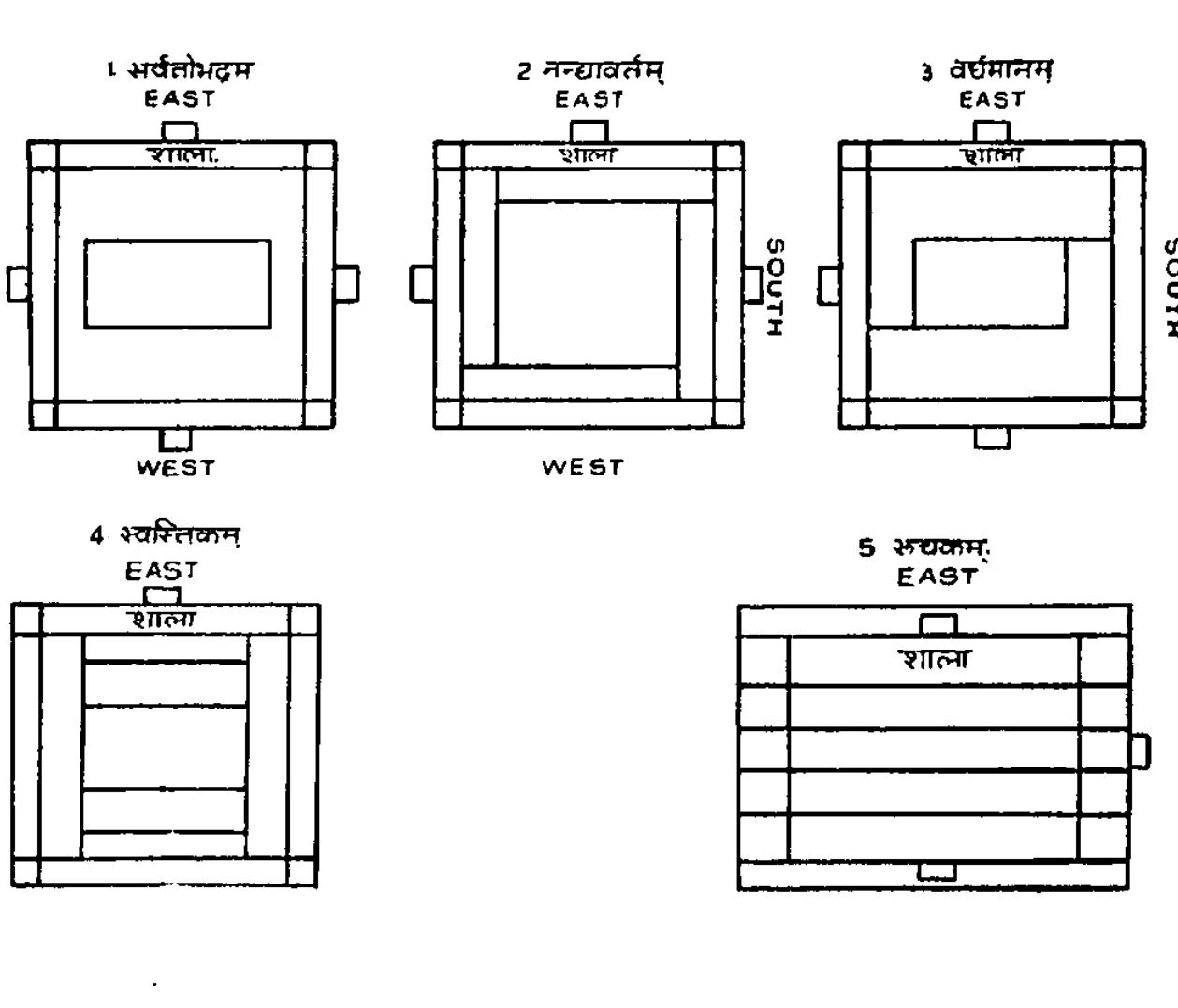 The five house-types (Utpala's plans, p462/PDF p507): 1 Sarvatobhadra, 2 Nandyāvarta, 3 Vardhamāna, 4 Svastika, 5 Rucaka.
- Sarvatobhadra ("all-auspicious") — an unbroken verandah all round and four doors; for kings and gods.
- Nandyāvarta — verandahs from the halls' walls; three doors, the western omitted.
- Vardhamāna — tiered front verandahs; no southern entrance.
- Svastika — the western verandah spans hall to hall; a single eastern entrance is beneficial.
- Rucaka — eastern and western verandahs reach the south and north; a northern entrance is not auspicious, the others good.
The verdict: Nandyāvarta and Vardhamāna are best for all classes; Svastika and Rucaka moderate; Sarvatobhadra for kings and ministers (BS 53.39, p507).
Three-halled houses (one hall missing): Hiraṇyanābha (no north hall — fortunate), Sukṣetra (no east — prosperity), Cullī (no south — loss of wealth), Pakṣaghna (no west — destroys children, breeds hatred) (BS 53.39, p507). Six two-halled houses name and judge each pairing: Siddhārtha (W+S → wealth), Tāmasūrya (W+N → owner's death), Daṇḍa (N+E → death by beating), Vāta (E+S → grief from strife), Gṛhacullī (E+W → loss of money), Kāca (S+N → enmity with kinsmen) (BS 53.40–41, p508). Older authorities counted 64, 120, even 256 varieties of building.
The Vāstu Puruṣa Maṇḍala — the 81-square diagram
The master diagram: draw ten lines east-to-west and ten north-to-south to divide the ground-plan into 81 squares; 45 deities occupy it — 13 within and 32 in the outer ring (BS 53.42–50, p512–515). [classical]
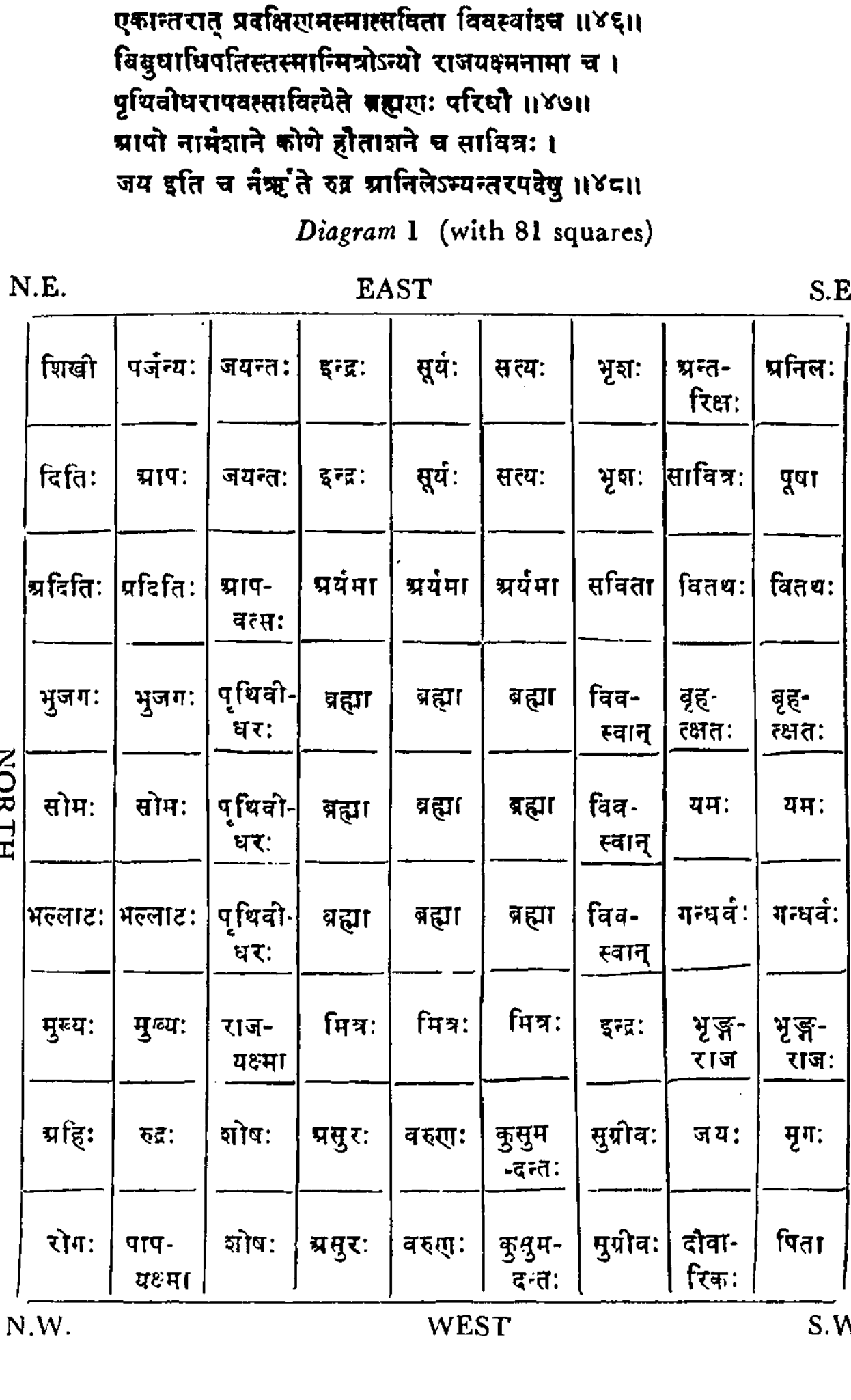 Diagram 1, the Vāstu Puruṣa Maṇḍala of 81 squares (p468/PDF p513) — Brahmā holds the central nine; the 32 outer cells run from Śikhin at the north-east corner clockwise.
The 32 outer deities run clockwise from the NE corner: Śikhin, Parjanya, Jayanta, Indra, Sūrya, Satya, Bhṛśa, Antarikṣa, Anila (the east side); Pūṣan, Vitatha, Bṛhatkṣata, Yama, Gandharva, Bhṛṅgarāja, Mṛga, Pitṛ (to the SW); Dauvārika, Sugrīva, Kusumadanta, Varuṇa, Asura, Śoṣa, Pāpayakṣman, Roga (the west); Ahi, Mukhya, Bhallāṭa, Soma, Bhujaga, Aditi, Diti (the north). At the centre, Brahmā occupies nine squares; around him sit Aryaman, Savitṛ, Vivasvat, Indra, Mitra, Rājayakṣman, Pṛthivīdhara, and Apavatsa, with Āpaḥ, Sāvitra, Jaya, and Rudra in the four inner corners. The cells are unequal — corner deities own one square, the outer ring two each, the four around Brahmā three each, Brahmā nine (BS 53.49–50, p514–515). Alternatively a 64-square plan (nine lines each way, with diagonals; Brahmā holds the central four) is used (BS 53.48, p516).
The body-correspondence
The diagram is a body: "This Vāstu Puruṣa, who lies prone on the site, has his head turned towards the north-east" (BS 53.51, p515). [classical] Each deity sits on a limb — Agni (Fire) on the head, Āpaḥ (Water) on the face, Aryaman on the breast, and so on down the right and left sides through nineteen limbs; Brahmā on the heart, Pitṛ on the feet (BS 53.51–54, p515–516). This is the seed of the whole Vāstu idea that a dwelling is a living person — and "this division of the ground into 81 squares should be resorted to while planning… cities, villages and houses."
Marmas — the vulnerable points
"The meeting-points of the longer diagonals and the exact middle points of the squares should be considered Vulnerable Points (marma), which a wise astrologer ought not to hurt" (BS 53.55, p518). [classical] The diagonals (vaṁśa/rajju) — two main and four minor — give nine intersections, the gravest marmas. To pierce a marma with nails, pillars, pegs, or heavy stones "would cause trouble to the owner in the corresponding limb of his body" (BS 53.56, p518) — the human limbs answering to the House-God's.
Two divinations follow. If, when consulted, the owner scratches a limb, the matching part of the house is afflicted; and bad omens at the founding sacrifice mark which limb is hurt (BS 53.57, p519). The buried "thorn" (śalya) is read by type: wood → loss of money, bone → disease (and to cattle), iron → trouble from weapons, skull or hair → death, charcoal → thieves, ashes → fire; gold and silver alone are auspicious (BS 53.58–60, p519). Above all, guard Brahmā at the centre: defiling the central nine squares harms the owner (BS 53.62, p520). And the missing limb foretells: no right arm → loss of wealth and disgrace through women; no left arm → loss of money and corn; no head → the owner "falls from all virtues"; no feet → troubles from women, death of sons, servitude. A House-God "endowed with all the limbs in fine shape" brings the occupants honour, wealth, and happiness (BS 53.63–64, p521).
The same Vāstu Puruṣa is laid over towns and villages, with the four classes housed in the north (Brāhmaṇas), east (Kṣatriyas), south (Vaiśyas), and west (Śūdras), and courtyards arranged "so the house lies to your right as you enter" (BS 53.65, p521).
Doors — placement and defects
Each of the 32 outer squares carries an effect when a door is set there (BS 53.66–72, p522–523): a door at Śikhin brings danger from wind, at Bhṛśa "immense wealth," at Indra "royal favour," and so on around the ring — most cells inauspicious, a few good. The auspicious door-squares are: east — Parjanya, Jayanta, Indra; south — Bṛhatkṣata; west — Kusumadanta, Varuṇa; north — Mukhya, Bhallāṭa, Soma. (For kings and the four classes alike the 81-square plan is essential, and the door-positions must be marked before the walls go up.)
A door is also judged by what faces or wounds it (BS 53.76–83, p526–528): "A door pierced by a road, tree, corner, well, pillar, or water-sluice is inauspicious," unless removed to twice its height away. Wounded by a road → the owner's death, by a tree → harm to children, by a well → epilepsy, by an idol → the owner's destruction, by a pillar → frailty of women, and a door facing Brahmā (the centre) → extinction of the family. A door that opens by itself → lunacy; that shuts by itself → ruin of the family; too big → trouble from the king; too low → robbers; crooked → extinction. The principal door should outshine all others, embellished with water-pots, fruit, foliage, and auspicious figures. Evil spirits (Cārakī, Vidārī, Pūtanā, Rākṣasī) lurk in the outer corners (BS 53.84, p528).
Reading the ground
Trees around a house (BS 53.85–86, p528–529): Peepal, banyan, fig, and Aśvattha are harmful in the S/W/N/E but beneficial in the N/E/S/W; thorny trees → danger from enemies, milky trees → loss of wealth, fruit trees → loss of children — even their timber is to be avoided. The remedy: plant an auspicious tree (Punnāga, Aśoka, Nimba, Bakula, jack, Śamī, Sāl) between the house and a tree that can't be removed.
The best ground "is soft, even, of sweet smell and taste, abounding in excellent herbs, trees and creepers, and not hollow underneath" — it "confers all-round prosperity even on those who merely rest on it to relieve the fatigue of travel, how much more on those who build a home and live there" (BS 53.87, p529). [classical] Neighbours matter too: a minister's house adjacent → loss of wealth; a gambler's → death of a son; a temple → mental affliction; a crossroads → infamy (BS 53.88–89, p530). The ground should slope toward the north for Brāhmaṇas, east for Kṣatriyas, south for Vaiśyas, west for Śūdras (BS 53.90, p530).
The classic soil tests (BS 53.91–96, p530–531): dig a one-cubit pit and refill it — if earth is left over, blessed; if just filled, moderate; if short, harmful. Or fill the pit with water, walk a hundred paces and return: if the water hasn't sunk, the ground is blest. Or set a four-wicked lamp facing the four directions — the site favours the class of the wick that burns longest. Or lay four colours of flower overnight — the class whose flower has not faded will flourish. And, decisively, "any site would be auspicious for a person, provided his heart feels very happy there" (BS 53.95, p531) — the verse Svoboda makes the "last word" on site selection. Soil colour, smell, taste, and grass each grade the four classes in turn.
The rites of building
Before building, the owner goes at the astrologer's hour to a ploughed, sprouted, cow-and-Brahmin-blessed site, worships the deities, honours Brahmins and architects, and (touching head/breast/thigh/feet according to his class) draws the first line (BS 53.97–101, p533). The line read by its instrument: drawn with thumb, gold, gem, curds, or flower → good; with a weapon → death by weapon; with iron → imprisonment; with ashes → fire; clockwise → prosperity, anticlockwise → hatred. On entering the half-finished house the architect watches the auguries — a sun-scorched bird's harsh cry, a donkey's bray while the measuring string is stretched, a dog crossing the line — each revealing a buried bone in the limb the owner is touching; a sweetly warbling bird marks buried treasure (BS 53.102–109, p533–536). If the string snaps the owner will die; a peg driven upside-down brings disease; a dropped water-pot, cerebral illness.
The foundation is begun with worship in the north-east corner, the first stone laid there and the rest clockwise, the pillars and doors raised decorated (BS 53.110–113, p536). Pillars and doors that shake, fall, or are mounted by birds carry the dire effects of "Indra's Banner" (ch. 43) (BS 53.114, p539). The floor must be level on all sides; if any part must be raised, only the east or north (the least serious faults) (BS 53.115–117, p539–540).
Room directions and water
The verse later authors quote most: "In a four-halled house (Catuḥśāla) the worship-room should be in the north-east, the kitchen in the south-east, the store-room in the south-west, and the treasure-room and granary in the north-west" (BS 53.118, p540). [classical] This single line is the classical seed of the whole directional placement scheme that modern writers (Svoboda among them) elaborate. Water in the eight directions has graded effects: east → loss of children, south-east → danger from fire, south → fear of enemies, south-west → quarrel among women, west → frailty of women, north-west → poverty, north → increase of wealth, north-east → prosperity of children (BS 53.119, p540–541).
Timber and entering
For timber, avoid trees that house birds, or are broken, withered, burnt, growing in temples or burial-grounds, milky, or of the inauspicious species (Dhava, Vibhītaka, Nimba, Araṇi); the tree, once worshipped, is cut clockwise from the north-east, and is blest only if it falls north or east (BS 53.120–122, p541–542). The cross-section's colour reveals hidden creatures within. A man "wishing for prosperity ought not to sleep above grains, cows, elders, fire, or deities, nor along the diagonals, nor with his head to the north or west, nor naked, nor with wet feet" (BS 53.123, p542). Finally the owner enters the finished house — strewn with flowers, arched, set with water-filled pots, its site-deities worshipped, and "resounding with the sound of Brāhmaṇas chanting the Vedas" (BS 53.124–125, p542–543).