Home / Astrology of the Seers / Chapter 2
Astrology East and West
This chapter sets up the one technical fact that most separates Vedic astrology (Jyotiṣa) from the astrology familiar in the West: the two systems use different zodiacs, and so a person who is "a Taurus" in a Western newspaper column may well be "an Aries" in a Vedic chart. Frawley frames the whole discussion as a dialogue between East and West, ancient and modern, but the load-bearing content is concrete — the distinction between the Tropical and Sidereal zodiacs, the precession that has driven them apart, and the correction number (the ayanamsha, about 23–24°) that converts one into the other.
Astrology East and West
Frawley opens with his comparative-civilization argument. Astrology has existed everywhere and at all times, most strongly in the ancient ritual cultures of Egypt and Babylonia. In Europe and the Middle East those ritual cultures were replaced by Christian and Islamic medieval cultures, which kept astrology but demoted it to a secondary pursuit — "the religion of the One God would not admit the powers of the Gods." India, by contrast, maintained continuity from ancient times: it kept worshipping the Gods and seeking the Divine Self, with no exclusive monotheism or church suppressing it, so "an older and perhaps more complete form of astrology survived there." The ritual calendar based on the stars, the worship of the planets as Gods or cosmic forces, and temple culture continue in India today as they did in Babylonia and Egypt three thousand years ago (AoS ch.2, p38). [modern: Frawley]
He adds that astrology has undergone "a kind of renaissance in the West during the last hundred years" — a modern, scientific, psychological approach that broadened it beyond the medieval mind — and that this modernizing is beginning in India too, though less far developed. Astrology has survived the materialistic age and may even have benefited by being forced into greater clarity. So astrology becomes "a good point of dialogue and interchange between East and West, the ancient and the modern" (AoS ch.2, p38). [modern: Frawley]
The two zodiacs
This is the chapter's core. Most of us assume there is only one zodiac — that of the fixed stars or constellations — and that when an ephemeris (a table of planetary positions) says "Jupiter in Sagittarius," a telescope pointed at the stars of Sagittarius would find Jupiter there. Usually it would not. The zodiac used by most Western astrologers today, the Tropical zodiac, is no longer based directly on the stars and does not correspond to observable positions. An astrological "Jupiter in Sagittarius" would more likely be found astronomically among the stars of Scorpio — even near Antares, the red first-magnitude star at the Scorpion's heart, if it sat around 8° Sagittarius (AoS ch.2, p39).
The reason is that the Tropical zodiac is anchored to the equinoxes, not to the stars. Its first degree of Aries (0° Aries) is always identical with the vernal equinox — the Sun's place on the first day of spring — and not with any group of stars. The Tropics of Cancer and Capricorn likewise mark the Sun's place at the summer and winter solstices. So the Tropical zodiac begins with the Sun at the vernal equinox (0° Aries), reaches 0° Cancer at the summer solstice, 0° Libra at the autumnal equinox, and 0° Capricorn at the winter solstice. The seasons mark its cardinal points (AoS ch.2, p39–40).
But the orientation of the equinoxes to the fixed stars drifts over time, because of the precession of the equinoxes — a slow wobble in the tilt of the Earth's axis that makes the equinox point move backwards through the constellations. Over roughly 25,000 years the equinox point makes a full circuit of the zodiac. Concretely: the Tropical sign of Aries today corresponds to the fixed stars of early Pisces; soon it will correspond to Aquarius (the much-discussed "age of Aquarius"); in about 10,000 years Tropical Aries will fall against the stars of Libra (its opposite); and some 23,000 years hence it will once more line up with the actual stars of Aries (AoS ch.2, p39). [traditional]
The zodiac that does correspond to the actual constellations is the Sidereal zodiac. Vedic astrology uses it, as does Western Sidereal astrology (which took its orientation from the Indian model). Around 2,000 years ago, when Western astrology was in its formative stages, the two zodiacs coincided. Since then the precession has been pulling them apart at about 50 seconds of arc (50″) per year, so the Tropical zodiac now shows roughly the actual astronomical positions of two thousand years ago (AoS ch.2, p39). [traditional]
The contrast, stated plainly: the Tropical zodiac does not consider the precession — it stays locked to the seasonal points, and many who use it have not even known the precession exists. The Sidereal zodiac calculates the precession into its positions, so its signs stay identical with the fixed stars. Frawley credits the ancient Hindus with maintaining knowledge of the precession "throughout the course of human history, something no other culture was able to do." In the Vedic system, the sign Aries is always equal to a thirty-degree section of the fixed stars containing the constellation of Aries (AoS ch.2, p40). [modern: Frawley]
Modern Tropical astrologers know their signs no longer match the stars, and rest their validity on other grounds: some on the seasons; some hold the signs to be a temporal rather than spatial symbolism — a division of time more than of space — which they relate to the West's time-and-progress orientation versus the East's static, space-oriented view. Tropical astrology does acknowledge the Sidereal zodiac and the precession, but applies the precession to world-ages (collective time, like the age of Aquarius), not to the individual's lifetime. Vedic astrology, symmetrically, does note the planets' positions relative to the equinoxes and solstices, but uses that only as one of several points for judging planetary strength, not as a major interpretive factor (AoS ch.2, p40). [traditional]
So two methods of dividing the zodiac exist, each a different kind of calculation, and "neither is necessarily wrong." They use the same vocabulary for different measurements. The Tropical signs are not really star signs — they follow the analogy of the twelve constellations but measure the Sun–Earth relationship, not the relationship between the solar system and the fixed stars. The Sidereal signs are identical with the fixed stars (more precisely, with the thirty-degree section of sky containing them) (AoS ch.2, p40–41).
Frawley notes a further refinement: a few people today try to tie the signs to the actual stars only rather than to a thirty-degree division — seeing Aries as just the small constellation, not the wider band. Vedic astrology rejects this. It sees in the twelvefold division a harmonic division of the light coming from the center of the galaxy; that harmonic division is what matters most, not the individual stars within it (though those have their significance too) (AoS ch.2, p41). [traditional]
The controversy between the two zodiacs
Because two systems exist, a controversy naturally arises. Some hold one zodiac to be true and the other in error; some accept both to differing degrees; some try to use both together. Frawley's own stance: if we are unbiased, we can find accurate readings and bad readings in both systems — accuracy may depend more on the practitioner than on the system (AoS ch.2, p41). [modern: Frawley]
He rejects the idea that the Tropical system is "for Westerners" and the Sidereal "for Easterners": Sidereal astrology reads Westerners accurately, Tropical reads Easterners, and the East–West barrier is breaking down everywhere — "we cannot make the influence of the stars dependent upon geographical influences" (AoS ch.2, p41). [modern: Frawley]
The crux of the confusion is restated carefully. When a Tropical astrologer says "the Sun is in Aquarius," he does not mean the Sun sits among the fixed stars of Aquarius (it is probably in the stars of Capricorn); he means it is in the eleventh of a twelvefold division based on the vernal equinox. When a Sidereal astrologer says "the Sun is in Capricorn," he means the actual fixed stars, knowing the Tropical division would call it Aquarius. Same words, different portions of sky (AoS ch.2, p41).
The practical consequence: because Vedic astrology is sidereal, the signs shift between the Vedic chart and the common Tropical chart. A Taurus Sun in the Western system may become an Aries Sun in the Vedic; an Aquarius Sun may become Capricorn; a Western Capricorn may become a Vedic Sagittarius. This shift "naturally causes some consternation," especially for people attached to their Tropical chart. Frawley adds in passing that the Vedic system does not make a big thing of Sun signs at all — it treats the Ascendant and the Moon as more important. Hence it is crucial to understand the two zodiacs so as not to confuse one system with the other or judge one by the other's standards (AoS ch.2, p41–42). [traditional]
Frawley then argues that the Sidereal zodiac is probably the original one historically, since it is the observable zodiac; the Tropical, being abstract, must have derived from it (abstractions usually rest on underlying observable things). The zodiac was invented long before the vernal equinox lay in Aries, so it must originally have been based on direct star observation — when the Egyptians and Babylonians spoke of Taurus, in their era (around 2000 B.C.) Taurus, not Aries, marked the vernal equinox; it is hard to imagine calendar-keeping cultures locating the springtime Sun in an abstract Tropical "Aries" while it visibly stood in the stars of Taurus. And any long-continuous culture — as India was — would have to reckon with the precession: a star-and-Moon-based calendar drifts about two weeks per thousand years, a month per two thousand, so the precession could only be forgotten when such cultures declined (as it was lost altogether in Europe's dark ages). Frawley reads the many calendar shifts recorded in the ancient Vedic texts as evidence of exactly this tracking (AoS ch.2, p42). [modern: Frawley]
The advantage of the Sidereal zodiac, then, is that the astronomers' standard complaint — that astrology's signs no longer match the stars — cannot be lodged against it. Whether the Tropical zodiac is an improvement, an alternative, or a deviation is a separate question; Tropical astrology can be accurate, but Vedic astrology holds the Sidereal more important. The Tropical zodiac's own advantage is that it is the commonly known one, "the astrological language of our culture." Frawley notes that the psychic Edgar Cayce, who also used a sidereal system, predicted the sidereal model would prevail in time (AoS ch.2, p43). [modern: Frawley]
The orientation of the sidereal zodiac
Here Frawley gives his own framing — clearly marked as "according to my interpretation." Western astrology orients the zodiac to the vernal equinox (its 0° Aries). Vedic astrology, on his reading, orients the zodiac to the galactic center — the "central galactic Sun" whose influence reaches us through the fixed stars of Sagittarius. He names the galactic center "Brahma," the creative force, or "Vishnunabhi," the navel of Viṣṇu; from this galactic Sun emanates the light that determines life and intelligence on Earth and directs the seven rays of creation and the distribution of karma. It is the reference point for the meaning of the signs, which reflect the twelvefold division of its light relative to our solar system (AoS ch.2, p43). [modern: Frawley]
In Sidereal terms the galactic center lies in early Sagittarius, within the lunar constellation (nakshatra) called "Mula," meaning "the root or source." Mula can be seen as the first of the lunar constellations, marking the first 13° 20′ of Sagittarius, with the galactic center in its middle. The last lunar constellation is "Jyeshta," "the eldest," covering the end of Scorpio. Frawley reads this naming — root at the galactic center, eldest just before it — as evidence the ancients knew of the galactic center and ordered their constellations around it (AoS ch.2, p43). [modern: Frawley]
He notes the broader Vedic practice here: India uses a system of 27 lunar constellations (nakshatras), often more than the 12 signs, because the Moon resides in one nakshatra per day (versus two and a half days per sign), making observation easier — know which nakshatra the Moon is in on one day and you can work out the rest of the month. This grounding in lunar observation again shows Vedic astrology was built on firm star-observation (AoS ch.2, p44). [traditional]
Frawley then lays out three orientation points forming a fire triangle: (1) Aries, cardinal fire, the field in which the cosmic light is projected; (2) Leo, fixed fire, the field in which it is sustained; (3) Sagittarius, mutable fire, the field in which it is completed or transformed. The arrangement is fixed by the Sun's relationship to the galactic center: the galactic light comes through Jupiter and early Sagittarius and triangulates through Aries and Leo, which sit in trines (120° angles) from it. The energy of the galactic center is transmitted chiefly by Jupiter — called "Guru," the teacher, in the Vedic system, even "the teacher of the Gods" and so the teacher even of the Sun — and by its positive sign Sagittarius (AoS ch.2, p44). [modern: Frawley]
From this he divides the zodiac into three groups of four signs, each beginning with a fire sign and ending with a water sign of the same quality. Frawley lays them out as three columns, each headed by its directing planet:
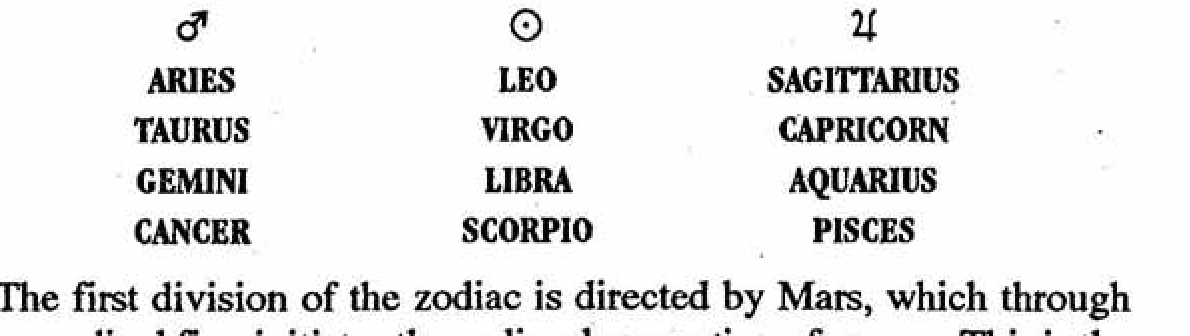 The zodiac divided into three groups of four, each directed by a planet — Mars (♂), the Sun (☉), and Jupiter (♃) — and each running from a fire sign to a water sign of the same quality (p44).
- Group 1 (cardinal, directed by Mars): Aries (cardinal fire) — Taurus — Gemini — Cancer (cardinal water). Responsible for beginning movement, initiating activity, casting the seed forces.
- Group 2 (fixed, directed by the Sun via Leo): Leo (fixed fire) — Virgo — Libra — Scorpio (fixed water). Two fixed signs (Leo, Scorpio), one cardinal (Libra), one mutable (Virgo). Responsible for sustaining movement, stabilizing activity, bringing energy into form — giving continuity to life.
- Group 3 (mutable, directed by Jupiter via Sagittarius): Sagittarius (mutable fire) — Capricorn — Aquarius — Pisces (mutable water). Two mutable (Sagittarius, Pisces), one cardinal (Capricorn), one fixed (Aquarius). Responsible for completing movement, transforming energy, destabilizing form — moving us from energy and form into the domain of thought.
These three groups, Frawley says, represent creation, preservation, and destruction according to the galactic force transmitted through the solar system (AoS ch.2, p44–45). [modern: Frawley]
Note on the OCR: the source text on p44 garbles the sentence introducing the first (Mars-directed) group; the surrounding paragraphs on p45 make the cardinal/fixed/mutable division and its rulerships clear, and the reconstruction above follows them.
Solar and cosmic astrology
Frawley summarizes the two systems with a memorable relabeling. Tropical astrology is best called "Solar astrology": its signs are really "solar houses" or "equinoctial signs," measuring the Earth–Sun relationship with no direct correlation to the other fixed stars. Its concern is therefore psychology, personality, character-types — "the solar side of our life." It shows how the planets distribute the solar force, but not how they distribute the energies of the stars and the galaxy ("the secret light of intelligence") (AoS ch.2, p45). [modern: Frawley]
Sidereal astrology can be called "Cosmic astrology": its signs are the stellar constellations and its zodiac measures the relationship among the solar system, the fixed stars, and the galaxy itself. Its concerns are broader; it has good predictive power and "perhaps a better basis for a spiritual astrology," since spiritual astrology must consider the great galactic center and the signs' positions relative to it (AoS ch.2, p45). [modern: Frawley]
He stresses the two can be integrated. Both use a system of houses, based on the Earth's daily axial rotation. The Tropical zodiac adds the Earth's yearly rotation around the Sun; the Sidereal zodiac adds the millennial rotation of the solar system through the precessional cycle. In principle one could measure all three factors and unite Eastern and Western astrology — but in practice this becomes "complex and cumbersome." Alternatively the two can simply coexist as alternatives, like different healing systems, which may broaden astrological knowledge. Even if one proves superior, parts of each help the other: many Vedic astrologers add Uranus, Neptune, and Pluto; the West's psychological sophistication can enrich the Vedic system; and Vedic methods flow the other way too — its use of gems as remedial measures can serve Western astrology (which generally lacks methods for harmonizing planetary influences), and harmonic charts now popular in the West (like the dwads) come originally from the Vedic system (AoS ch.2, p45–46). [modern: Frawley]
Ayanamsha
This is the chapter's key technical term. In Sanskrit, "ayana" means solstice and "amsha" means portion; the ayanamsha is the difference, measured among the fixed stars, from the current vernal-equinox point to the beginning of the constellation Aries. It is, in effect, the gap between the two zodiacs — the number you subtract from a Tropical position to get the Sidereal one (AoS ch.2, p46). [traditional]
The main dispute among Sidereal astrologers is the ayanamsha's exact size. Some Western astrologers say the vernal equinox is already in Aquarius, implying an ayanamsha over 30° — a view Frawley calls hard to validate astronomically, since the equinox is still in early Pisces, far from the actual stars of Aquarius. Western Sidereal astrologers place the ayanamsha around 24° 02′ as of 1950. Most Vedic astrologers place it between 21° 40′ and 23° 10′ for that era. The 23° 10′ value — the "Lahiri" ayanamsha — is the standard adopted by the government of India, though not accepted by everyone. The trouble is that while it is easy to fix where the vernal equinox points today, it is hard to fix what should count as the true first point of Aries: the identity of the Vedic star Revati, said to mark that position, is disputed, and so is the date the equinox stood there (AoS ch.2, p46–47). [traditional]
Frawley tabulates the competing values:
Ayanamsha for 1950:
| Ayanamsha | Source |
|---|---|
| 23° 10′ | Lahiri (government of India) |
| 21° 42′ | B. V. Raman |
| 21° 46′ | Sri Yukteswar |
| 22° 03′ | J. N. Bhasin |
| 24° 02′ | Fagan–Bradley (American Sidereal Astrology) |
Rate of movement of the ayanamsha (the yearly precession rate, also disputed and apparently variable over time — which is why the date the two zodiacs coincided is calculated differently; Vedic astrologers put that coincidence at 200–550 A.D., while some Western astrologers want to use the birth of Christ):
| Rate / year | Source |
|---|---|
| 48″ | Lahiri |
| 50.3″ | Raman |
| 54″ | Sri Yukteswar |
Frawley states his own preference: the system of Sri Yukteswar (the guru of Paramahansa Yogananda), from his book The Holy Science, because Yukteswar "was both an astrologer and a Self-realized soul." Yukteswar begins the cycle at 499 A.D. and makes it a 24,000-year cycle, following the Vedic theory of the four yugas; Raman's and Bhasin's figures are close to his. Astronomy, by contrast, places the cycle at 25,800 years (rate about 50.3″), but admits fluctuations that make the period speculative (AoS ch.2, p47). [modern: Frawley]
He counsels pragmatism: choose the ayanamsha you find best; for ordinary planetary positions the difference seldom matters — it becomes significant mainly for harmonic charts and planetary periods. "In the end it is the practice rather than the theory that reveals the truth." Practically, a modern Tropical ephemeris may list the Western Sidereal ayanamsha by the month (which you subtract from all positions); ephemerides with Lahiri or Raman positions can be bought from India; and Vedic-astrology computer programs let you choose a standard ayanamsha or add your own — "Vedic astrology has made it in the West, at least on computer!" (AoS ch.2, p47–48). [modern: Frawley]
Frawley then prints a reference ayanamsha table for the twentieth century, giving both the Lahiri and Yukteswar values at ten-year intervals:
Ayanamsha 1900–1990:
| Date | Lahiri | Yukteswar |
|---|---|---|
| Jan 1, 1900 | 22° 27′ 59″ | 21° 00′ 54″ |
| Jan 1, 1910 | 22° 35′ 51″ | 21° 09′ 54″ |
| Jan 1, 1920 | 22° 44′ 43″ | 21° 18′ 54″ |
| Jan 1, 1930 | 22° 52′ 40″ | 21° 27′ 54″ |
| Jan 1, 1940 | 23° 01′ 21″ | 21° 36′ 54″ |
| Jan 1, 1950 | 23° 09′ 34″ | 21° 45′ 54″ |
| Jan 1, 1960 | 23° 17′ 54″ | 21° 54′ 54″ |
| Jan 1, 1970 | 23° 26′ 21″ | 22° 03′ 54″ |
| Jan 1, 1980 | 23° 34′ 31″ | 22° 12′ 54″ |
| Jan 1, 1990 | 23° 42′ 56″ | 22° 21′ 54″ |
For intermediate years one averages by the yearly rate; since the values move about 9 minutes per ten years, add roughly 0.9′ per year (AoS ch.2, p48). [traditional]
How to calculate the Vedic chart
The method is disarmingly simple. A Vedic chart is calculated exactly like a Western Tropical chart, except that the ayanamsha is subtracted from every planetary and sign position. Any standard Western chart can thus be turned into a Vedic chart just by subtracting the ayanamsha — so Frawley does not teach chart calculation here, deferring to common Western astrology books. (There is a traditional Indian method of casting charts, but it is very complicated — it depends, for instance, on the time of dawn — and need not be learned.) Two caveats: the planetary aspects from a Western chart will not carry over to the Vedic system, and the Western house cusps mark the middle, not the beginning, of the Vedic house — both points taken up in later chapters (AoS ch.2, p48). [traditional]
In short: cast the Western chart, then transpose it to the Eastern by subtracting the appropriate ayanamsha, using a Vedic computer program or an astrological service. Vedic astrology has many more calculations than the Western system, so a computer program is "almost essential" for practice — and, as always, one must verify the accuracy of the birth data (AoS ch.2, p48–49). [traditional]
Sample birth chart — the Rāśi Chakra
Frawley closes with a worked example: the chart of Mahatma Gandhi, drawn in the South Indian style (the North Indian style uses a diamond pattern). He prefers the South Indian style here because in Vedic astrology one reads the houses not only from the Ascendant but also from the Moon and other planets — relationships that are easy to see on the square South Indian grid but not on the Northern chart. In this style the signs occupy fixed cells: the upper-center star (★) marks the constellation Aries, and the rest of the signs follow in clockwise order around it. Exact degree positions of planets and houses are usually listed separately, but are not needed for a simple reading. Notice, Frawley says, that this layout puts much more emphasis on the signs, whereas the usual Western circular chart emphasizes the aspects between planets (AoS ch.2, p49). [traditional]
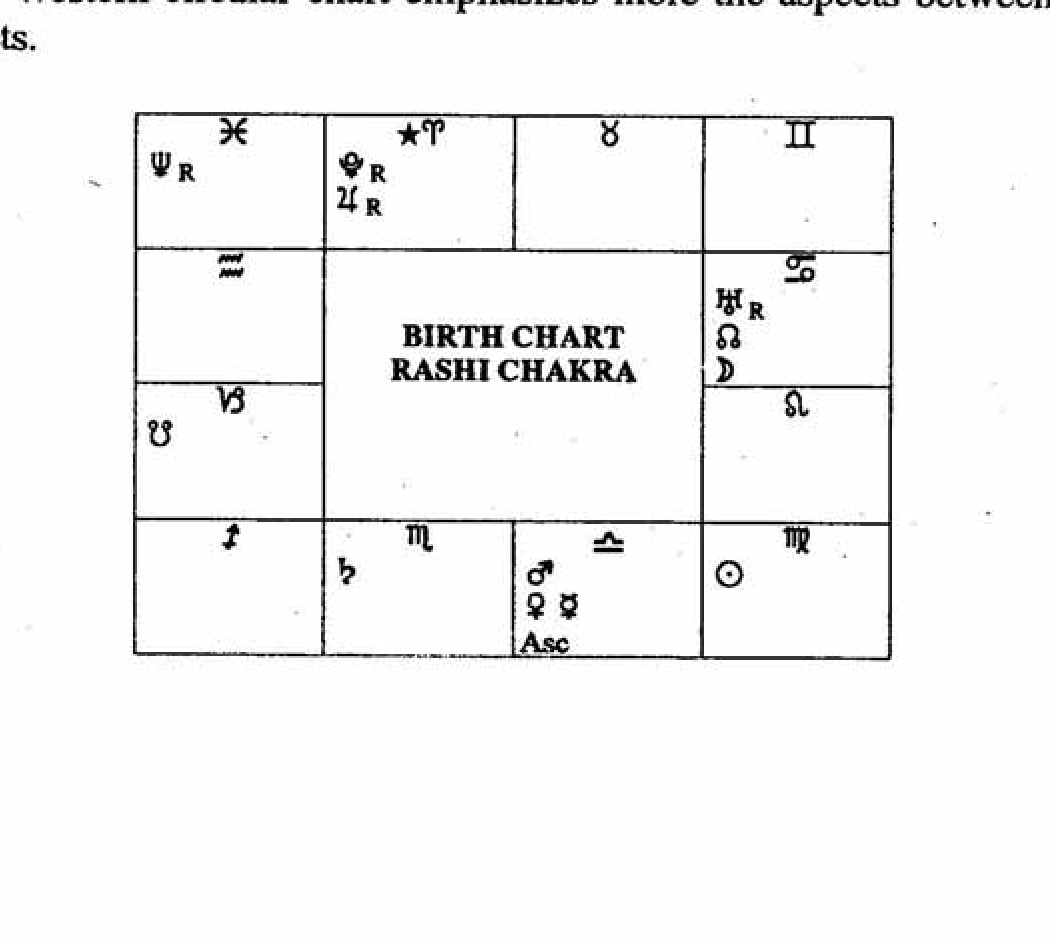 Mahatma Gandhi's birth chart (Rāśi Chakra) in the South Indian style: the star (★) cell is Aries (♈) and the signs run clockwise; the Ascendant and most planets fall around Libra–Virgo (p49). The square grid foregrounds the signs, unlike the Western circular chart that foregrounds the aspects between planets.