Home / Astrology of the Seers / Chapter 14
Worship and Meditation on the Planets
This short chapter — the fifth and last of Part III, "Remedial Measures of Vedic Astrology" — turns from the gems, mantras, and herbs of the preceding chapters to the devotional side of remediation. Devotional worship and meditation can likewise be used to balance the planetary influences in a chart, or simply to attune ourselves with the cosmos; the practices involve mantras, symbols, rituals, visualizations, and meditations, and Frawley outlines a representative set of them (AoS ch.14, p256).
The planetary deities
Each planet has its representative deity and its specific form. Each deity carries a certain color, a number of arms and types of implements, a certain face or appearance, and a particular vehicle — the animal it rides, signifying the deity's underlying power (AoS ch.14, p256).
All the planetary deities are regarded as male. This is because all the signs and constellations are regarded as female: the planets are the forces (male) that work in the fields of the signs (female). Beyond their own deity, the planets also have a ruling deity (adhidevatā) and an overruler (pratyadhidevatā), which may be male or female according to the nature of the planet. The standard scheme (AoS ch.14, p256):
| Planet | Ruling deity (adhidevatā) | Overruler (pratyadhidevatā) |
|---|---|---|
| The Sun | Agni, God of Fire | Shiva, the Great God |
| The Moon | Apas, Water Goddess | Parvati, the Great Goddess |
| Mars | Bhūmi, Earth Goddess | Skanda, War God |
| Mercury | Vishnu, the Maintainer | Nārāyaṇa, another form of Vishnu |
| Jupiter | Indra, King of the Gods | Brahmā, the Creator |
| Venus | Indrāṇī, Queen of the Gods | Indra, King of the Gods |
| Saturn | Yama, God of Death | Prajāpati |
| Rāhu | Durgā, Goddess of Power | Sarpa, the Serpent God |
| Ketu | Chitragupta, God of Karma | Brahmā, God of Knowledge |
The OCR of the source table is slightly scrambled (some overruler cells run together); the pairings above follow the standard Jyotiṣa scheme that the page lays out — Agni/Shiva for the Sun, Apas/Parvati for the Moon, and so on (AoS ch.14, p256).
Each deity also has its vehicle (vāhana), the animal it rides (AoS ch.14, p256–257):
| Planet | Vehicle |
|---|---|
| Sun | Seven-headed horse |
| Moon | Deer |
| Mars | Goat / ram |
| Mercury | Lion (with an elephant's trunk) |
| Jupiter | Elephant |
| Venus | Horse |
| Saturn | Ox |
| Rāhu | Lion |
| Ketu | Serpent |
Forms of the planetary deities (the dhyāna verses)
The book gives a dhyāna (meditation verse) for each planet — a verbal icon describing the deity to be visualized in worship. Each follows the same shape: color of clothing and body, number of arms, identity or epithet, vehicle, implements held, the crest jewel (the planet's gem) on the head, and the closing benediction that the deity, "making the gesture that gives boons" (the varada-mudrā), may ever grant us his grace. These verses are the heart of the chapter's devotional content (AoS ch.14, p257). [classical]
- The Sun — Standing on a lotus, with the lustre of a red lotus, who has two arms, with a lotus in his hand, the creator of the day, the teacher of the world, whose vehicle is a horse with seven heads, with a ruby crest jewel on his head, making the gesture that gives boons — may the Divine Sun ever grant us his grace (AoS ch.14, p257).
- The Moon — Clothed in white, white in lustre, whose ornaments are white, who has two arms, with a lotus in his hand, whose soul is immortal, who is a yogi, whose vehicle is a deer, with a pearl crest jewel on his head — may the Divine Moon ever grant us his grace (AoS ch.14, p257).
- Mars — Dressed in red, with a red body, who has four arms, the son of the Earth, whose vehicle is a ram, who carries a trident, spear and mace in his hands, with a coral crest jewel on his head — may Divine Mars ever grant us his grace (AoS ch.14, p257).
- Mercury — Dressed in green, with a green body, who has four arms, the incarnation of Vishnu, who is a yogi, whose vehicle is a lion with an elephant's trunk, who carries a sword, shield and book in his hands, the son of the Moon, with an emerald crest jewel on his head — may Divine Mercury ever grant us his grace (AoS ch.14, p257).
- Jupiter — Dressed in yellow, with a yellow body, who has four arms, the teacher of the Gods, peaceful in nature, whose vehicle is an elephant, who carries a rosary, a water pot and a staff in his hands, with a yellow sapphire crest jewel on his head — may Divine Jupiter ever grant us his grace (AoS ch.14, p257).
- Venus — Clothed in white, white in lustre, who has four arms, the teacher of the demons (Śukra, guru of the Asuras), whose nature is peaceful, whose vehicle is a white horse, who carries a rosary, water pot and staff in his hands, with a diamond crest jewel on his head — may Divine Venus ever grant us his grace (AoS ch.14, p258).
- Saturn — Dressed in blue, dark blue in color, who has four arms, the son of the Sun, who appears fearful, whose nature is peaceful, whose vehicle is an ox, who moves slow, who carries a trident, bow and mace in his hands, with a blue sapphire crest jewel on his head — may Divine Saturn ever grant us his grace (AoS ch.14, p258).
- Rāhu — Dressed in black, black in color, who has four arms, who is fearful to behold, a head without a body, whose body is a serpent, whose vehicle is a lion, who carries a sword, trident and discus in his hands, with a hessonite crest jewel on his head — may Divine Rāhu ever grant us his grace (AoS ch.14, p258).
- Ketu — Dressed in grey, of the color of smoke, who has two arms, whose head is cut off, who has a serpent's head, whose vehicle is a serpent, who carries a mace in his hand, with a cat's eye crest jewel on his head — may Divine Ketu ever grant us his grace (AoS ch.14, p258).
The body of the chapter points the reader to a plate of these forms in the book's illustration section ("See Illustrations p. 9"), and the chapter-end deity plate in this span is Rāhu — drawn exactly to his verse: a fearful four-armed figure, the serpent coiled about him, bearing sword, trident, and discus, his lion vehicle beside him (AoS ch.14, p265). [classical]
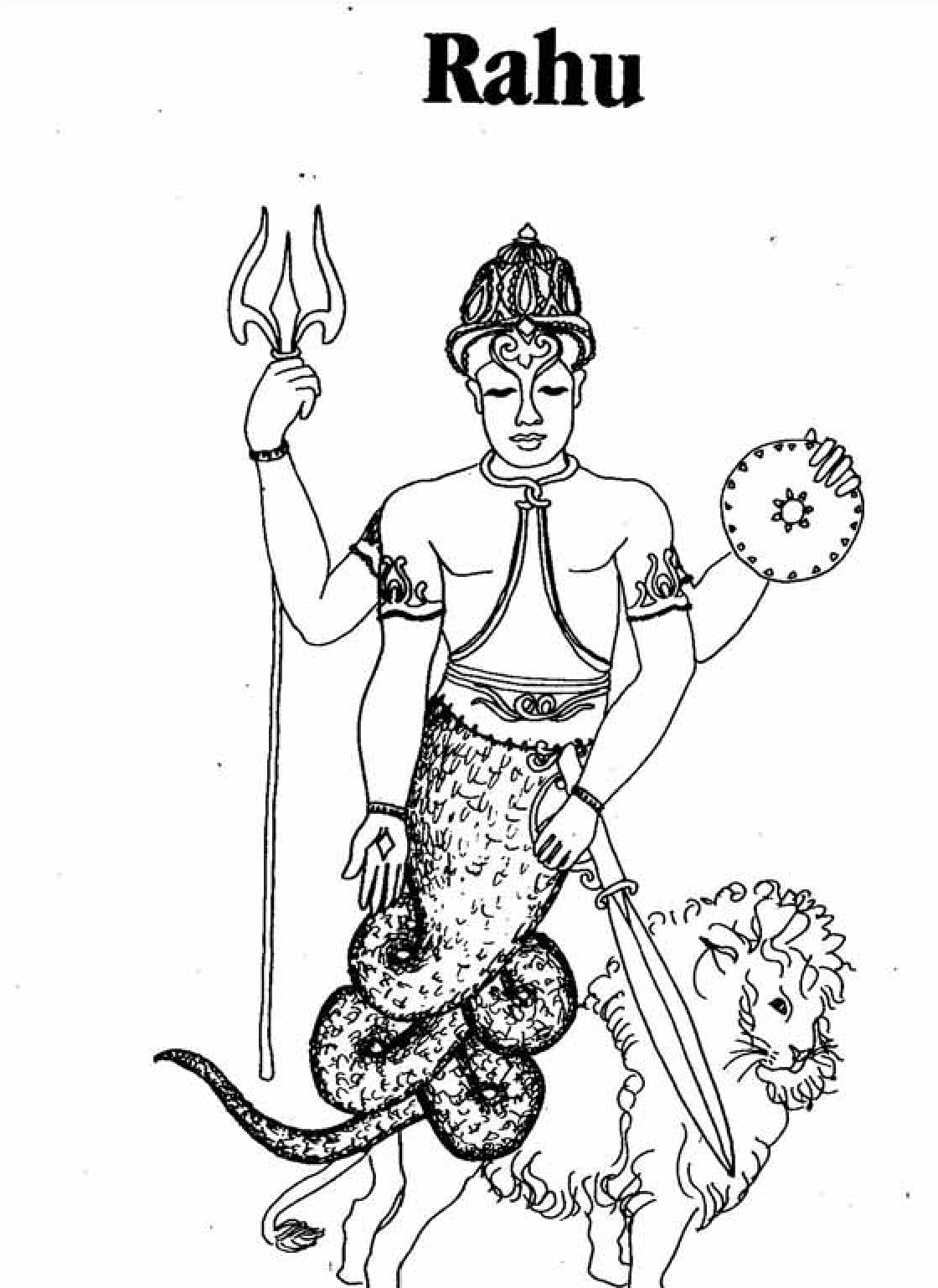 Rāhu. The dhyāna reads: "Dressed in black, black in color, who has four arms, who is fearful to behold, a head without a body, whose body is a serpent, whose vehicle is a lion, who carries a sword, trident and discus in his hands, with a hessonite crest jewel on his head, making the gesture that gives boons, may Divine Rāhu ever grant us his grace." (p265).
Other forms for worshipping the planets
Beyond the anthropomorphic deity, the planets can be worshipped through several simpler material correspondences — grains, gems, symbols, and directions — which let one set up an altar without elaborate iconography.
Grains and legumes
Each planet corresponds to a particular grain or legume. Each planet can be represented on an altar by a small bowl of its grain; they correspond to the qualities of the planets and are generally good foods to take when their respective planet is weak (AoS ch.14, p258):
| Planet | Grain / legume |
|---|---|
| The Sun | Wheat |
| The Moon | White rice |
| Mars | Red dhal |
| Mercury | Mung beans |
| Jupiter | Chick peas |
| Venus | Lima beans |
| Saturn | Sesame seeds |
| Rāhu | Black gram |
| Ketu | Horsegram (kulattha) |
Inexpensive worship-gems
In place of the costly prescriptive gemstones of the gem chapter, one can use less expensive gems — as clusters or uncut stones — purely for worship on an altar. These are: the Sun — garnet; the Moon — cloudy quartz crystal; Mars — carnelian; Mercury — green tourmaline; Jupiter — citrine; Venus — clear quartz crystal; Saturn — amethyst; Rāhu — golden garnet; Ketu — quartz cat's eye (AoS ch.14, p259).
Symbols for the planets
Each planet also has an abstract symbol that can be used in worship: an arrow for Mercury, a five-pointed star for Venus, a crescent Moon for the Moon, a square for Jupiter, an eight-pointed star for the Sun, an upward-pointing triangle for Mars, a flag for Ketu, a bow for Saturn, and a magnet for Rāhu (AoS ch.14, p259).
Directions of the planets
The planets relate to the directions of space, useful for orienting worship. By one scheme: the Sun — east, Venus — southeast, Mars — south, Rāhu — southwest, Saturn — west, Moon — northwest, Mercury — north, Jupiter — northeast (AoS ch.14, p259).
A second arrangement is used specifically when making the planets into symbols or yantras, or when laying them out in a pattern on an altar: the Sun — center, Moon — southeast, Mars — south, Mercury — northeast, Jupiter — north, Venus — east, Saturn — west, Rāhu — southwest, Ketu — northwest (AoS ch.14, p259).
Yantra
Just as each planet has a mantra — a special sound energy — so too it possesses a yantra, a special energy pattern. The yantra is the visible form, the energy body, of the mantra and of the planet to which it corresponds. Two general types exist: numerical yantras, in which numbers are inscribed, and geometric yantras, built on a certain geometrical design (AoS ch.14, p259).
The most common geometric yantra is that for the Sun, the Surya yantra, which is used for the cover of this book. The most common planetary yantras, however, are the numerical types, and they are all based on a single sequence (AoS ch.14, p259).
Numerical yantras
The numerical yantras all develop from the same numerical sequence — specifically the magic square of the number five, a design with the number five in the center in which the rows, columns, and diagonals each add to the same total, fifteen. The number for each respective planet occurs in the upper center of its square, starting with the Sun as the number one; the Solar yantra shows the basic form of this pattern. Each subsequent planet's yantra is formed by increasing every number by one, so that the planet's own number (Sun 1, Moon 2, Mars 3, … Ketu 9) always sits in the top-center cell (AoS ch.14, p259–260).
Solar yantra — based on the number one. Its row total is 15; the total of all nine numbers is 45 (9 × 5), showing the full development of the fivefold force (AoS ch.14, p260).
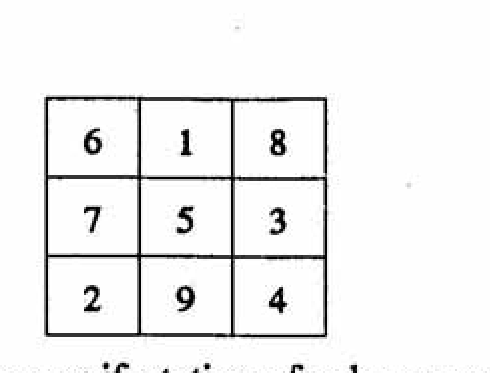 Solar Yantra. Magic square of fifteen, the Sun's number (1) in the top center; every line adds to 15, all nine cells to 45 (p260).
Frawley adds that this same sequence, called the "Writing from the Lo River" or the Book of Lo (Luoshu), is the basis for the I Ching and so for Chinese astrology — "these numbers contain the key to oriental astrology." He also reads cosmic law into the root number five: five elements, five sense organs, five limbs (two arms, two legs, and head), so the figure is "not just a mathematical curiosity but reflects cosmic law" (AoS ch.14, p260). [modern: Frawley]
Lunar yantra — based on the number two. Each number of the solar square is raised by one, so everything now adds to 18, the number that completes the lunar manifestation; the total of all the numbers is 54 (AoS ch.14, p260).
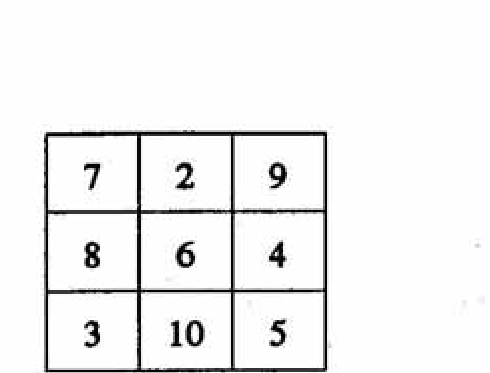 Lunar Yantra. The Moon's number (2) in the top center; each line adds to 18, all cells to 54 (p260).
Mars yantra — based on the number three. The numbers add up to 21 for each line, or 63 for the total (AoS ch.14, p260).
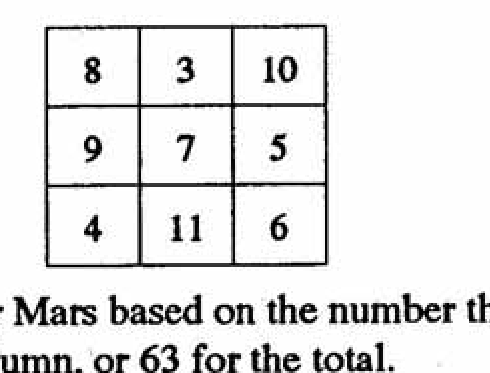 Mars Yantra. Mars' number (3) in the top center; each line adds to 21, all cells to 63 (p260).
Mercury yantra — based on the number four. The numbers add up to 24 for each line, and 72 for the total (AoS ch.14, p261).
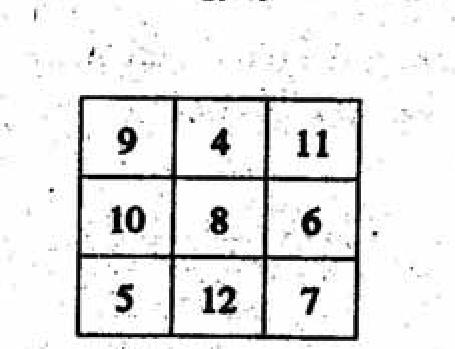 Mercury Yantra. Mercury's number (4) in the top center; each line adds to 24, all cells to 72 (p261).
Jupiter yantra — based on the number five. The numbers add up to 27 for each line, and 81 for the total (AoS ch.14, p261).
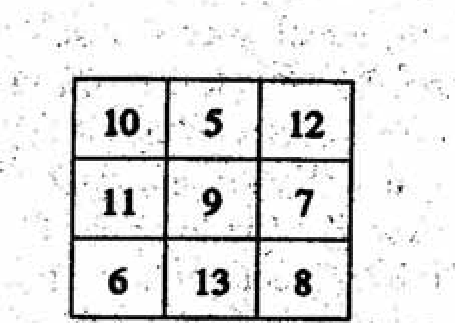 Jupiter Yantra. Jupiter's number (5) in the top center; each line adds to 27, all cells to 81 (p261).
Venus yantra — based on the number six. Each line equals 30, and the total equals 90 (AoS ch.14, p261).
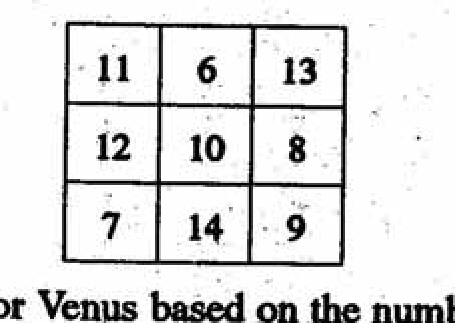 Venus Yantra. Venus' number (6) in the top center; each line adds to 30, all cells to 90 (p261).
Saturn yantra — based on the number seven. Each line equals 33, and the total equals 99 (AoS ch.14, p261).
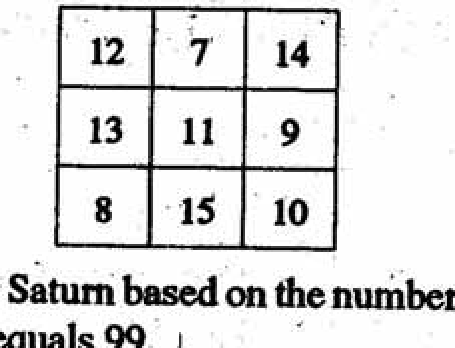 Saturn Yantra. Saturn's number (7) in the top center; each line adds to 33, all cells to 99 (p261).
Rāhu yantra — based on the number eight. Each line equals 36, and the total equals 108 (AoS ch.14, p262).
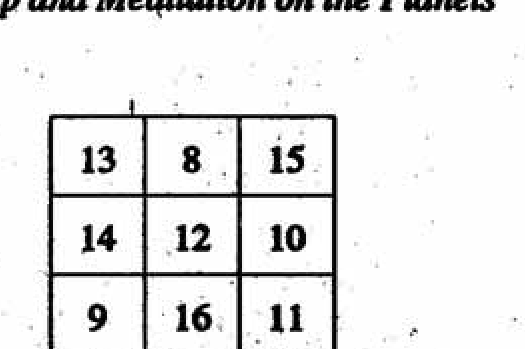 Rāhu Yantra. Rāhu's number (8) in the top center; each line adds to 36, all cells to 108 (p262).
Ketu yantra — based on the number nine. Each line equals 39, and the total equals 117 (AoS ch.14, p262).
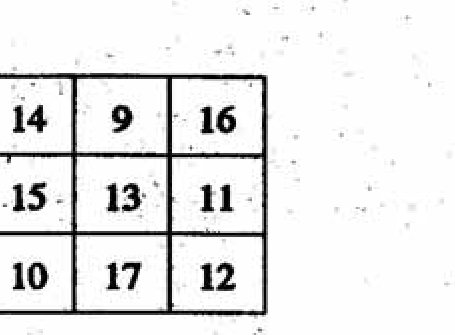 Ketu Yantra. Ketu's number (9) in the top center; each line adds to 39, all cells to 117 (p262).
These planetary yantras are available inscribed in copper, the most common way to use them, though we can also write them ourselves to benefit from their power. Special yantras inscribed with mantras or the names of the planets also exist: common is a triangular yantra bearing the names of Mars, and special yantras for Saturn made out of five metals and inscribed with Saturn's names (AoS ch.14, p262).
Yantra and mantra (the bīja yantra)
A simple combined yantra can be made from the solar square together with the bīja (seed) mantras for each planet — each planet's seed-syllable written into the cell where its number falls in the solar pattern (AoS ch.14, p262):
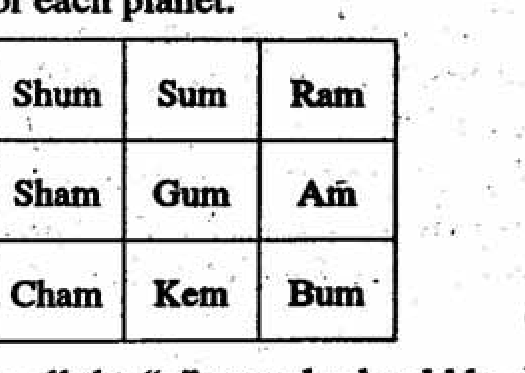 The bīja-mantra yantra: the nine planetary seed-syllables placed in the solar-square pattern — top row Shum, Sum, Ram; middle row Sham, Gum, Aṁ; bottom row Cham, Kem, Bum (p262).
For pronunciation: every "a" vowel is short, as in the word "the"; the "u" vowels are also short, as in "put"; and the "e" vowel is like the English long a, as in "came" (AoS ch.14, p262).
Other yantras for the planets (deity yantras)
Yantras for the deities corresponding to the planets can be used to balance planetary influences as well. Typical ones (AoS ch.14, p263):
| Planet | Deity yantra(s) |
|---|---|
| Sun | Surya Yantra, Gāyatrī Yantra, Vishnu Yantra |
| Moon | Sri Yantra, Lakshmi Yantra |
| Mars | Mangala Yantra |
| Mercury | Vishnu Yantra |
| Jupiter | Ganesh Yantra |
| Venus | Sri Yantra, Lakshmi Yantra |
| Saturn | Sri Shani Yantra |
| Rāhu | Kali Yantra, Durga Yantra |
| Ketu | Mahāmṛtyuñjaya Yantra |
The Sri Yantra is the best for all general purposes. Yantras should always be used along with mantras and meditation on their deities (AoS ch.14, p263).
Use of yantras
Practical guidance closes the chapter. Copper yantras can be used to purify water (copper being the best substance for this) or to energize medicines; they can serve as energy sources placed on altars, meditation seats, and treatment rooms, and small ones can be worn like gemstones in pendants or rings. Yantras for planets should be frequently energized with the appropriate planetary mantras, and cleared and empowered periodically just as gemstones are (AoS ch.14, p263).
Silver or gold yantras have more power; copper is the most common and not too expensive; those on steel, silk, or the bark or wood of sacred trees (like sandalwood) have less power. Copper tends to tarnish and must be cleaned periodically — but chemical copper cleaners may be toxic and must be removed completely before using a yantra to purify water or before using yantra-purified water in medicine. Yantras may be written on paper or inscribed on more durable substances; either way it is important to meditate upon the meaning of the numbers and designs. They are less expensive than gemstones, can be as effective as gems when used with mantras, and have no side-effects — though they can be hard to procure or difficult to make (AoS ch.14, p263).
This chapter ends Part III. The next page is the divider for Part IV, "Vedic Astrology in Practice" (AoS ch.14, p264).