Home / Astrology of the Seers / Chapter 6
The Houses
After the planets and the signs, the houses are the third great factor of the chart, and in Vedic astrology the most decisive one for prediction. Where the signs are a fixed twelvefold division of the zodiac — the same for every chart — the houses are a changing twelvefold division whose starting point varies with each birth. The houses reflect the position of the Earth in its daily rotation relative to the heavens: as the Earth turns through the day, the whole zodiac is drawn to rise in the east and set in the west, so that depending on the moment of birth, any point in any sign may mark the beginning of the houses (AoS ch.6, p130).
The houses are fixed by the cardinal points of the Earth's orientation to the heavens at birth. The point of the zodiac rising on the eastern horizon becomes the cusp of the First house; the point directly overhead becomes the Midheaven, the cusp of the Tenth house; the other ten are usually derived mathematically from these two. The Sanskrit term for a house is bhāva, "a field of action" — each house delineates a domain of our life on Earth, a field of our activity (AoS ch.6, p130).
The Ascendant: the most variable factor
The rising point — the First house — is the Ascendant (Lagna), and it is the most variable of the major factors astrology uses, which is exactly why it gives the greatest specificity in prediction. The Sun moves through one sign in a month; the Moon in about two and a half days; but the sign of the Ascendant changes every two hours. In Vedic astrology the Ascendant is therefore the most important factor in prediction, with the Moon-sign second and the Sun-sign a distant third — logical, since the Ascendant most finely differentiates one chart from another (AoS ch.6, p130). Two people born on the same day but at different hours have different Ascendants though their other planets barely move; conversely, two people born at the same time of day on adjacent days usually share an Ascendant and so read more alike than two born the same day at different hours (AoS ch.6, p130–131).
The Ascendant is a spatial factor — it varies with place on Earth, so two people born at the same instant in distant places have different Ascendant points, the more so the greater the distance. It shows the Earth's orientation in the chart and thereby determines the outer domains of life and our action in the material world; one might say it represents the Earth itself as a planet in our chart. It indicates our physical incarnation and how we project ourselves into the world (AoS ch.6, p131). The signs reflect more our nature or character; the houses, how we express and manifest it — the deeper, more cosmic mind and soul relate to the signs and stars, while the more personal, outer expression of who we are comes through the houses and the Earth. For this reason Vedic astrology judges personality type not by the Sun-sign but by the Ascendant, which becomes the lens through which the whole chart is read (AoS ch.6, p131).
The houses and their analogy to the signs
The houses carry the same basic meanings as in Western astrology, with a few important variations, and generally follow the analogy of the signs — the nth house resembling the nth sign (AoS ch.6, p131):
- First house — like Aries: the head, the ego, the self-sense in life.
- Second house — like Taurus: gathering and holding personal and material resources.
- Third house — like Gemini: curiosity and research.
- Fourth house — like Cancer: mother, home, emotional happiness.
- Fifth house — like Leo: our soul nature and creative intelligence.
- Sixth house — like Virgo: health and disease, work and service.
- Seventh house — like Libra: relationship and partnership.
- Eighth house — like Scorpio: sex, death, the occult, vice, the hidden side of life.
- Ninth house — like Sagittarius: religious, philosophical, or ethical principles.
- Tenth house — like Capricorn: public status and worldly achievement.
- Eleventh house — like Aquarius: aspirations and goals, intelligence, friendship.
- Twelfth house — like Pisces: the subconscious and our hidden emotional nature.
The Vedic system departs from this analogy more than the Western does — though neither follows it rigidly — particularly in the Third and Eleventh houses. The analogy cannot be exact because the houses divide up a different kind of space: the signs show a cosmic (sidereal) or solar (tropical) division, whereas the houses show an earthly one (AoS ch.6, p131–132).
Different systems of house determination
There are several systems for fixing the location and extent of the houses, and both Western and Vedic astrology carry their own controversies, most of them shared. House location and rulership are central to Vedic astrology but less important to most Western astrologers — some of whom dispense with houses altogether and use only four quadrants (AoS ch.6, p132).
The main difference is in the cusp. Both systems agree that the cusp is the most important and powerful point of a house, and that a planet on the cusp has the strongest, most typical effect. But Western astrology makes the cusp the beginning of the house, while the Vedic system makes the cusp the middle. This shifts placements: the Vedic First house contains the latter half of what the Western system calls the Twelfth, and so on (AoS ch.6, p132). The gap is smaller than it looks, however. Most Western astrologers grant the cusp at least a 5° orb (sometimes 10° for the luminaries), so a planet a few degrees before the cusp — technically in the prior house — is read as influencing the next house through conjunction with its cusp. The effective difference is thus more like 5°–10° than 15°. Some Western studies even find a planet strongest when placed about 8° before the Ascendant or Midheaven, which supports the Vedic placing of such a planet in the First or Tenth rather than the Twelfth or Ninth (AoS ch.6, p132). The net effect: in a Vedic chart a planet can shift backwards not only the better part of a sign but also up to half a house (AoS ch.6, p133).
House systems using the Midheaven
The shared problem is locating the cusps. All agree the Ascendant is the cusp of the First; some use the Midheaven (the point directly overhead) as the cusp of the Tenth. Because house orientation depends on position on the globe, this grows more variable the farther one is born from the equator — it is rare for there to be exactly 90° between Ascendant and Midheaven except near the equator or at the equinoxes. Away from the equator the Earth's orientation divides the zodiac into more and more unequal sections; a twelfth of the day does not see a twelfth of the zodiac rise (in the arctic some signs do not rise for days, and others do not set) (AoS ch.6, p133).
If one uses the Midheaven, the simplest method is to divide the arc between Ascendant and Midheaven equally. Frawley's worked example: Ascendant 20° Libra, Midheaven 2° Leo — a difference of 78° — divided by three gives an extent of 26° per house, so the cusp of the Eleventh is 28° Leo and that of the Twelfth is 24° Virgo. This is the method most often used in Vedic astrology (AoS ch.6, p133). One may object that if the cardinal points are not equally spaced, the intervening houses should not be divided equally either — which is why systems like the commonly used Placidian were devised. Since India lies fairly close to the equator (where these inequalities are slight), the issue mattered less there than in Europe, much of which sits near the Arctic Circle. For practical use one can take a Western Table of Houses with Placidian (or other) cusps, subtract the appropriate Ayanāṁśa from each, and treat the result as the center of each house (AoS ch.6, p133–134).
When a planet falls between two house cusps, divide the difference to settle which Vedic house it occupies. In the running example, Mars at 16° Leo falls between the Tenth cusp (2° Leo) and Eleventh cusp (28° Leo); the midpoint at 15° Leo marks the boundary, placing Mars in the Eleventh house. Computer programs do this automatically and usually allow a choice of systems; Frawley advises not fretting over minor differences, "there is more than one way to read nature" (AoS ch.6, p134). [modern: Frawley]
Equal House systems
Because Midheaven-based systems are so variable, simpler Equal House systems arose that ignore the Midheaven as a cusp: keep the Ascendant as the First cusp and place every other cusp an equal 30° from it. If 5° Gemini is the Ascendant, the Second cusp is 5° Cancer, the Third 5° Leo, and so on (AoS ch.6, p134). (The printed text has "5° Virgo" for the Third here, evidently a typo — from 5° Gemini the Third cusp is 5° Leo.) Their advantages: they are easier to calculate, and easier to read for aspects — since aspects are reckoned by degree-position in signs, a planet on the Equal-House Tenth cusp is always in a 90° (square) aspect to the Ascendant, whereas in unequal systems a planet conjunct the Midheaven may form no angular aspect to the Ascendant at all (AoS ch.6, p134). Equal House systems become especially important in extreme latitudes, where several houses may crowd into one sign, or several signs into one house. Their drawback is that they do not adequately account for the Midheaven as a special point of power — in an Equal House chart the Midheaven may fall in the Ninth, Tenth, or Eleventh house (AoS ch.6, p134).
House and sign charts in Vedic astrology
Vedic astrology usually employs two house systems. First, a dedicated chart called the Bhāva Chakra ("House Chart") that specifically measures the houses — it can be cast either from the Midheaven or as an Equal House system from the Ascendant, and most resembles the Western house charts with their usual variations. Second, it reads the houses straight off the Rāśi Chakra ("Sign Chart"), and this is the more common practice. Here it is not merely an Equal House system but an Equal Sign system: if some degree of Taurus is the First house, then Gemini is the Second, Cancer the Third, and so on — true whether the Ascendant falls at 1° or 29° of the sign. This is the simplest method, giving primacy to the signs over the houses (AoS ch.6, p134–135). In practice, houses are judged generally from the Rāśi Chakra and then specifically from the Bhāva Chakra (which is another chart, giving the precise house positions and sometimes the exact cusp degrees) (AoS ch.6, p135).
This sign-based simplicity may look crude to Western astrologers used to elaborate cusp calculations, but — as with aspects — the additional use of harmonic charts (vargas) restores specificity. The most important is the harmonic-ninth or Navāṁśa, from which all houses and aspects can be read as an additional chart; its Ascendant changes sign every 13 minutes, making it the most variable factor and the best instrument for fine-tuning. In harmonic charts, houses and aspects are always determined by sign, so complex calculation is avoided without losing precision (AoS ch.6, p135).
Houses from the Moon, and other Ascendants
Vedic astrology also treats the Moon (and sometimes the Sun) as an Ascendant: the Moon's sign at birth becomes the First house, the next sign the Second, and so on, by the Equal Sign system. When a given house is afflicted from both the Ascendant and the Moon, the result is far more certain — for instance, if the Fifth from both is aspected by Saturn, inability to have children is much likelier than if only one were afflicted (AoS ch.6, p135–136).
More generally, Vedic astrology can take any house as an Ascendant for a particular purpose. To judge the affairs of the wife or partner, count the Seventh as her Ascendant and read the rest from there (so the Eighth from the Seventh — the Second in the usual order — shows her longevity). The Fourth serves as an Ascendant for the mother, the Ninth for the father. Likewise, planets in malefic houses from a given house (the Sixth, Eighth, or Twelfth from it) tend to harm it, while planets in benefic houses (the Fifth or Ninth from it) help it. The houses are thus treated as a flexible system of coordinates that can be re-centered on any point — but the houses from the prime Ascendant and from the Moon-sign remain the most important; the rest are for fine-tuning (AoS ch.6, p136).
Because many practitioners read the houses from the Rāśi and Navāṁśa charts directly, the more specific Bhāva Chakra is often not cast at all — some use only the Rāśi and Navāṁśa and still give very accurate readings, and most books omit the Bhāva Chart. Frawley's own view is that the Midheaven should at least be weighed as a point of power even in the Rāśi Chart, and that the Bhāva Chart, though the least important of the three, is still worth knowing how to construct (AoS ch.6, p136). [modern: Frawley] The recommended order of approach: master the houses in the Rāśi Chakra (Equal Sign system, read from both Ascendant and Moon) first, then consult the Bhāva Chakra for more specific indications (AoS ch.6, p136).
A worked illustration: Ascendant 25° Libra, Sun at 2° Virgo. The Sun sits in the Eleventh house in the Bhāva Chakra but the Twelfth in the Rāśi Chakra. Reading both: in outer action this person has great goals and accomplishes much (Eleventh-house meaning), yet in inner nature is solitary and self-effacing (Twelfth-house meaning) — the two views blended give deeper insight (AoS ch.6, p137). Indeed, the house systems that ignore the Midheaven effectively treat the Ascendant as a planet — the most important planet, marking the Earth — and once we see it that way, the twelve-house scheme can be applied relative to any planet to show how its energy is distributed. This freer use of the houses as coordinates is characteristic of Vedic astrology (AoS ch.6, p137).
Houses by quality and element
Just as signs are grouped by quality and element, so are houses; these qualities apply (to a lesser degree) even to houses counted from the Moon (AoS ch.6, p137).
Angular houses (Kendra) are 1, 4, 7, 10 — the angles or quadrants from the Ascendant. Planets here tend to be strong and active; in character they resemble Cardinal signs — sharp, energetic, decisive, penetrating — giving power for accomplishment and an outgoing, creative will. Among them the Tenth is the strongest, then Seventh, Fourth, First; a planet in the Tenth dominates the chart and overpowers even the Ascendant. Malefics in angles can produce a dark nature and inflict much damage; benefics in angles give luck, grace, and protection (AoS ch.6, p137).
Succedent houses (Panaphara) are 2, 5, 8, 11. Planets here are only moderate in strength; like Fixed signs they show the accumulation of resources and the development of stability and reserve — good for preserving, not for new beginnings or conclusions. Among them the Fifth is strongest, then Eleventh, Second, Eighth (AoS ch.6, p138).
Cadent houses (Apoklima) are 3, 6, 9, 12. Planets here are weak, uncertain, or hidden; like Mutable signs they give mental sensitivity and adaptability (hence often high intelligence) but also instability and a tendency to nervous trouble. They are usually better than angular houses for spiritual development. Among them the Ninth is strongest, then Third, Sixth, Twelfth (AoS ch.6, p138).
It is generally best to have some angular planets for worldly success; quadrant placement matters even more here than Cardinal signs do, and the charts of the famous and powerful usually show strong angular planets whatever their signs. (For this reason the North Indian chart design is built around the angular houses.) Yet malefics in angles, while they often bring outward success, show a destructive character, and too many planets in angles can cost us sensitivity and introspection — without some Cadent or Mutable emphasis the spiritual life is usually not possible, and without some Angular or Cardinal emphasis no decisive action is. A balance across all three groups gives more harmony (sattva) to the nature (AoS ch.6, p138). House and sign qualities reinforce each other: Cardinal signs with angular houses make a decisive, aggressive, highly rājasic nature; Mutable signs with Cadent houses make a sensitive, weak, or neurotic one; Fixed signs with Succedent houses make a possessive, conservative one. Generally the sign qualities color character traits, the house qualities the capacity for success in the domains of life, and the two must be read against each other (AoS ch.6, p138–139).
Trines, increasing and decreasing houses, dushthānas
Trine houses (Trikoṇa) are 1, 5, 9 — they form a triangle to the Ascendant. Residing in a trine is a source of strength, like residing in a quadrant, though angles are stronger than trines. Jupiter likes trines (its trine aspect comes into play there), and the Moon does well in them too. By this factor the Ninth, though Cadent, is still very good — the best trine — and the Fifth is boosted into the best Succedent house. Planets here, though not as strong for outer action as angular ones, matter more for the spiritual and inner nature, and the lords of these houses become very auspicious for the chart (AoS ch.6, p139).
Upachaya ("increasing") houses are 3, 6, 10, 11 — planets in them increase in strength through time and give progressively better results with age. Malefics (Sun, Saturn, Mars, the Lunar Nodes) do well here, whereas in trines they would indicate a malefic nature. But the lords of these houses (except the Tenth) are usually inauspicious, being too impulsive. Of them the Tenth and Eleventh are the best locations; the Eleventh is an excellent place for any planet, malefics doing very well and benefics not badly (AoS ch.6, p139). Note the broader pattern: planets do well above the horizon, in houses 9, 10, 11, which show how we affect the world through our values (9th), actions (10th), and goals (11th); opposite them, houses 3, 4, 5 represent the self in terms of vital energy (3rd), emotional state (4th), and intelligence (5th) (AoS ch.6, p139–140).
Apachaya ("decreasing") houses are 1, 2, 4, 7, 8 — planets here lose strength through time, and malefics do not do well. The Eighth is the worst, probably the most unfortunate house for a planet (though it can still give high intelligence) (AoS ch.6, p140).
Dushthāna (difficult or malefic) houses are 6, 8, 12 — planets here are weakened and can cause problems: disease or enmity in the Sixth; disease, injury, loss, or death in the Eighth; loss and sorrow in the Twelfth, especially under malefic aspect. Yet there are nuances: a malefic in the Sixth may give power to defeat enemies but still bring disease; Mars in the Eighth can cause violent death or losses, while Saturn in the Eighth can aid longevity (without prosperity); benefics in the Twelfth can give a spiritual nature or good rebirth, and Venus is exceptional in being usually good in the Twelfth, giving comfort and prosperity; Ketu does well in the Twelfth (spiritual insight, warding off negative psychic influence) and Rāhu in the Sixth (freedom from enmity, success through foreigners, though it can still disturb the nerves). The dushthānas are difficult because they are points of transition — on either side of the Seventh (the 6th and 8th) and just above the Ascendant (the 12th) (AoS ch.6, p140).
Houses and the four aims of life
The houses also map onto the four puruṣārthas, the goals of life (AoS ch.6, p140):
- Dharma (nature, vocation) — houses 1, 5, 9: basic nature (1st), creative expression (5th), higher aspiration (9th).
- Artha (wealth, possessions) — houses 2, 6, 10: basic possessions (2nd), the work and difficulty they cause (6th), what we achieve through them (10th).
- Kāma (desire) — houses 3, 7, 11: basic vital energy (3rd), the ways we wish to enjoy it (7th), the goals we seek through it (11th).
- Mokṣa (liberation) — houses 4, 8, 12: basic seeking of peace (4th), the struggle to find it (8th), the self-negation by which we arrive (12th).
Houses by element
Like the signs, the houses correlate to the elements by number: 1, 5, 9 are fire; 2, 6, 10 earth; 3, 7, 11 air; 4, 8, 12 water. This is a secondary factor that seldom deserves much weight — though, for example, many planets in the watery Twelfth are found in the charts of those who drown. All these house qualities should also be considered relative to the Moon-sign as a second Ascendant (AoS ch.6, p140–141).
Description of the houses
What follows is the heart of the chapter: the specific meaning of each of the twelve bhāvas.
The First House
The First relates to the self and our basic self-expression in the material world. In Sanskrit it is Tanu Bhāva, "the house of the body" — the main factor for physical constitution and, more broadly, our whole orientation to life. It is the house of birth and shows our origin; strongly afflicted it produces a difficult birth or even infant mortality, and being weak it is a primary factor in ill-health (AoS ch.6, p141). Frawley distinguishes the three self-indicators: the Sun shows who we are in ourselves; the Moon how we relate and appear socially; the Ascendant how we project on a public level — our general appearance to the world, the whole structure of our outer manifestation, body and personality alike (so afflictions here can cause mental disorders). Any significant accomplishment needs a strong First house and its ruler; whatever it associates with becomes intimate to our life (linked to Ninth-house factors it gives an ethical or spiritual nature, to Sixth/Eighth factors disease, to Second/Eleventh factors wealth). The Ascendant is our significator in the chart, our vehicle of manifestation — the most important factor, whose strength can override everything else (AoS ch.6, p141).
The Second House
The Second is the house of livelihood — earning capacity and our ability to provide for ourselves, particularly what accrues through our own labor (it shows financial success in a career, not the career itself). Relating to the face, it shows beauty; relating to the mouth, appetite and taste (in food and in art); as the house of speech it shows intellect and communication, education, and — following the First — the period of childhood (afflictions can mean unhappy childhood or separation from parents). By strength it gives wealth, social prestige, or powers of speech and writing; afflicted, excessive spending or harsh speech. Note the East–West shift: its material-resource indications match the Western Second, but its intellect indications fall under the Third house in the Western system (AoS ch.6, p141–142).
The Third House
The Third is the house of brothers, friends, and companions — how we act within a defined group of equals, our capacity for cooperation and leadership, the alliances we make. It is a martial house, a house of prowess, symbolized by the arms: it shows our basic energy, the impulse and intention that drive us, our passion, courage, and boldness (which can become rashness), our will and ambition. It shows motivation and our main interests — what we really like to do, our hobbies and sports; well-placed planets here give a capacity for profound interest, deep research, and scientific thinking. This differs from the Western Third, which relates more to the informational mind, rational thought, and logic (these appear here under its curiosity aspect). Blending both, the Third is the acquisitive or motivated mind, which can lead us into dangerous action (AoS ch.6, p142).
The Fourth House
The Fourth is the house of home and happiness — our house and environment, outwardly and inwardly (the mind), the mother and the domestic situation. It shows our basic emotional nature, the heart and feelings, and so our joy, aesthetic sense, appreciation of love and beauty, and capacity for art (upbringing and refinement are sometimes read here). It shows land and property and the vehicles we own (cars), and indicates the masses and thereby our public popularity. Psychologically it shows how happy we are at home and may reveal deep subconscious drives and our capacity for rest — the psychological house per se, whose afflictions show emotional and mental disorder and lack of peace (probably the most sensitive house, and the hardest to remedy). Spiritually it indicates our faith and family religious background, our capacity for devotion and contemplation; it is the nadir, the lowest point of the chart — what is internal, hidden, and personal — and benefics here are good for meditation (AoS ch.6, p142–143).
The Fifth House
The Fifth is traditionally the house of children — the capacity to have them and the relationship we will have with them (afflicted, it denies children or limits joy with them; for a woman the Fifth from the Moon is often more telling for children than the Fifth from the Ascendant). It is the house of creativity in general and, higher, of creative intelligence and original thinking, and of the capacity to give good counsel (important for lawyers and politicians). It is the most important house for judging intelligence (as opposed to mere intellect) — a factor the Western system does not assign here. Spiritually it is the house of the Iṣṭa Devatā (the chosen deity one worships), of aspiration and devotion; like the Ninth it is a house of grace, and even more than the Ninth a house of good karma, showing the merits or curses we bring into life; it is the house of mantra, showing our power to use words and thoughts spiritually (AoS ch.6, p143). It is a house of love, higher or lower, of romance and the beloved (not necessarily the marriage partner), of pleasure, sport, and recreation — what we love to do — and another house of wealth and fortune, showing gain through speculation (the stock market), through our productions, creations, and imagination (AoS ch.6, p143–144).
The Sixth House
The Sixth is the house of disease and enmity — opposition, difficulty, and obstacle. As a house of disease, planets here cause disorders according to their nature, particularly of the digestive system, which it rules; influences here, like those to the Ascendant, are important for physical constitution. It is a house of injury (wounds and accidents) and of the negative effects of the abuse of power — our own martial prowess or our enemies', and the self-harm any violent force invites. Malefics here (Sun, Saturn, Mars) are strong and can show the power to defeat enemies, but still give health problems and struggle; the Sixth may indicate theft or litigation and thus poverty, marking where we should place our caution. Yet it also relates to work and service, to karma yoga, discipline, and austerity, so well-placed planets here can aid spiritual evolution (benefics making us service-oriented, gentle, without enmity), though it may also mean overwork or subservience. It often gives skill and intelligence but seldom recognition, and shows our capacity for great labor and our dealings with foreigners or distant relatives (AoS ch.6, p144–145).
The Seventh House
The Seventh is the house of the partner — the wife in a man's chart, the husband in a woman's — the main house for marriage and male/female relationship. As the house opposite the Ascendant (the Self), the Seventh or Descendant represents one's complement, "the other." It is a house of love and passion, giving a strong sexual nature, and represents long-term committed relationship rather than the romantic infatuation of the Fifth. Reflecting our relationship with "the other," it shows our social nature and capacity to affect people generally — even political power over others (especially with malefics like Saturn or Mars, which may also disturb the sexual function). Planets generally do not do well here for personal relationship, except Jupiter or a well-placed Moon: Mercury gives quick or superficial relations, Venus a sensual nature, Mars conflict but power, Saturn separation and detachment but power, the Sun domination, and Rāhu/Ketu psychic or psychological sensitivities or derangements in relationship (AoS ch.6, p145–146).
The Eighth House
The Eighth is the infamous house of death — destruction and dishonor, the negative, criminal, or violent side of the mind, severe chronic disease or fatal injury, and those we are likely to lose to death; planets here make us suffer over the affairs they represent. On the positive side it can give wealth through inheritance or legacy (and suits those in insurance or estate administration). It is a deep and mysterious house, indicating occult studies, profound thought, research, invention, mathematics, and philosophy, and proficiency in Tantric yoga; it gives a piercing but not always benevolent intelligence that can amount to genius, and shows strange travels and adventures in body and mind — the house of transformation. On its dark side it shows our connection with the underworld, evil in our nature, drugs, prostitution, and the power to manipulate, and a strong sexual passion and attractiveness without the Seventh's concern for partnership. It is the house of longevity, indicating the span of life, the nature of death, and the factors that keep us alive — its negative and positive sides being major factors in the ultimate meaning of our lives (AoS ch.6, p145–146).
The Ninth House
The Ninth is the house of dharma — "the law of one's nature," "the principle of one's being" — showing our prime values, principles, and ideals. It is the house of the father (his fate is read from it) and of the authorities that guide and inspire us. It is the house of religion, philosophy, and law, our spiritual and ethical disposition and capacity for abstract thought, and can reveal our profession (as teacher or religious figure). It is the prime house of grace, fortune, and luck, giving sudden unexpected gains (lottery and race winners usually have good influences here), and good planets here go far to counteract negative ones elsewhere. It gives honor, prestige, and power — usually beneficent — and easy recognition, but carries the responsibility to use its grace well, lest the good fortune be wasted (AoS ch.6, p146).
The Tenth House
The Tenth is the house of karma — "action" — the main house for our effect upon the world, hence often linked to career or vocation (though it does not itself determine the career; for that the First house and other factors matter). It shows our success in career and the status we achieve: a house of skill, achievement, honor, recognition, and prestige, important for political, social, and worldly power, measuring our mark on the world and whether we bring it good or bad karma (it can indicate pilgrimages and religious charities through its good-karma side). As the highest point in the chart, planets here are generally very strong and can raise us up, winning the favor of government or established authority and making us crave visibility, titles, and acknowledgement — the danger being that it makes us too outgoing and achievement-oriented (AoS ch.6, p146).
The Eleventh House
The Eleventh is the house of gains — income and whatever brings us increase, and goals, aspirations, wishes, will, and ambition (and the results we acquire through them). It measures our individualistic motivation, which can become impulsive and egoistic, but also the realization of our ideals; in family terms it shows elder brothers and sisters. It is a house of abundance where planets are usually very strong and favorable (even though its lord usually has a negative power): whatever planet sits here bestows its qualities in great measure — Venus here can mean several wives, Jupiter here great wealth — and on a higher level it can give great spiritual gains and an expansive, articulate intelligence (resembling its opposite, the Fifth). It gives great material gain but also a tendency to over-extend: not only the place of abundance but of excess. Unlike the Western Eleventh (group work and friendship), the Indian Eleventh is individualistic and sometimes anarchic or egoistic — giving many resources to manifest through, but from a position of power rather than equality (AoS ch.6, p147).
The Twelfth House
The Twelfth is the house of loss, as the Eleventh is of gain — a house of expense, decrease, wastage, and decay; we tend to lose or waste the traits of planets here (the Sun, loss of self-confidence; the Moon, emotional drain and moodiness; Saturn, worry and weak nerves; Mercury, over-thinking; Mars, a wasting of vital energy). It is the house of sorrow, disappointment, and resignation, of limitation, confinement, even imprisonment; a secretive house of work behind the scenes (hospital, asylum, monastery), but also of passion, luxury, and dissipation — the secret pleasures that keep us hidden. It represents the past (as the Ninth does the future) and the karma we are bound to, and can bring guilt and grief; it shows the subconscious, where rational mind and ego dissolve, and indicates fantasy, illusion, mental disorder, and trance — an astral house connecting us to the subtle planes and indicating our after-death state. As the end of the life-cycle it shows exhaustion, but as the negation of life it also indicates liberation (mokṣa) — the denial of ego through renunciation and surrender — and is thus a house of yoga and meditation: it shows one alone, negated by adversity into sorrow, or by inner peace into enlightenment (AoS ch.6, p147–148).
House correlation — Bhāvat Bhāvam
A principle unique to Vedic astrology is the correlation of houses, Bhāvat Bhāvam ("from house to house"): a house the same number of places from a given house as that house is from the Ascendant takes on similar effects. Counting the house itself as the first, the tenth-from-the-tenth is the Seventh, so the Seventh shares the Tenth's power and prestige. The ninth-from-the-ninth is the Fifth, which thus shares the Ninth's grace and luck. The eighth-from-the-eighth is the Third, so longevity is read from both the Eighth and the Third (both afflicted means short life far more likely). The sixth-from-the-sixth is the Eleventh, which also touches disease and enmity (a planet ruling both Sixth and Eleventh is doubly a significator of violence). The fifth-from-the-fifth is the Ninth, examined alongside the Fifth for children; the fourth-from-the-fourth is the Seventh, read with the Fourth for emotional affairs (AoS ch.6, p148).
The principle extends to negation: the twelfth from any house negates it (the Twelfth being the house of negation). Twelfth from the Ninth (grace, honor, luck) is the Eighth — misfortune, disfavor, dishonor. Twelfth from the Seventh (relationship) is the Sixth — enmity, conflict, the denial of relationship. Since the Second and Seventh are twelfth from the Third and Eighth (houses of longevity), they too can represent death, and their lords can cause it. The negation can even neutralize a negative house: the Sixth is disease, and twelfth from it is the Fifth, the negation of disease — so strengthening the Fifth and its ruler can counter the Sixth and help prevent disease (AoS ch.6, p148–149).
House significators (kārakas)
Both systems judge a house by the influences on it and on its ruler (the planet ruling the sign on the cusp). To this the Vedic system adds a general house significator (kāraka) — the same planet for every chart, whose own position is read for that house's affairs. Some houses have more than one significator for their different concerns (AoS ch.6, p149):
- 1st — Sun (the self)
- 2nd — Jupiter (earning capacity); Mercury (childhood, speech, education)
- 3rd — Mars (energy and prowess)
- 4th — Moon (mind, emotions, mother)
- 5th — Jupiter (children, creativity, intelligence)
- 6th — Mars (enmity, injury, theft); Saturn (disease)
- 7th — Venus (wife, in a male chart); Jupiter (husband, in a female chart)
- 8th — Saturn (death and longevity)
- 9th — Jupiter (dharma); Sun (the father)
- 10th — Mercury and Jupiter (profession); Sun (fame and prestige)
- 11th — Jupiter (gain)
- 12th — Saturn (loss)
Note that significators are not the rulers of the analogous signs: Mars significates the Third house, but Mercury rules the third sign (Gemini). Some planets significate several houses — Jupiter for 2, 5, 7, 9, 11; Saturn for 6, 8, 12 — which helps discriminate a planet's effects (Jupiter + 5th for children, Jupiter + 9th for dharma, Jupiter + 11th for income, Jupiter + 2nd for livelihood; Saturn + 6th for disease, Saturn + 8th for longevity, Saturn + 12th for sorrow and liberation). Rāhu and Ketu act as joint significators with their counterparts — Rāhu with Saturn, Ketu with Mars — but Rāhu is the special significator of foreigners (judged with the Sixth) and Ketu of liberation (judged with the Twelfth) (AoS ch.6, p149–150). For the outer planets, Frawley suggests Pluto corresponds most to the Eighth (death, the hidden will), Neptune to the Twelfth (imagination, the subconscious), and Uranus acts like Saturn and the Sixth as a disrupting influence (AoS ch.6, p150). [modern: Frawley] Some significations span several houses — Venus is the significator of art, judged through the Second (poetry), the Fourth (emotion, pathos, drama), and the Fifth (general creativity). A useful rule: it is good for a significator to aspect its house, but not good for it to be located in it (Jupiter in the Fifth is not good for children) — and a planet in a sign or house it owns or significates suffers any negative aspect doubly (AoS ch.6, p150).
Planetary lords and the principle of house rulership
Frawley frames the planets mythologically as lords of cosmic powers, extending downward into the cosmic unconscious (the domain of the demons or Asuras, the descending, devolutionary force) and upward into the cosmic consciousness (the domain of the Gods or Devas, the ascending, evolutionary force). The two forces clash through the five elements and are also complementary — the planets project both, functioning as deities that carry us up or as demons that drive us down, depending on how consciously we use their energy (through self-knowledge, meditation, mantra, and gems upward; through unconsciousness downward) (AoS ch.6, p151). [modern: Frawley] Each planet is the natural lord of certain forces by its basic nature and sign rulership, but it is also a "temporal lord" — a temporary ruler of certain affairs through time — according to the principle of house rulership, and it is from this principle that much of a planet's great power, for good or ill, emerges (AoS ch.6, p151–152).
This is one of the most important and distinctive principles of Vedic astrology: the nature of a planet changes according to which houses it rules relative to the Ascendant. What is a benefic for one Ascendant may be a malefic for another. Vedic astrology does not give planets a fixed nature — it modifies that nature for each Ascendant, which is central to understanding how planets project their effects through time (AoS ch.6, p152).
Lords of houses
A planet takes on the qualities of the houses it rules, and its disposition as a house lord is as important as its natural disposition — and for predicting events in planetary periods, often more important. The art of Vedic astrology lies largely in blending a planet's natural and temporal status into one interpretation (AoS ch.6, p152). Many yogas (planetary combinations) are stated purely in terms of house lordship: when the lords of the Second and Eleventh combine, it is very auspicious for wealth (both being houses of income), and it is only secondary whether the planet involved is Jupiter (a natural significator of wealth, which would enhance the yoga) or Saturn (a natural significator of poverty, which would make it manifest slowly or through property) — the house lordship is the overriding factor (AoS ch.6, p152). Thus the same planet means different things for different Ascendants: Saturn for a Libra Ascendant, where it is a strongly benefic house ruler, is radically different from Saturn for a Leo Ascendant, where its rulership is highly malefic. Each Ascendant is "a different astrological game" with its own rules (AoS ch.6, p152–153). [modern: Frawley]
The laws of house rulership
Planets are classed as temporal (functional) benefics or malefics by the houses they rule from the Ascendant. Generally, ruling benefic houses makes a planet benefic; ruling malefic houses makes it malefic — so even naturally benefic Jupiter can become functionally malefic if it rules no benefic houses (AoS ch.6, p153). The laws (AoS ch.6, p153):
- Lords of trines (1, 5, 9) are always auspicious. Trine rulership only enhances a planet's nature, making it more benefic.
- Lords of quadrants (4, 7, 10) are auspicious if they are natural malefics (Mars, Saturn, and by some accounts the Sun), but inauspicious if natural benefics (Jupiter, Mercury, Venus, and by some accounts the Moon). Quadrant rulership reverses the normal benefic/malefic status.
- Lords of houses 3, 6, 11 are generally inauspicious (these being houses of egoism, power, impulse, violence, and disease).
- Lords of houses 2, 8, 12 are generally malefic but functionally neutral — their effect depends on what other house the planet rules. The stain of ruling the Eighth is greater than that of the 12th or 2nd.
A subtlety: while it is more troublesome for a planet to sit in a difficult house (6, 8, 12), the lords of houses 3, 6, 11 project a more negative force in the chart than the lords of those difficult houses do. The system is grounded in the principles of sign rulership (AoS ch.6, p153).
Dual house rulership
Every planet rules two houses, except the Sun and Moon, which rule one each. So a planet's temporal status must be read from both its houses — and a planet often rules one benefic and one malefic house, giving a mixed influence (AoS ch.6, p153). When one is benefic and one malefic, the stronger or more important house decides the overall effect — rulership of certain houses outweighs others (AoS ch.6, p154). Frawley's worked rules:
- The ruler of the Ascendant is always generally auspicious, even if its other house is the 6th, 8th, or other malefic — though that malefic rulership does taint it.
- The ruler of the Twelfth generally gives the effect of its other house. Venus, ruling 5 & 12 for a Gemini Ascendant, is very auspicious and gives mainly Fifth-house results; but the Twelfth's negative effect shows most when the other house is also malefic — Saturn, ruling 11 & 12 for Pisces, is very inauspicious because the Eleventh is itself difficult.
- Consider the planet's Mūlatrikoṇa sign: a planet gives predominantly the effect of the house ruled by its Mūlatrikoṇa sign. Saturn rules 8 & 9 (worst and best) for Gemini, but since its Mūlatrikoṇa (Aquarius) rules the Ninth, its effects are on the whole positive; for Virgo, Saturn is less auspicious because its Mūlatrikoṇa governs the malefic Sixth.
- Consider natural friendship with the Ascendant lord: Saturn, though ruling malefic houses from Mercury Ascendants (Gemini, Virgo), gives better results than expected because it is a natural friend of Mercury — more so if it is a temporal friend too.
- Consider which of a planet's two signs is stronger by aspect or occupancy: Saturn in the Fifth in Capricorn for a Virgo Ascendant lets its Fifth-house influence outweigh its Sixth-house one.
(AoS ch.6, p154)
The Sun and the Moon
Ruling only one house each, the Sun and Moon are handled by two systems. The first treats them as a single planet ruling the same houses as Saturn relative to opposite Ascendants, making them auspicious for Aries, Cancer, Leo, Scorpio, Sagittarius, and Pisces Ascendants and malefic for the rest. The second treats them separately — the Sun as a malefic (auspicious ruling quadrants and trines), the Moon as a benefic (auspicious ruling trines). The trouble with the second is that the benefic Moon then becomes malefic as a quadrant lord — in fact the friendly Moon ends up malefic more often than benefic as a house lord — so Frawley would not necessarily count the Moon as a negative lord merely for ruling quadrants (though it does give bad results as lord of the 6th, 8th, or 12th, especially under affliction). The Moon as an Ascendant is generally auspicious for all charts, and when houses are counted from the Moon (or secondarily from the Sun), the lord of that sign gains the auspicious status of an Ascendant lord (AoS ch.6, p154–155). [modern: Frawley]
House lords as specific significators
As house lords, planets have more specific meanings tied to the houses they rule. The lord of the Eleventh, though generally malefic for health and prone to make the character egoistic, is still the lord of the house of gains — good for material acquisition and group work. When Mercury rules the Second and Eleventh for a Leo Ascendant, it rules two houses of income and becomes a double significator of wealth, particularly good for money despite its somewhat malefic effect on health. The rule: a planet is good for the affairs of the houses it rules, even if not for the Ascendant or chart as a whole — so the lord of the Twelfth is good for giving losses (the power of the house it boosts), the lord of the Sixth good for promoting disease or empowering enemies, the lord of the Eighth able to give death or devitalization (AoS ch.6, p155).
Raja Yoga
When a planet rules both a Trine and a Quadrant sign (apart from the Ascendant), it gains special power and becomes a Rāja Yoga Kāraka — "significator of great power" — able to confer status, prestige, and, literally, the power to make one a king, judge, mayor, or administrator (it does not necessarily give wealth, knowledge, or spirituality, though it may give material gain through the power it yields). Most political leaders have such planets, though they are not rare and need reinforcement to be truly effective (AoS ch.6, p156). For some Ascendants a single planet produces Rāja Yoga, making it a doubly powerful temporal benefic: Saturn for Gemini and Libra, Venus for Capricorn and Aquarius, Mars for Cancer and Leo. For Aries and Scorpio, Rāja Yoga comes from the combination of the Sun and Moon. Other combinations of trine and quadrant lords — especially the lord of the Ninth with the lord of the Tenth — create Rāja Yoga when well placed and not also ruling bad houses (AoS ch.6, p156).
House rulership is one of the primary methods of judging a planet's power, as important as the basic meaning of planets and signs. A good rule to remember: natural benefics, even as temporal malefics, will do some good, while natural malefics, even as temporal benefics, will cause some harm; and when a planet has the same significance both naturally and temporally, the effect is clear, unmixed, and easy to predict (AoS ch.6, p156). [modern: Frawley]
The power of Ascendants
By the laws of house rulership some Ascendants tend to be better than others. Libra is sometimes reckoned the best Ascendant: Saturn (ruling 4 & 5) becomes a Rāja Yoga planet and great benefic, while Jupiter — usually the most benefic of planets — becomes the main malefic and so can do little damage (some even hold Jupiter gives good results for Libra); Libra is also a Cardinal sign, which adds strength. Yet Libra is best chiefly for affecting the world, not for everything (AoS ch.6, p156). Aquarius is sometimes reckoned the worst: its ruler Saturn (already difficult) also rules the Twelfth, the house of loss, so Aquarius types seldom develop fame or charisma and often "end up losers" (Frawley names Mondale) — yet for that same reason (the Twelfth also indicating liberation) Aquarius is often the best sign for spiritual growth (Frawley names Ramakrishna) (AoS ch.6, p157). [modern: Frawley] By the same house–sign correlation, Virgo (sixth sign) carries some Sixth-house tendency to disease, Scorpio (eighth) some Eighth-house propensity to death and negativity, Pisces (twelfth) some Twelfth-house emotional confusion. Cardinal signs — especially Libra and Cancer — often do better as Ascendants for political and social influence; Mutable signs (especially Virgo and Gemini) make weaker Ascendants for health and outer success but give much intelligence; Trine signs like Leo and Sagittarius are usually auspicious. Even so, it is better to have a generally weaker Ascendant with strongly placed planets than a strong Ascendant with weak planets — strong Ascendants raise expectations that, unmet, deepen the sense of failure (AoS ch.6, p157).
Planets by Ascendant
The laws of house rulership let us differentiate Ascendants and adjust each planet's meaning accordingly. Each house is a "field" of activity and the ruler of a house is the "lord" of that field. Frawley's list of the prime house significations (used to translate house-numbers into meaningful terms) (AoS ch.6, p157):
- Self, body, general prosperity, well-being
- Livelihood, speech, youth
- Power, brothers, friends, motivation, interest
- Happiness, home, property, mother
- Creativity, intelligence, romance, children
- Disease, enmity, foreigners
- Partnership, marriage
- Death, destruction, longevity, research
- Dharma, grace, fortune, father
- Skill, achievement, success
- Gain, aspiration, impulse
- Loss, sorrow, limitation, liberation
So if the lord of the self (1st) is in the field of destruction (8th) and the lord of destruction is in the field of the self — an exchange between the First and Eighth lords — the person is apt to have a short or difficult life (AoS ch.6, p158).
Indicators of power, wealth, knowledge, disease (the yoga-kārakas)
By ruling certain pairs of houses, each planet becomes a temporal indicator of certain affairs (AoS ch.6, p158):
- Indicators of power — Rāja Yoga Kārakas. A planet ruling two houses of power, as discussed above.
- Indicators of wealth — Dhana Yoga Kārakas. A planet ruling two houses of wealth. Strongest is ruling houses 2 & 11 (livelihood and gain): Mercury for Leo, Jupiter for Aquarius. Ruling 2 & 5 or 2 & 9 gives it to a lesser extent: Mercury for Taurus, Jupiter for Scorpio, Venus for Virgo, Mars for Pisces. Dhana yogas hinge on the lord of the Second (the main wealth-house), with the 11th (income), 5th (speculation), and 9th (windfalls) also weighed (AoS ch.6, p158).
- Indicators of knowledge — Jñāna Yoga Kārakas. Jñāna is spiritual knowledge. A planet ruling houses 9 & 12 (religion and liberation) acquires it: Jupiter for Aries, Mars for Libra. Ruling 2 & 9 gives it secondarily (Venus for Virgo, Mars for Pisces — these give divine grace). Ruling 5 & 8 (intelligence and research) can give extraordinary mental powers if strong: Mercury for Aquarius, Jupiter for Leo (AoS ch.6, p158).
- Indicators of disease and injury. The Sixth (disease) and the Eleventh (sixth-from-the-sixth): a planet ruling 6 & 11 is a powerful disease significator — Mars for Gemini, Venus for Sagittarius (Mars the worst, being naturally harmful). The Eighth (death, chronic disease) and the Third (eighth-from-the-eighth): ruling 3 & 8 makes a strong significator of death and disease (and of longevity, both being longevity-houses) — Mars for Virgo, Venus for Pisces. Planets ruling the 6th or 8th together with another malefic house (3, 6, 11, 12) become strong disease significators: Mercury for Aries, Jupiter for Taurus, Saturn for Cancer and Leo, Jupiter for Libra, Mercury for Scorpio, Saturn for Sagittarius, Jupiter and the Sun for Capricorn, Mars and the Moon for Aquarius, Saturn for Pisces (AoS ch.6, p158–159).
- Indicators of life and longevity. Longevity-houses are 1, 3, 8. Ruling two of them gives special power: Mars for Aries and Venus for Libra (ruling 1 & 8) to the highest degree; Mars for Virgo and Venus for Pisces secondarily (AoS ch.6, p159).
- Significators of passion. Houses of passion and sexuality are 5 (romance), 7 (marriage), and 12 (secret pleasures). Ruling two of them gives a strongly passionate nature: Mars for Taurus and Sagittarius, Venus for Gemini and Scorpio (AoS ch.6, p159).
- Significators of egoism. Houses 3, 6, 11 indicate egoism, excess force, manipulation, and ulterior motive (sometimes the 10th is added). Ruling two of them, if strong, makes one impulsive and self-promoting to the point of violence: Mercury for Aries, Mars for Gemini, Jupiter for Libra, Venus for Sagittarius; adding the Tenth, Saturn for Aries (and Saturn for Leo, ruling 6 & 7, the 7th being tenth-from-the-tenth); Mars for Aquarius and Venus for Leo (ruling 3 & 10) are also very impulsive and power-seeking. More complex meanings come from reading the two houses together — Mars for Capricorn and Venus for Cancer rule 4 & 11, indicating either gain (11th) through property (4th), or violence/ inclination to injure (11th) in the mind (4th) (AoS ch.6, p159–160).
Such meanings must be blended with the planet's natural status and its combinations with other planets; a planet must always be read by the houses it rules and their meanings on every level (the Sun and Moon, ruling one house each, give their influence most unmixed) (AoS ch.6, p160).
The House Rulership Table
The chapter closes its doctrine with a master table giving the temporal disposition of each planet for each of the twelve Ascendants — the houses each planet rules and whether that makes it Auspicious (A), Inauspicious (I), Neutral/mixed (N), Very Auspicious / Rāja Yoga Kāraka (A*), or Very Inauspicious (I*). Frawley notes a whole book could be written on this system, "one of the core insights of Vedic astrology," and that the classification is general, subject to the variations discussed above (AoS ch.6, p160).
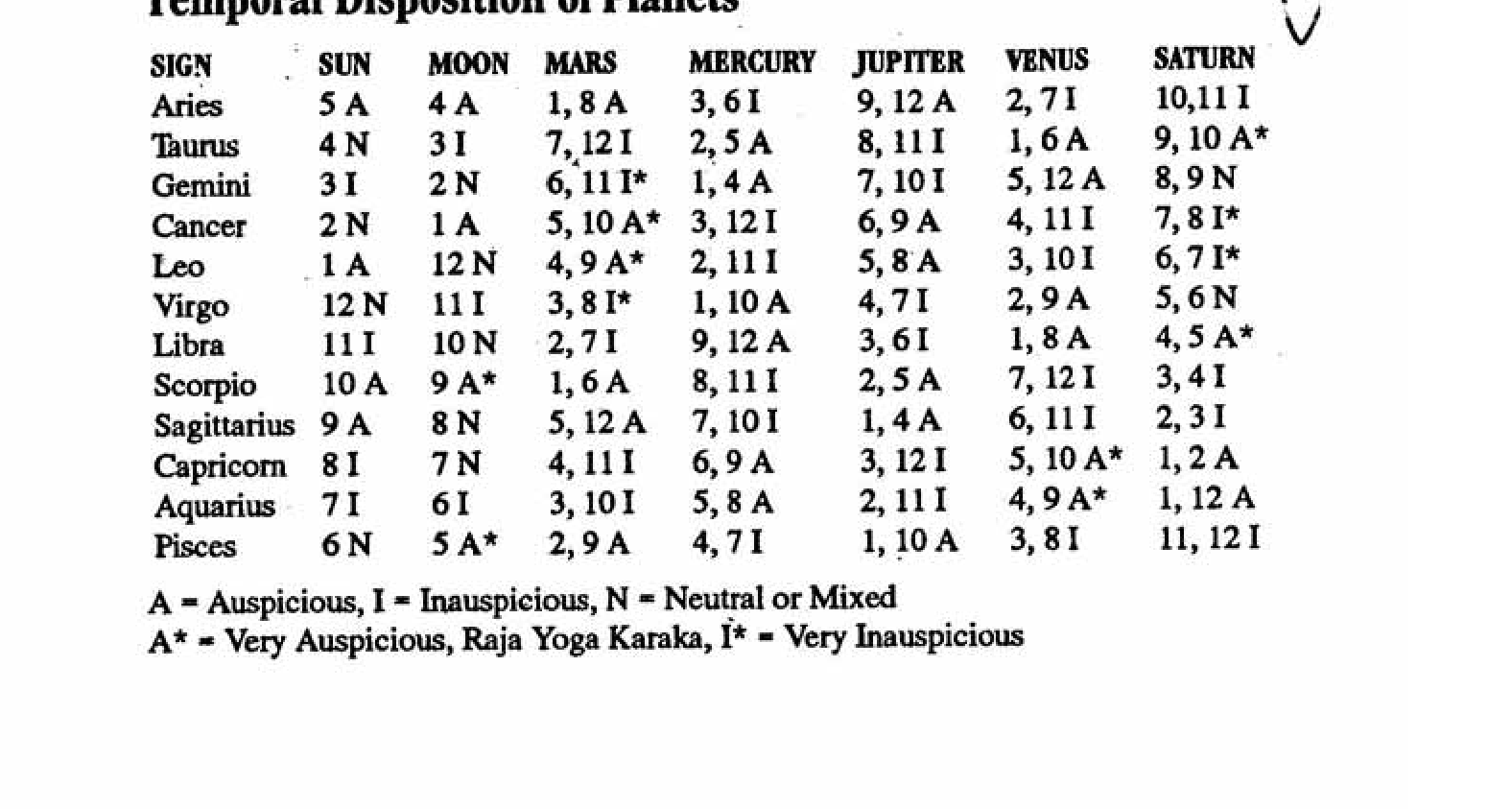 House Rulership Table — "Temporal Disposition of Planets." Rows are the twelve Ascendants (Aries…Pisces); columns are the seven classical planets; each cell lists the houses ruled and its status (A = Auspicious, I = Inauspicious, N = Neutral or Mixed, A* = Very Auspicious / Rāja Yoga Kāraka, I* = Very Inauspicious) (p160).
Chapter-end deity plate: Mercury
As elsewhere in the book, the chapter ends with a devotional plate of a planetary deity — here Mercury (Budha) — with a Sanskrit-style dhyāna (meditation verse) (AoS ch.6, p161). [classical]
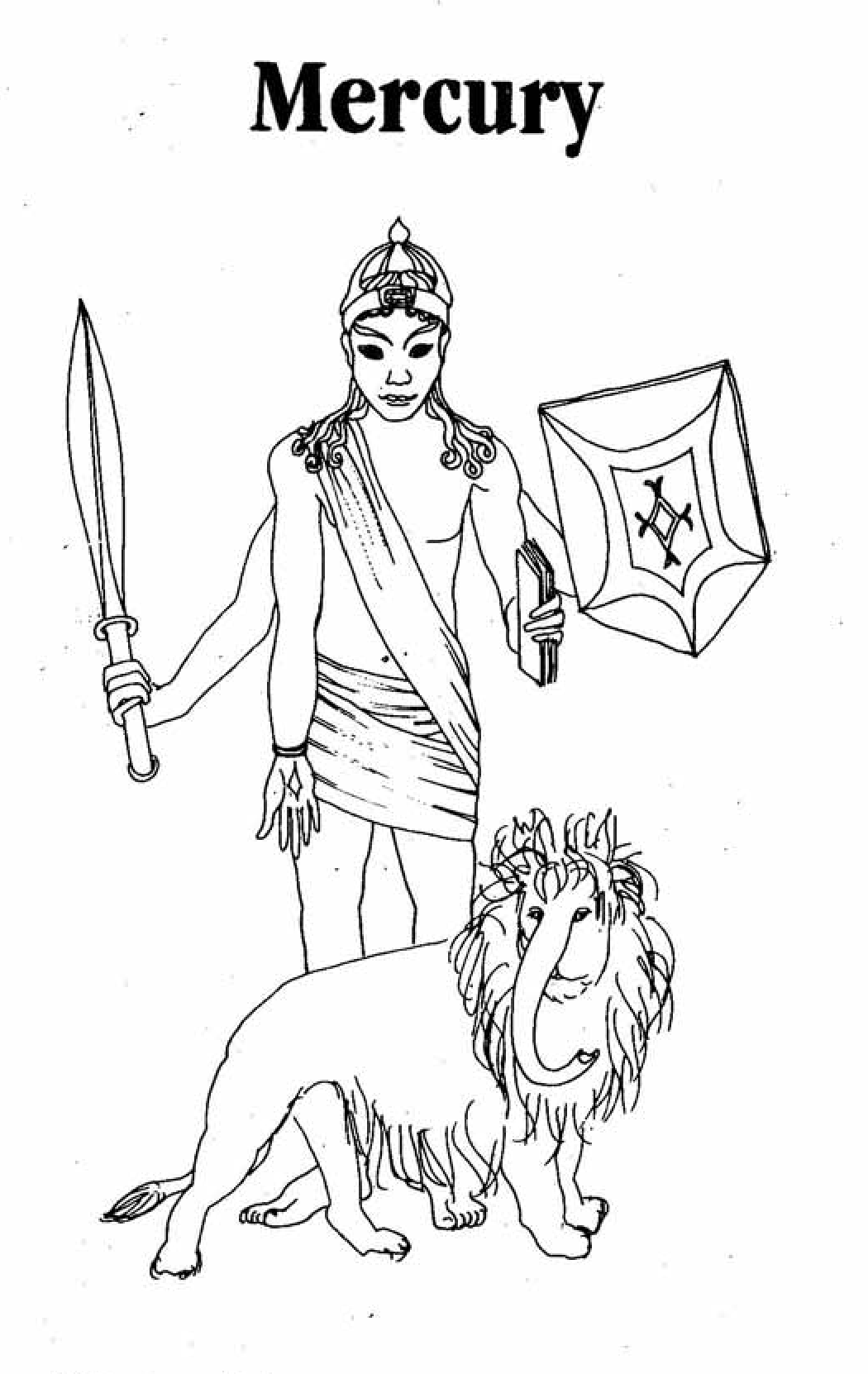 Mercury (Budha). The verse reads: "Dressed in green, with a green body, who has four arms, the incarnation of Viṣṇu, who is a yogi, whose vehicle is a lion with an elephant's trunk, who carries a sword, shield and book in his hands, the son of the Moon, with an emerald crest jewel on his head, making the gesture that gives boons, may Divine Mercury ever grant us his grace." (p161).