Home / Astrology of the Seers / Chapter 1
Towards a New Vision of Astrology
The book opens — before chapter 1 — with a frontispiece gallery of the planetary deities (its printed ILLUSTRATIONS): the carved Surya Yantra and line-drawing deities of the grahas, each with its dhyāna (meditation) verse. The first three are gathered here; the rest appear at later chapter and part boundaries (Mars closes Part I; Mercury, Jupiter, Venus, Saturn, Rāhu, and Ketu fall through Parts II–IV).
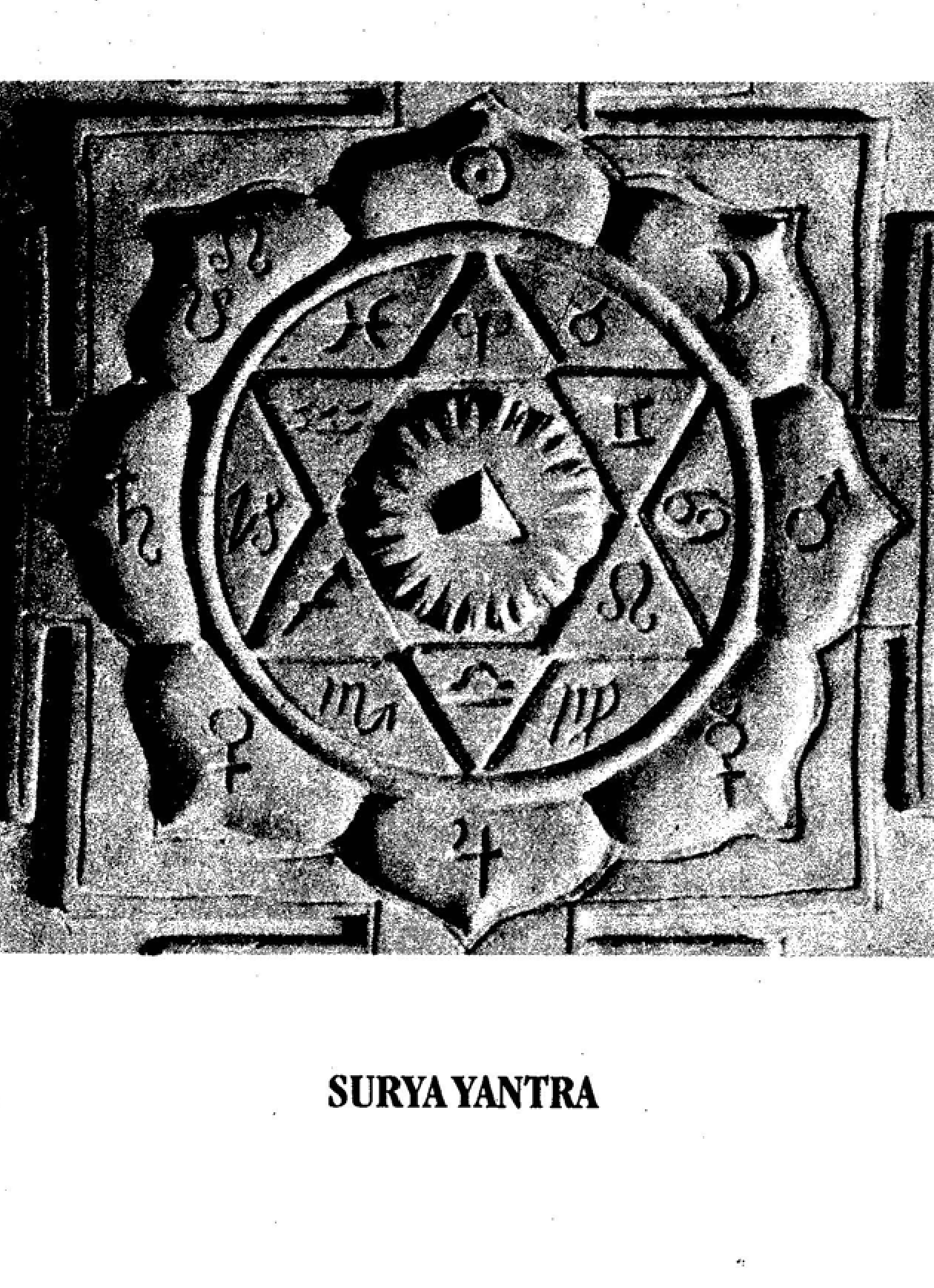 Surya Yantra — the geometric emblem of the Sun, the book's frontispiece (front matter, PDF p5).
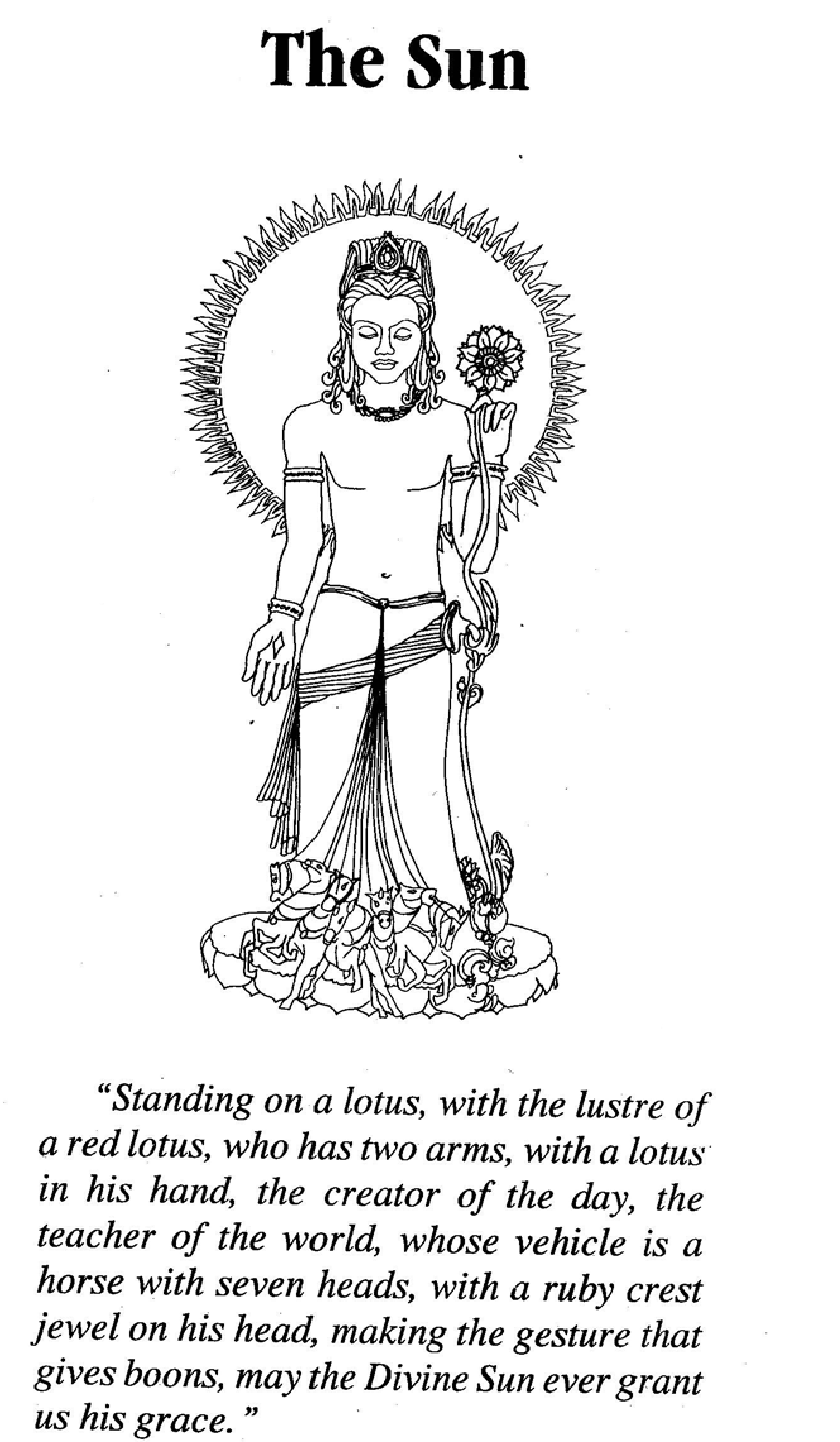 The Sun (Sūrya): "Standing on a lotus, with the lustre of a red lotus, who has two arms, with a lotus in his hand, the creator of the day, the teacher of the world, whose vehicle is a horse with seven heads…" (front matter, PDF p8). [classical]
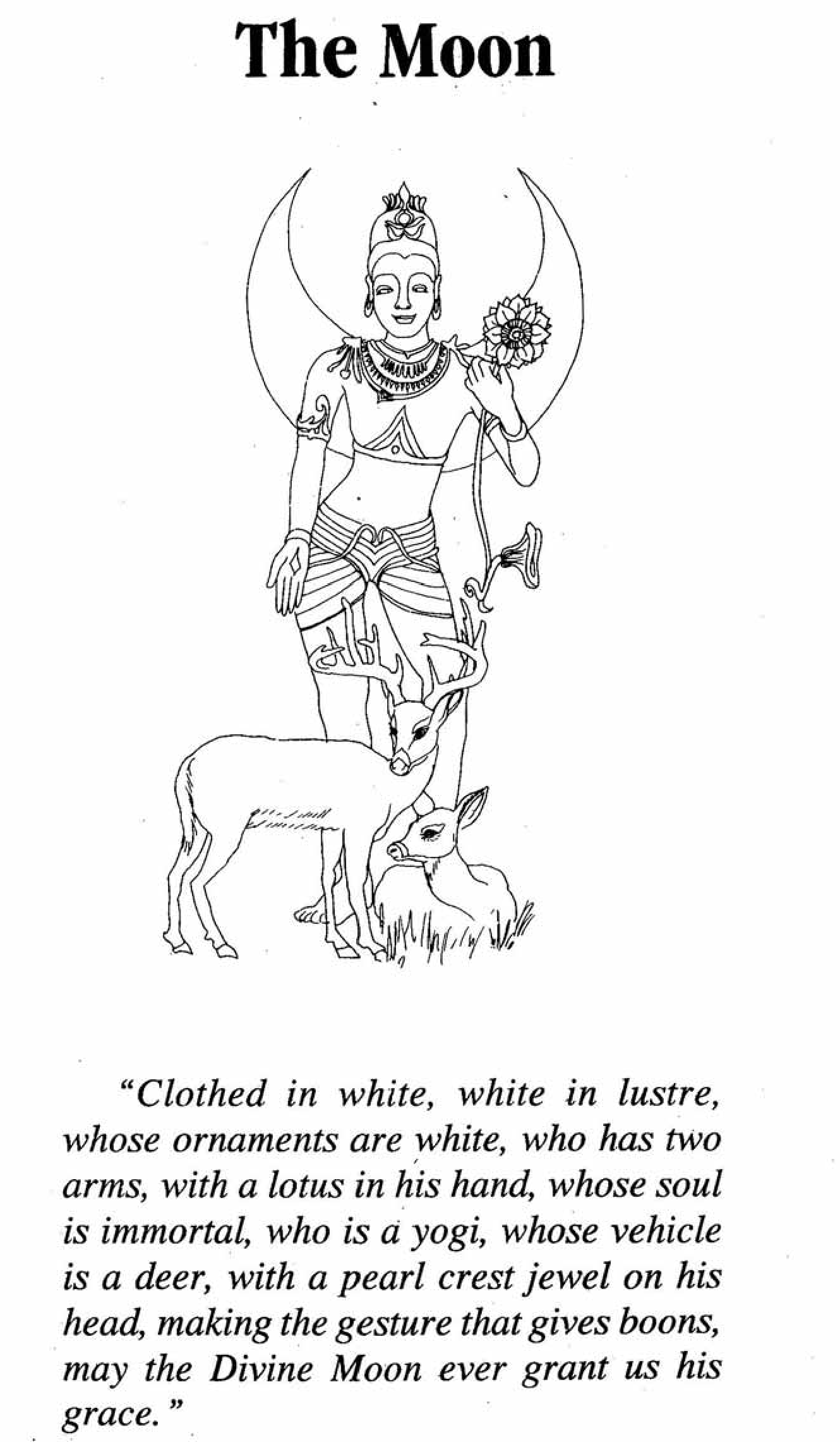 The Moon (Chandra): "Clothed in white, white in lustre, whose ornaments are white, who has two arms, with a lotus in his hand, whose soul is immortal, who is a yogi, whose vehicle is a deer…" (front matter, PDF p15). [classical]
The opening chapter is Frawley's manifesto for the whole book. He is not yet teaching technique — no planets, signs, or charts are explained here — but arguing what astrology is for: that it was humanity's original science, that it is properly the science of time, that the planets are cosmic powers (Gods, and Lords of karma), and that astrology at its height is a spiritual science whose real subject is self-knowledge. The register throughout is Frawley's own framing and East–West polemic [modern: Frawley]; he braces it with two devotional hymns and several scriptural quotations that carry the genuinely classical and traditional material.
The original science
Frawley opens with the claim that astrology is the original science — the oldest system of knowledge humans devised, and the most important until the rise of modern science. It was the basis for the first cosmologies, the science of fate or destiny used to read earthly events as originating in the heavens, and both an outer science of the physical universe and an inner science of mind and soul (AoS ch.1, p16). [modern: Frawley]
His point is that astrology underlies the other sciences because it "shows the basic language of cosmic energy." Ancient medicine — Āyurveda in India, and ancient Greek medicine — reckoned with astrological influences, and Yoga is founded on balancing the solar and lunar forces within the body. The great spiritual cultures of antiquity — Egypt, Babylonia, India, China, Mexico — were all built on the cornerstone of astrology, so that "the astrology of a culture is a good key to its development" (AoS ch.1, p16). [modern: Frawley]
From this he mounts a critique of modern culture. Our astronomical knowledge is more intricate than any prior civilization's, but without astrology it is "like a body without a soul": we have turned the sacred powers of the cosmos into mere numbers and chemical reactions — like reducing a person to height and weight, or judging a great painting by the chemistry of its pigments. The modern age does not even count astrology a science because it is not materialistic — yet if the universe has a dimension of consciousness (as Frawley notes some physicists suspect), then astrology must be acknowledged as "one of the legitimate sciences of consciousness." For a new spiritual age to dawn, astrology must be brought back into the mainstream of human knowledge, applied more deeply than the superficial fortune-telling it has decayed into. He notes that while the spiritual use of astrology "all but perished in the West," it survived in the East — not in the cultural mainstream (where it too degenerated into fortune telling) but among yogis and sages secluded from the world, whose wisdom is what this book seeks (AoS ch.1, p17). [modern: Frawley]
The science of time
The second section frames astrology as the science of time. Frawley anchors it with a hymn from the Vedas:
The Vedic Hymn to Time (Atharva Veda XIX.23.1–4): "Time is a horse that moves with seven rays, with a thousand eyes, undecaying, who projects a manifold seed. Him the seers mount, illumined in mind. His wheels are all the worlds. Time moves seven wheels. He has seven mouths, whose center is immortal and undecaying… A full vessel is set in time… He gathered all the worlds together. He encompasses all the universe. As their father, he became their son, apart from whom there is no other light." (AoS ch.1, p18) [classical]
On this Frawley builds his teaching: time is the original power that rules the universe, for all things originate through it; "the world is time," and in each second is the creation and destruction of the entire universe. To be in awe of time is no superstition — our wonder at birth and fear of death are themselves a reverence for time (AoS ch.1, p18). [modern: Frawley]
He identifies time with the highest deities of the Indian tradition: Mahākāla ("Great Time") is Mahādeva, Śiva the transcendent Lord; the force of time, Mahākālī, is the great Goddess, his consort Mahāśakti, the supreme Power. Time is "the Divine breath" that creates, sustains, and destroys, and "the dance of the great God" (AoS ch.1, p18). [traditional]
The planets enter here as the channels of time: "the Gods of time are the Sun, the Moon and the planets, which are the channels that direct the energy of time through this solar system." The Gods of the planets and the Gods of time are the same; the planets "reflect the powers of the cosmic intelligence that rules all things through the movement of time" (AoS ch.1, p18). [modern: Frawley]
Frawley then ties this to a modern, almost physical picture: time is not Newton's empty continuum but a force field, a dimension with a texture, set by the gravity of the objects within it — above all the Sun and its planets, which have large magnetic and gravitational fields. The planets are "points of light in a vast energy network, connected… by subtle lines of force," whose energy fields reach Earth and shape Earth-life and our own bodies and minds (AoS ch.1, p18–19). [modern: Frawley]
He gives the concrete time-cycles the planets generate, which is the only quantitative content in the chapter: the Earth's axial rotation determines the day; the Moon's orbit of Earth the month; the Earth's orbit of the Sun the year; the movement of Saturn a "month of years," i.e. 30 years; and the movement of Uranus our basic lifetime, 84 years. Each planet "gathers in and gives out forces," transmitting a particular wavelength of energy. Great world-ages of thousands of years correspond to special planetary conjunctions and to the Sun's movement around other stars and the galactic center — "cycles within cycles ad infinitum" (AoS ch.1, p19). [modern: Frawley]
The deeper claim is the doctrine of the karmic quality of the moment: "Each moment of time has a certain quality to it. There is a certain karma… to the forces operating at any specific time period. Everything that happens at a particular moment shares the quality of the moment." Hence the moment of birth can be read like "the nature of a tree… in the seed from which it comes," and the moment one starts a marriage or a business likewise shows the life-arc of that endeavor (AoS ch.1, p19). [traditional] As "Lords of time," the planets are therefore the Lords of karma or destiny: they show the cosmic rays we are developing, the forces we are susceptible to, and how they may harm us. Astrology opens an "inner vision" so we can navigate this ocean of cosmic forces and avoid being struck down by them (AoS ch.1, p20). [modern: Frawley]
Astrology, he adds, reaches beyond this life: the planets show past and future life-conditions, for all time follows one rhythm of birth and death. And the planets "not only show our bondage to time but also indicate the way of liberation from it." When we become conscious of the cosmic forces working through the planets, we "pass beyond their rule," integrate their powers, and reintegrate "the cosmic man who is our inmost Self." So astrology becomes a symbol of spiritual development: we can meditate on its forms as archetypes for inner growth, and use it as a symbolic tool even apart from its calculations — the goal being not attachment to our particular destiny but using it "as a door to the cosmic life" (AoS ch.1, p20–21). [modern: Frawley]
The planets and the Gods
This section is introduced by a second devotional hymn, which gives the iconography of the nine planetary deities (the navagraha) — the first place the book names them:
Hymn to the Planets (by Vyāsa):
- Sun (Sūrya) — "lustre of a red hibiscus," power of perception, great effulgence, dispeller of darkness, destroyer of sins, maker of the day.
- Moon (Candra) — color of yogurt, sea-shell, or snow, who arose from the ocean of milk, whom Śiva wears as a crest jewel.
- Mars (Maṅgala) — born from the womb of the Earth, with the brilliance of lightning, the Divine youth who carries a spear.
- Mercury (Budha) — dark like the Priyaṅgu flower, of unequalled form, the intelligent son of the Moon, of gentle nature.
- Jupiter (Bṛhaspati) — teacher of the Gods and seers, lustre of gold, endowed with wisdom, ruler of the three worlds.
- Venus (Śukra) — lustre of a snow mountain, supreme teacher of the demons, who explains all the scriptures.
- Saturn (Śani) — dark blue, born before the God of death, the son of the Sun and shadow.
- Rāhu — who has only half a body, great in valor, who oppresses the Sun and Moon, born from the womb of a lion.
- Ketu — whose head is the stars and planets, with the dark lustre of a palāśa flower, fierce and terrible in nature. (AoS ch.1, p21) [classical]
Frawley then develops his thesis that the Gods of antiquity are personifications of cosmic powers, not naive anthropomorphisms. The ancients revered the planets as Gods because they saw in them "the primal powers of cosmic intelligence," and worshipped those same powers within themselves as powers of the soul — seeing the Sun rise "not only in the outer world but in the inner space of the heart." Drawing on Jungian psychology, he argues the Gods are "the expression of a cosmic intuition": the unconscious speaks in symbols (myth and legend) and contains not only repressed desires but the deeper soul and the cosmic mind. Our most primary archetypes are those of time — birth, death, transience (he cites the riddle of the Sphinx) — so our myths are "naturally of time," and therefore of the planets. "The language of symbols… is essentially the language of astrology" (AoS ch.1, p21–22). [modern: Frawley]
He then sets out a graded scale on which the planets operate, from highest to lowest — a structure that recurs through the chapter:
- The seven rays. Outwardly the planets are "the seven rays that determine the play of creation": seven forces in nature, "the seven levels of the cosmos, the seven planes of existence" ("Life is a tapestry of seven times seven"); inwardly they create the rational and emotional mind together with the five senses (AoS ch.1, p22). [modern: Frawley]
- The highest level — One God and the matrix. In all ancient religions the Sun is the symbol of the One God, the unitary cosmic intelligence and force of spiritual evolution — cosmic lord, creator, and "Divine Son who is the father of the worlds." The Moon is the essential power of nature, the matrix, the great Mother Goddess. As the creative rays descend from the spiritual planes they take on density and differentiation and "come more and more to clash" (AoS ch.1, p22–23). [modern: Frawley]
- The astral level — lesser deities. Lower down the planets are "lesser deities, the astral powers that govern, sometimes capriciously, the destinies of men" — the level of the Greek Gods. Here "Mars is the energy principle which, when acting on its own, creates violence and conflict"; the old myths illustrate the inherent conflict of these forces on a lower level (AoS ch.1, p23). [modern: Frawley]
- The mental level — Gods of mind and intellect. Higher than the astral but still bound, the planets become the principles of art, science, and philosophy. As "mere forces of the mind" they have no real transformative power; behind them still works "the same mechanism of egoism and desire." The moral failure of the Greek Gods mirrors "the spiritual failure of an intellectual culture": the intellect refines but cannot transcend the vital passions of anger, greed, and fear (AoS ch.1, p23). [modern: Frawley]
- The lowest level — demons. At bottom the planets become "the demons, the Asuras… that obstruct our spiritual growth." Frawley reads Lucifer as the fallen star — Venus in its lower energy — and these as powers of falsehood working through "illusion, glamor, hypnosis, deception, arrogance and exploitation." Yet they are "nothing but the higher rays inverted on a lower field of manifestation," appealing to inner needs in a perverted way (AoS ch.1, p23). [modern: Frawley]
The key linguistic datum here is traditional Jyotiṣa: the Sanskrit word for planet, graha, also means "demon," or "that which seizes / possesses a person." As the powers ruling this world of ignorance, "the planets are primarily demonic in their effect" — they weave "a veil of hypnosis in which we project their energy as if it were our own." War between peoples mirrors disharmony between planets; disease reflects "susceptibility to certain negative planetary rays." In ignorance we are controlled by the planets; their only purpose is "to wake us up that we may take mastery over them" (AoS ch.1, p23–24). [traditional] This is why, Frawley says, the ancients looked on the planets with fear — aware of "the awesome, terrible and often unpredictable universe in which they lived" (AoS ch.1, p24). [modern: Frawley]
But the same planets, rightly understood, are the highest spiritual potentials: "The Sun is our inner Self, our Divine being. Venus is our sense of Divine love, beauty and grace." We must raise the planets "from the lower level of world-manifestation… to the higher level of self-manifestation." Frawley casts this as a work of redemption: "To save ourselves, we must redeem the planets, we must reintegrate the cosmic rays" — and "enlightenment is resurrecting the Sun out of darkness" (AoS ch.1, p24). [modern: Frawley]
Astrology as a spiritual science
Here Frawley states the book's governing thesis directly: astrology has been, and should again be, a spiritual science. "Our birth chart is, in a sense, the mirror of our soul and its orientation to our particular incarnation." This does not mean truth or liberation can be found by reading charts; it means astrology gives "keys to the unfoldment of the spirit" (AoS ch.1, p25). [modern: Frawley]
The metaphysics he asserts is uncompromisingly idealist: the stars and planets "are not just outer entities; they are alive within us as well," and in fact the outer comes from the inner, not the reverse — "our own inner lights take shape outwardly as the stars and planets," though the outer can in turn affect the inner. "There is no ultimate real difference between the external and the internal"; each thing in nature is "a symbol of some aspect of the cosmic being." Our own soul is "a star, a sun, a point of cosmic light," called the causal being because it is the causative power behind life and thought, containing "the power to create the entire universe." The light by which we see is directly continuous with "the one Divine light that resides in the Sun and in all the stars," and in the central Sun of galaxy and universe (AoS ch.1, p25–26). [modern: Frawley]
Astrology can examine every domain — health, wealth, career, relationships, body and mind — and is "the most comprehensive science we have"; but at its highest level it is part of the science of the spirit, the practice of Yoga, whose purpose is to guide us beyond the outer forces to their source. That source "is not in the heavens… It is… who we really are when our minds are pure and clear." A worked example: anger is "a typical lower energy of the planet Mars," but is really "the power of truth to manifest what is right and insist upon it" — it only appears as anger when truth is identified with an egoistic opinion. "All the lower indications of the planets are higher powers struggling in limitation… which require reintegration — not suppression" (AoS ch.1, p26). [modern: Frawley]
The pivot of the whole spiritual reading is self-knowledge. Frawley quotes the maxim that "self-knowledge is the basis of all knowledge," but insists it means more than psychological analysis or even knowledge of past lives (which is "only a more extensive memory still caught in the veil of form"). Self-knowledge is knowledge of "our true being, which is the light of awareness and not an external identity… the Self of which all incarnations are masks" — found "by negating all identity and reintegrating all life… within our own hearts." Astrology, properly employed, "shows us the world within us and our self within the entire world," becoming "a tool for meditation wherein the planets represent the qualities we must realize within ourselves" (AoS ch.1, p26–27). [modern: Frawley]
He restates the planet-by-planet logic of liberation: our solar system manifests the seven creative rays in their dual power as Sun and Moon and their fivefold diversification as the five major planets — Mars, Mercury, Jupiter, Venus, Saturn. "Each planet is a teaching… a door to liberation": if we do not integrate a planet's energy it will bind us into sorrow and conflict; taking too much or too little causes imbalance; taking it divisively leads to disintegration, taking it "as a part of our deeper Self" leads to cosmic unfoldment. "Each planet represents a particular kind of Yoga," a path of unfoldment whose angle of approach differs but whose goal is one (AoS ch.1, p27–28). [modern: Frawley]
Frawley extends this to peoples and sages: different souls, countries, races, and religions "fall under different planetary rays." Some ancient sages were said to belong to "families" of Jupiter, others of Venus; ancient Egypt and ancient America followed a calendar centered on Venus, ancient India and China one based on Jupiter — reflecting which creative ray was their guiding inspiration. He is careful to say this does not mean sages "came from these planets by spaceship," but that they were "inwardly attuned to the cosmic ray belonging to the planet" (AoS ch.1, p28). [modern: Frawley]
Death, the after-death journey, and the lunar realm
A long passage gives Frawley's account of the soul's journey, framed astrologically. At death "we return along our planetary rays," usually merging through the Moon or the Sun, and we retain consciousness on this journey according to our evolution and the bodily "orifice" we leave through (lower centers to lower worlds, higher centers to higher) (AoS ch.1, p29). [modern: Frawley]
- The Moon is the gateway to the astral worlds — the subtle/dream plane, including "the heavens and hells of our religious beliefs" (on the lower astral) and the realms of art and mysticism (higher); from these, rebirth into the physical is "inevitable."
- The Sun (via the crown chakra) is the gateway to the causal worlds — the formless "worlds of pure intelligence," the realm of cosmic law, "the true home of our individualized soul, where it stores its karmic residues" and envisions another birth (AoS ch.1, p29–30). [modern: Frawley]
Frawley dwells on the lunar realm as our ordinary prison. Our culture is proud to have landed a man on the Moon, yet "we go to the Moon all the time" on the astral level — "for on its lower level the Moon is our memory, our past, our karmic storehouse." "The past impressions of the Earth life are stored in the Moon… The wonder is not that we are going to the Moon outwardly by spaceship; the wonder is that so few of us have ever gotten beyond the lunar realm inwardly." In sleep the mind expands into the astral (dream) body and then the causal (deep-sleep) body; were it not for attachment through memory we would experience in sleep or death "a natural return to cosmic consciousness and liberation," true rest being possible only in deep sleep "when our minds are temporarily resolved into their light source, the inner Sun." In ignorance, instead, "we become food for the Moon," trapped "in the lower lunar circle, which is the realm of desire" (AoS ch.1, p30–31). [modern: Frawley]
The diagnosis underneath is that the ego, not the world, is the problem: "We arrogate a certain portion of nature to ourselves as 'I am this' or 'This is mine.'" His recurring example: when I am angry, "it is not that 'I' am really angry — anger is just one aspect of the cosmic fire energy." "The planets only cast energy. It is we who make that energy positive or negative… What turns it negative is the ego." Without the ego, the energy of Mars "would not be anger but just fire," increasing vitality and perception (AoS ch.1, p31). [modern: Frawley]
The astral and causal bodies
Frawley closes the section by naming astrology's proper object. "Our birth chart is something like a photograph of our astral body" — the astral body being formed of stellar and planetary influences and equated with the mind (memory, imagination, intellect, reason). Hence "astrology is naturally the astral science, the science of the astral body," which is also why it can read past-life influences. Beyond it is the causal body, which relates more specifically to the Sun; by a higher perception astrology can be "elevated… into a causal science," reading "the movement of our souls from life to life" and our purpose as a soul in this incarnation (AoS ch.1, p32). [modern: Frawley]
He ends with a caution that keeps his idealism honest about astrology's limits. To make astrology a spiritual science "is to take it beyond its natural scope," possible only "if we know how to apply it with complete integrity, objectivity and awareness." He grants that "astrology as it is commonly practiced is not spiritual… It is full of illusion, a thing of māyā," and concedes the traditional point that "only the ignorant are entirely subject to their birth chart… the wise are not concerned about it." Astrology "cannot become a spiritual science without understanding its limitations" — yet, used rightly, it can convert the whole universe "into a symbol, a language for the development of the soul" (AoS ch.1, p31–32). [modern: Frawley]
Vedic science
Frawley now grounds the book's tradition. Vedic astrology arose from the vision of the ancient seers of India, the Vedic ṛṣis — "great men of spiritual realization and occult perception" of the legendary ages of light, whose knowledge passed down (largely orally) and was gradually "lost, distorted, or made rigid" but not destroyed (AoS ch.1, p33). [modern: Frawley]
From their meditations came "Vedic Science," an integral spiritual science cast "in the language of mantra, the human replica of the cosmic sound vibrations at the origin of creation." Mantras are seed sounds — the foremost being Oṃ — that hold "the laws and the archetypes behind all the workings of energy in the universe," so that by applying mantric knowledge on different levels the ṛṣis became adept in Yoga, philosophy, astrology, geomancy, medicine, poetry, art, and music (AoS ch.1, p33). [traditional]
He grounds the Sun–life-force correspondence in a quoted Upaniṣad:
Maitrāyaṇī Upaniṣad VI.1: "The Self carries himself twofold, as the life-force (Prāṇa) and as the Sun. Two are his paths within and without by which he revolves by day and by night. The Sun is the outer Self; the life-force is the inner Self. Hence, by the movement of the outer Self, the movement of the inner Self is measured. But according to the Knower… it is by the movement of the inner Self that the movement of the outer Self is measured." (AoS ch.1, p33) [classical]
The seers used the Sun's movement to understand the life-force in the body — the basis of Yoga — and, conversely, by meditating on the inner life-force came to understand the Sun (AoS ch.1, p33). [traditional]
The center of Vedic Science, where all its disciplines converge, is self-knowledge — Ātma Vidyā, "the Self… through knowing which everything is known." From this central Self-knowledge derives the mantra, and the mantra was first manifested in the Ṛg Veda — "the actual record of the ancient seers," whose intuitive symbolic language holds "the basic laws of the cosmos." Vedic astrology "looks back to the Ṛg Veda as its origin, and its great mantras to the planetary deities come from it." The Vedic mantras mean primarily spiritual knowledge and Yoga, and secondarily knowledge of creation — the foremost of those occult sciences being astrology — and they also yield Āyurveda (AoS ch.1, p33–34). [traditional]
Frawley names the lineage of Vedic astrology itself. The greatest of the ancient seers was the ṛṣi Vasiṣṭha; to his grandson Parāśara Śakti — himself the seer of some of the most esoteric Ṛg Vedic hymns — the origins of Vedic astrology are traced. Parāśara's great work, the Bṛhat Parāśara Horā Śāstra, "though weathered by time… is still used as the main book, the source book or scripture, in the field today," and the system presented in this book is based on it (AoS ch.1, p34). [traditional]
A closing note on epistemics: self-knowledge "transcends time, space and person" and "has no form" — so it is "not the possession of any person, teacher, group, organization, lineage or religion." Vedic astrology's first principle is therefore the primacy of inner knowing: it is "meant to help us to our own direct knowing, not to impose any external authority." Its first ethical principle is "reverence for that Self in all beings who controls even time and the planets" — and an astrologer without self-knowledge "will merely impose his own judgments upon his clients," practicing "astrology of the ego, not of the soul" (AoS ch.1, p34–35). [modern: Frawley]
Vedic astrology
This section makes the historical case for Vedic astrology's antiquity and reach. Vedic astrology is the traditional astrology of India, going back many thousands of years to before 3000 B.C., based on the Vedas (AoS ch.1, p35). [modern: Frawley]
Frawley's dating argument rests on precession of the equinoxes read off the lunar mansions (nakṣatras) — the only technical mechanism he invokes:
- Later Vedic literature has many references to the vernal equinox in the Pleiades (Kṛttikā), the beginning of Taurus → c. 2500 B.C.
- The earlier Ṛg Veda points further back, to the Gemini–Orion era (equinox in Mṛgaśira, c. 4000 B.C.) and the Cancer era (equinox in Punarvasu, c. 6000 B.C.) and earlier (AoS ch.1, p35). [modern: Frawley]
The Ṛg Veda, he notes, already shows twelve signs and a 360-degree circle, a lunar calendar with intercalary months, knowledge of the seven main planets (the Sun "conveyed by seven horses"), and the nakṣatras (lunar constellations). He reads one symbolic verse cosmologically:
"Four are his horns, three are his feet, two are his heads and seven are his hands. Bound triply the bull roars, Almighty God has entered into mortals." (Ṛg Veda IV.58.2) [classical]
— suggesting, Frawley argues, the later astronomical yuga era of 4,320,000,000 years, "with the seven hands as the seven zeros" (AoS ch.1, p35). [modern: Frawley]
On geographic and cultural scope: Vedic astrology was used by Hindus, Buddhists, Jains, and Sikhs, across India and into what are now Persia, Afghanistan, and Russian Central Asia, and still in Tibet, Sri Lanka, and Burma; it followed Hindu–Buddhist influence into Indochina and Indonesia and spread toward China, the Middle East, "perhaps even to ancient Babylonia and Egypt." If the Vedic astronomical references are accurate, "it may be the original form of astrology from which all the others emerged" (AoS ch.1, p36). [modern: Frawley]
Two name-points close the section. Vedic astrology is often called "Hindu astrology" after the culture that bore it, but "the basic system transcends any cultural identification" and is adaptable in the West alongside Yoga and meditation. Its most accurate traditional name is "Jyotiṣa," which means literally "the science of light" (AoS ch.1, p36). [traditional]
The four aims of life
The chapter ends with the framework that orders the book's values. Vedic Science recognizes four legitimate aims of human life — the puruṣārthas: Kāma, Artha, Dharma, and Mokṣa (AoS ch.1, p36). [traditional]
- Kāma — literally "desire"; our need for emotional and sensory happiness. Frawley renders it "enjoyment": all we do should be enjoyable and cause pain to no one.
- Artha — "achievement of goals," specifically the acquisition of valuable objects, so rendered "wealth": each of us should have the articles of wealth needed to function happily.
- Dharma — "principle or law," here the need for honor and recognition; Frawley renders it "vocation": to be acknowledged for what we can do and contribute to society without compromising who we are.
- Mokṣa — "liberation or freedom," the need for spiritual growth and transcendence of the three lower values: "We all must seek to go beyond who we are until we become one with all." (AoS ch.1, p36–37) [traditional]
Frawley's emphasis — his own ranking of the traditional scheme — is that the first three are subordinate to the last: "Liberation is the primary and essential goal… Without it the other goals have no real meaning." They are "a support for it," useful as means but not ends. He pictures the four "as a pyramid with liberation at the top," each meant to aid the others, and warns that "often our pursuit of the higher remains a pursuit of the lower in disguise — in the name of God we may still seek pleasure, power or fame." For astrology to "reclaim its spiritual integrity," it must recognize "the right orientation of the goals of life" (AoS ch.1, p37). [modern: Frawley]
Finally, beneath the four aims he places health — freedom from disease — as their foundation: "without health, what else can be accomplished?" Health is "not just physical, it is also mental," so astrology must weigh both physical health and psychological well-being. Hence, after spiritual astrology, medical and psychological astrology are its most important branches — a ranking that sets up Part III of the book (AoS ch.1, p37). [modern: Frawley]
Note on figures: PDF pages 16–37 of this chapter print no diagrams, charts, plates, or photographs — the chapter is continuous argumentative prose interspersed only with the two quoted hymns. No figures were captured for this span.