Home / Astrology of the Seers / Chapter 5
The Signs
This is the second chapter of Part II ("The Astrological Language") and the companion to the chapter on the planets. Its thesis, stated in the chapter title, is that the signs are how the planets transmit the influence of the stars — the signs are not independent forces but the twin fields generated by each planet's orbit. Frawley delineates all twelve in turn, then gives the technical apparatus a learner needs to weigh a sign placement: exaltation/debility with exact degrees, mūlatrikoṇa, planetary relationships, the kāraka significators, and the 27 lunar constellations. The register throughout is living-tradition Jyotiṣa; the East-West comparisons and a few framings are Frawley's own.
The twelve signs
Vedic astrology uses the same twelve signs of the zodiac as Western astrology, with similar meanings — but their locations are determined sidereally (fixed to the actual stars) rather than tropically (AoS ch.5, p102). Each sign has an English name, a Sanskrit name (the rāśi), an animal symbol, and a planetary ruler.
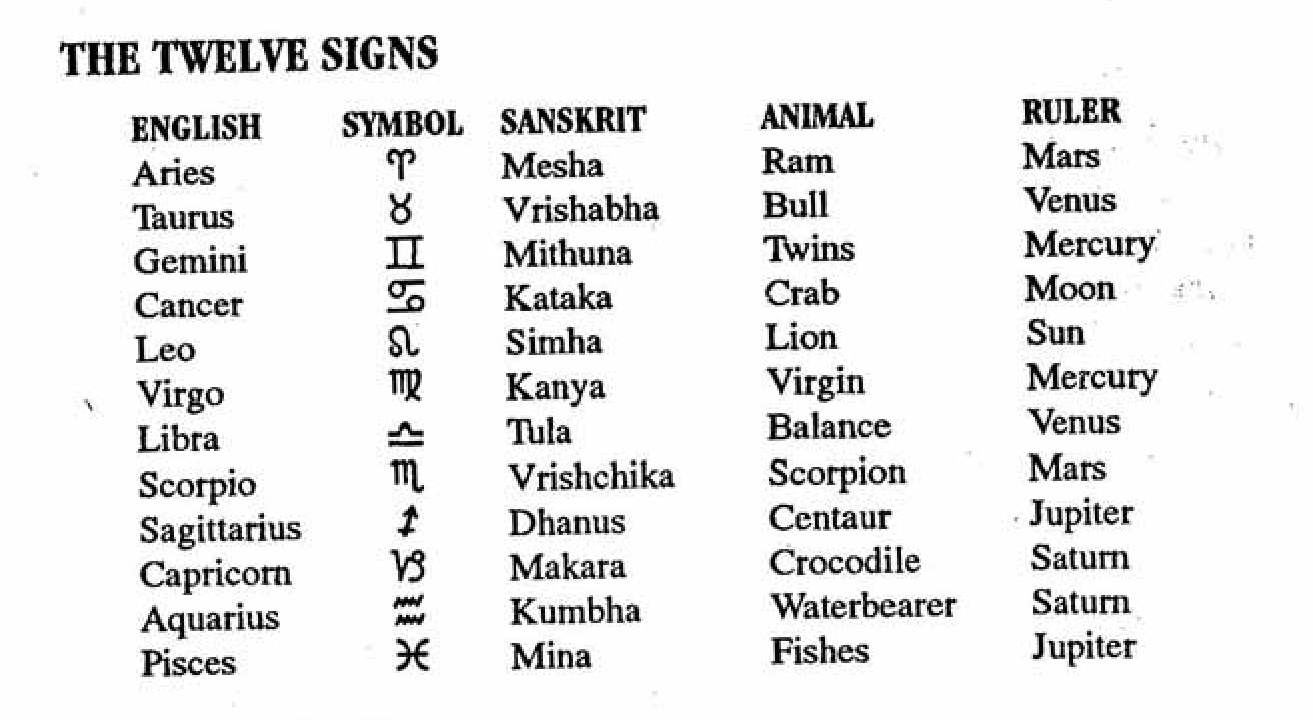 The twelve signs — English name, zodiac glyph, Sanskrit (rāśi) name, animal, and ruler (p102).
The full list (AoS ch.5, p102):
- Aries — Meṣa, the Ram, ruled by Mars
- Taurus — Vṛṣabha, the Bull, ruled by Venus
- Gemini — Mithuna, the Twins (a man and a woman), ruled by Mercury
- Cancer — Kaṭaka, the Crab, ruled by the Moon
- Leo — Siṁha, the Lion, ruled by the Sun
- Virgo — Kanyā, the Virgin, ruled by Mercury
- Libra — Tulā, the Balance, ruled by Venus
- Scorpio — Vṛśchika, the Scorpion, ruled by Mars
- Sagittarius — Dhanus, the Centaur/Archer, ruled by Jupiter
- Capricorn — Makara, the Crocodile, ruled by Saturn
- Aquarius — Kumbha, the Waterbearer, ruled by Saturn
- Pisces — Mīna, the Fishes, ruled by Jupiter
Sign rulership reflects the planets' orbits
The signs "reflect the meaning of the planet which rules them," and the key to rulership is that it mirrors the orbits of the planets around the Sun (AoS ch.5, p102). Read outward from the center:
- Cancer and Leo are the two innermost signs: they represent the orbit (and axial rotation) of the Sun itself — Cancer the Moon, Leo the Sun.
- Around them, Gemini and Virgo are the two halves of Mercury's orbit (the first planet out from the Sun).
- Taurus and Libra are the two halves of Venus's orbit (the next planet out).
- Aries and Scorpio are the two halves of Mars's orbit.
- Pisces and Sagittarius are the two halves of Jupiter's orbit.
- Aquarius and Capricorn are the two halves of Saturn's orbit, the most distant planet (AoS ch.5, p103).
So each planet rules two signs: the odd-numbered sign is the positive half of its orbit — where the planet is increasing and expressing its energy — and the even-numbered sign is the negative half — where it is decreasing and withdrawing (interiorizing) that energy. Cancer and Leo represent the positive and negative halves of the Sun's rotation on its own axis (AoS ch.5, p103). This orbital logic is why Vedic astrology cannot accept Uranus, Neptune, or Pluto as sign-rulers the way modern Western astrology does (assigning them to Aquarius, Pisces, and Scorpio): that would destroy the orbital sequence. Frawley allows them a looser link — Pluto to the negative side of Mars, Neptune to the negative side of Jupiter, Uranus to the positive side of Saturn — as possible co-rulers, much as Ketu and Rāhu are often treated as co-rulers of Scorpio and Aquarius (AoS ch.5, p104). [modern: Frawley]
The Moon as the feminine side of the Sun
Vedic astrology sees the Sun and Moon as in essence one planet: the Moon is the feminine side of the Sun, emanated to the proximity of the Earth to nourish life — "the incarnation of the Divine Mother who dwells in the Sun." It is no astronomical coincidence that Sun and Moon have the same apparent size from Earth; this is cosmic law, and it is precisely what makes eclipses possible. Eclipses are not accidental but "points of energy transformation necessary for the development of life on Earth." The Moon balances the Sun's influence — maintaining the homeostasis of positive/negative, masculine/feminine, yin/yang — and it is the Moon that lets the Earth hold water (the oceans, the rains, fertility, and the building up of body and mind) (AoS ch.5, p103). [modern: Frawley]
Odd and even signs (polarity)
The odd-numbered signs are positive, masculine, active; the even-numbered are negative, feminine, passive (AoS ch.5, p103). For example, Aries (sign 1) is the positive sign of Mars — its energy outgoing, expressive, manifest — while Scorpio (sign 8) is the negative sign of Mars, its energy internalized, hidden, acting behind the scenes. Generally planets are stronger in positive signs (they can accomplish more). Odd signs are more yang/solar and more Rājasic (energetic); even signs more yin/lunar and more Tāmasic (resistant). No high/low or good/bad is implied: the negative side is the portion of the orbit where a planet gathers in cosmic energy, the positive side where it releases it (AoS ch.5, p104).
The deeper picture: the planets exist to bring the sevenfold cosmic energy from the stars into the solar system. The planets are the dynamic principles; the signs are the fields or tissues maintained by their movement. The solar system is an organism, the zodiac its organic relationship with the galaxy, and the planets are "transmission stations" that bring in the seven rays from the galactic center and digest them for the evolution of life (AoS ch.5, p104). Hence the signs do not exist apart from the planets: Gemini is nothing but Mercury's energy in the positive half of its orbit; Virgo the same energy in the negative half (AoS ch.5, p104). [modern: Frawley]
Signs by quality (movable, fixed, dual)
Each sign carries one of the three major qualities — Western "Cardinal," "Fixed," and "Mutable." In Sanskrit: Chara ("active," movable), Sthira ("firm, immovable," fixed), and Dwiswabhāva ("both-natured," dual). These describe how a person directs energy in life. Frawley likens them to positive (Cardinal), neutral (Fixed), and negative (Mutable) electrical charges — no quality is better or worse; each has its own pattern and its own characteristic imbalance to master (AoS ch.5, p104).
The four Cardinal signs are Aries, Cancer, Libra, Capricorn; the four Fixed are Taurus, Leo, Scorpio, Aquarius; the four Mutable are Gemini, Virgo, Sagittarius, Pisces.
Cardinal types show the positive, active, initiating phase of their element; they correspond to Rajas — the principle of movement, impulse, direction, expression (but prone to agitation and over-forceful action). They are people of action — willful, aggressive, impulsive, often successful as leaders and executives — but may lack sensitivity or self-reflection, impose on others, and burn themselves out. As souls they are beginning a phase of manifestation. They need to cultivate patience, flexibility, stability, and to make sure their drive serves their deepest will, not action for its own sake (AoS ch.5, p105).
Fixed types show the static, stable, enduring phase of their element; they correspond to Tamas — form and substance, continuity (but prone to inertia and stagnation). They are firm, determined, settled, with strong faith and unwavering beliefs — "like a rock" — but can be obstinate, possessive, and unable to acknowledge another point of view; they change slowly, but what they change endures. As souls they are maintaining a phase. They need to attempt new things and stay open, and to make sure what they hold to is truth, not mere negativity or selfishness (AoS ch.5, p105–106). Frawley notes a wrinkle: he assigns Mutable to Sattva, but some Vedic astrologers reverse this — Fixed=Sattva (stable), Mutable=Tamas (disintegrating) — yet Mutable signs are best for developing the mind, which is itself Sāttvic (AoS ch.5, p106). [modern: Frawley]
Mutable types show the transitional, unstable, refined phase; Frawley aligns them with Sattva — the subtle, transformative state (but prone to instability, hypersensitivity, disintegration). They are flexible, adaptable, many-talented mental types — curious, communicative, agile when young but with poor endurance — yet indecisive, inconsistent, more liable to mental/nervous and immune/allergic disorders. They make good businessmen and performers but may be unstable. As souls they are completing a phase. They need initiative, daring, firmness, and above all to direct their sensitivity consciously rather than be disturbed by everything (AoS ch.5, p106–107).
Qualities of the planets themselves
When judging quality, also weigh the planets, because a strong planet can override the signs. In quality terms: the Sun and Mars are more Cardinal (lead, dominate). The Moon and Venus are more Fixed (yield, endure) — though an afflicted Moon turns very Mutable. Mercury and Jupiter are more Mutable (like change). Saturn is itself Fixed (tied to inertia), but its effect on other planets is to weaken them or render them Mutable. Rāhu and Ketu act as disruptive/Mutable forces unless well-placed, in which case they lend Cardinal strength. A Mutable Sun (say in Gemini) gives mutability to the will even amid Fixed planets; a Fixed Mars gives fixed purpose even with no other Fixed planet — so the qualities act through the particular planets that occupy them (AoS ch.5, p107).
Signs and the elements
Each sign also relates to one of the four elements — earth, water, fire, or air — in one of the three qualities. Where the quality shows how one directs energy, the element shows the level or density of being one operates in (AoS ch.5, p107).
Earth signs (Taurus, Virgo, Capricorn) give a strong sense of form, order, utility, practicality, and material expression; a connection to the body and physical matter (gardeners, doctors, bankers, farmers); work with the hands; mastery of the senses and body — but a certain gravity that can weigh one down. On the higher level they realize inner potentials in the material world and mark "old souls" tied to traditional cultures; on the lower they bind one to the body or the underworld. Well-placed: practical efficiency, purity, capacity for work. Poorly placed: constriction (AoS ch.5, p108).
Water signs (Cancer, Scorpio, Pisces) bring energy into feeling and emotion — love, affection, attachment, intuition, instinct; the need for emotional regard; fulfillment through relationship (family, friends, social or spiritual). Those with many Water planets gather people around them but may lack boundaries and clarity. Higher: wisdom, faith, devotion, compassion, the astral worlds of art and devotion. Lower: sentimentality, greed, attachment, drowning in unresolved emotion (water creates but also decays). Well-placed: love and creativity; poorly placed: emotional turmoil or stagnation (AoS ch.5, p108–109).
Fire signs (Aries, Leo, Sagittarius) show strong will, ambition, determination, discrimination, perception, and a critical mind; a focus on self and character rather than exchange with others; the wish to dominate and be popular. The field of activity is the will; one must be sure of one's motivation. Higher: independence, insight, strong judgment, high values, leadership, the power to project warmth and light. Lower: destructiveness, conflict, vanity, pride. Well-placed: illumination, freedom, enlightenment; wrongly placed: the will "burnt up" and in turmoil (AoS ch.5, p109).
Air signs (Gemini, Libra, Aquarius) show versatility of movement and change on the mental level — intellectual, communicative, idea-loving, speculative, often unconcerned with practical results; much work in thought and communication; they "seek to ascend but may not have the foundation for it," so their energy scatters. Higher: idealism, aspiration, philosophy, humanitarianism. Lower: confusion, ungroundedness, attachment to mental patterns that reflect nothing real. Well-placed: comprehensiveness, balance, sensitivity; wrongly placed: dispersed energy, mental or nervous problems (AoS ch.5, p109–110).
Examining the elements in the chart
For a complete reading, also weigh the elements of the planets themselves, especially the strongest planet. Many planets in Earth signs but predominantly fiery planets strongly placed (e.g. an exalted Mars in Capricorn) yields "Fire operating in the field of the earth" — fiery force and constitution (Pitta), but earthly realm of manifestation (AoS ch.5, p110). When planet and sign are of different elements, a cancellation or overpowering can occur: e.g. Mars, Saturn, the Sun, and the nodes (none watery) sitting in Water signs may negate water rather than express it, even creating "air" in the nature; if weakly placed, the water may instead overpower the planets' own elements (AoS ch.5, p110).
Element combinations across the chart reveal the inner tensions: earth + air → a battle between the practical and the idealistic; water + fire → emotions versus will; earth + water → energy sinks and contracts; fire + air → energy expands and ascends but disperses (AoS ch.5, p110–111). The three qualities and the elements correspond: Cardinal is like fire (energizing, expressive), Fixed is like water (gathering, stabilizing), Mutable is like air (fluctuating, communicative) (AoS ch.5, p111).
The signs share their elements' attributes (AoS ch.5, p111):
- Air signs — light, subtle, mobile, dry, clear; expansive, expressive, relating, sensitive — but may cause dispersion and disintegration.
- Fire signs — hot, radiant, light, sharp, clear; active, guiding, penetrating, separating — but may cause combustion and destruction.
- Water signs — wet, cloudy, cold, stable, smooth, soft; passive, yielding, receptive, calm — but may cause stagnation and decay.
- Earth signs — heavy, dark, hard, rough, static, slow; contracting, resistant, unyielding, unexpressive — but give stability, endurance, perseverance, loyalty.
How signs are used in Vedic astrology
Where Western astrology focuses on the Sun sign, Vedic astrology ranks the Ascendant (Lagna) first, the Moon sign second, and the Sun sign third. This is logical: the Ascendant is the fastest-changing factor — it changes sign every two hours (versus two and a half days for the Moon, a month for the Sun) — so it most directly reflects one's individuality and the meaning of this particular incarnation, being the point where Earth orients to the heavens. But whatever sign has the greatest strength by aspect or association of planets is strongest, even if it is none of these three (AoS ch.5, p111). Crucially, signs are not the irreducible factors — the planets are. Vedic astrology judges a person primarily by their most powerful planet(s); Saturn as the strongest planet, for instance, gives Capricornian traits even with no planet in Capricorn (AoS ch.5, p111–112). The portraits below are framed chiefly as Ascendants, and to a lesser degree apply as Moon or Sun signs (AoS ch.5, p112). [modern: Frawley]
Description of the twelve signs
Each portrait below opens with the sign's planetary polarity, its quality+element, its place on the body of the Cosmic Man (Kāla Puruṣa, time personified), and its symbol.
Aries — positive sign of Mars, Cardinal Fire, the head of the Cosmic Man, a ram; sign 1. Gives independence, force, self-expression, a strong personal orientation. Aries types are dynamic, aggressive, competitive, full of initiative; they "live in their heads" with penetrating, scientific, logical minds good at research and invention. Independent and adventurous, they hold strong passions under control, but can be willful, impulsive, headstrong, critical, opinionated — yet make good psychologists once self-examining. Their martial energy works through mind more than body (argument, not violence). Prone to vanity and self-preoccupation; can give themselves ulcers by over-thinking; benefit from relationship to balance them. Spiritual key: use the sharp mind to discover truth, not to promote the self (AoS ch.5, p112).
Taurus — negative sign of Venus, Fixed Earth, the face and neck of the Cosmic Man, a bull; sign 2. Gives a strong sense of relationship, partnership, and communication of feeling; seeks balance and harmony in relationships and immediate environment. Stable, enduring, fixed in their ways, with a strong sense of form and beauty (artists, poets); often attractive and fond of adornment; possessive, materialistic, sensual, fond of comfort and luxury; refined and graceful; communicate well and associate with foreigners; obstinate; slow to anger but slow to forgive; good memories but sentimental and clinging to the past. They value marriage and a stable home, are romantic and devotional ("all is love"), attached to the earth, work with their hands. Mode: to acquire, preserve, refine; inclined to tradition and ritual (AoS ch.5, p112–113).
Gemini — positive sign of Mercury, Mutable Air, the lower neck and shoulders of the Cosmic Man, the twins (a man and a woman); sign 3. Gives an energetic nature seeking change, interchange, motion, and invention. Nervous, restless, quick, and adaptable in body and mind, but exhaust themselves through excess activity; excellent intellects, powers of speech and language (writers, journalists, secretaries, programmers, scientists); good with information and statistics, but speculative — chasing ideas for their own sake or getting lost in fantasy and worry. As mobile in relationships as in mind: tend to marry more than once; strongly sexual but with vital energy that may not match their imagination; love novelty and stimulation, easily addicted to media; can be deceptive, tricky, indecisive, never finishing things — the most changeable of all types. Turned inward, they become quite spiritual, their energy being the most subtle and volatile of the signs (AoS ch.5, p113–114).
Cancer — sign of the Moon (even/negative), Cardinal Water, the chest of the Cosmic Man, a crab; sign 4. Shows a need for mental and emotional stability and happiness. Open, friendly, sympathetic, caring, nurturing ("under the sign of the mother"); value intimate relationship and the exchange of feelings; keep many people in their homes; seek popularity and are sensitive to the moods of the masses, gaining social/political influence — yet may be over-emotional, shy, attached, dependent, narrow in their love of home, country, or religion. Devoted, loving, intuitive — sensing others' feelings at once — with powerful imaginations but subconscious fixations; gentle and non-harmful but can become defensive or cowardly; just and frugal but sometimes lacking will and courage; receptive and contemplative, of a devotional bent. Once they feel connected and receptive to truth they gain confidence and power and can "shine over others like the Moon," doing great service (AoS ch.5, p114).
Leo — sign of the Sun (positive), Fixed Fire, the solar plexus of the Cosmic Man, a lion; sign 5. Shows a need for order and harmony around a central will and character. Strong sense of self, character, and will; want recognition; proud, bold, ambitious, aristocratic, dramatic, sometimes vain; like to attract attention, shine in society, and dominate; value honor, respect, and prestige; often strong souls with fine principles and good intelligence; refined or philosophical. Strong noble hearts, but suffer from too-powerful emotions and too great a need for attention; do poorly in equal partnership (ally with inferiors or subordinate partners), and may suffer through children they over-control. Mastering pride builds great power of character and spiritual perception; fallen Leos who fail their own high standards can be among the most miserable of people (AoS ch.5, p114–115).
Virgo — negative sign of Mercury, Mutable Earth, the intestines of the Cosmic Man, a virgin; sign 6 (2×3). Shows the need to balance energy, especially between body and mind. Like Gemini (also ruled by Mercury) they have good intellects, command of language, nervous sensitivity — good teachers with a strong sense of the facts; they project Mercury's healing ray (good doctors, healers, good at Haṭha Yoga); more physical than Gemini, fond of exercise, may excel as athletes; their knowledge is practical and detailed rather than theoretical (craftsmen, draftsmen, artists, method actors with a strong sense of form, line, and detail). But their sensitive, changeable nervous systems make them prone to neurosis and to nervous/variable digestion — usually the physically weakest of the signs, liable to chronic, hard-to-treat disorders, especially of the nervous system. Discriminating, exacting, clean, orderly; their discrimination can turn spiritual (suited to Vedānta's purity and detachment); helpful and service-oriented, good workers but prone to overwork and lack of recognition (AoS ch.5, p115–116).
Libra — positive sign of Venus, Cardinal Air, the lower abdomen of the Cosmic Man, the scales/balance; sign 7. Gives leadership, power, and command of ideas. Libra means something rather different in Vedic than in Western astrology: at its strongest it is the sign of reformers, revolutionaries, prophets, idealists, and fanatics. Strong sense of harmony, justice, and balance in the realm of ideas; they "want to see heaven on earth"; sensitive, humanitarian, excitable, able to arouse and influence the masses; often political — even great generals; love truth and ideals but may overshoot into propaganda; their idealism flows into art and drama as vehicles of social change; they seek fame and an audience. Usually attractive and charismatic (even sexually), unconcerned with home and family but (under Venus) fond of beauty and beautiful or famous friends; "live in the clouds," linked to the higher astral plane, and can quickly learn to transcend the world through love of truth; sociable and ambitious in business, but apt to lose themselves in their projects (AoS ch.5, p116).
Scorpio — negative sign of Mars, Fixed Water, the sexual organs of the Cosmic Man, a scorpion; sign 8 (2×4). Shows a need for balance and stability on a deeper, psychic level. A profound, mysterious sign. As Mars's physical side: soldiers, police, athletes — fond of physical force, good muscles, exercise — and prone to use force. Mentally developed, they have a strong capacity for research and inquiry (chemists, surgeons); more evolved Scorpios explore the depths of mind, the occult, and Tantra, with a Kuṇḍalinī easily aroused for good or ill; they may see life as a battle of light and darkness and become obsessed with techniques for directing energy. Intelligent and perceptive but cautious, secretive, reluctant to expose themselves; good orators, debaters, poets, actors who can express powerful emotion; passionate and very attached sexually; when unevolved, prone to vice, perversity, and emotional or physical violence. Intense, introverted, sometimes troubled, with an active subconscious; they must keep emotions clear and free of envy or they get stuck — yet this very sensitivity can yield profound insight rare among the types. The higher Scorpio is symbolized by the eagle — the vision and transcendence needed to subdue the serpent — and the path is to surrender the accumulated personal power of the solar plexus to the heart (AoS ch.5, p117).
Sagittarius — positive sign of Jupiter, Mutable Fire, the hips of the Cosmic Man, a horse/centaur/archer; sign 9 (3×3). Shows grace, beneficence, completion, full harmony — the manifestation of the will in action. Projects Jupiter's positive side: a positive, generous, expansive nature with a moral, religious, or philosophical disposition and a strong sense of principle, law, and justice; warm, friendly, dramatic — yet sometimes too conventional, too law-abiding, overly moralistic, caught in dogma (lawyers, religious leaders, successful businessmen who stay within their group's convention); critical, strongly opinionated, prone to self-righteousness and to missing their own limitations. Often athletic (though not competitive), lovers of nature and the outdoors, fond of play and partying (which can tip into indulgence); they find it hard to settle down. Lucky in life — things come easily, the world responds quickly and favorably, they can inherit much from father or family; a helpful, enthusiastic presence and devoted friends; however successful materially, they keep some higher aspiration toward religion or the spiritual life (AoS ch.5, p117–118).
Capricorn — negative sign of Saturn, Cardinal Earth, the knees of the Cosmic Man, a crocodile; sign 10. Shows the state of power, order, and complete organization. Often the lowest and the highest of the signs in achievement — the sign of practical realization. Materially it breeds worldliness, obstinacy, and selfishness; less evolved Capricorns are "sons of the earth" (farmers who know little beyond their farm), more evolved the hard-headed businessman saving for some eventual great gain; spiritually it can manifest spiritual principles in daily practical work. Hardworking, persevering, tenacious, with power for eventual great accomplishment; they usually have to work for themselves and value what their own effort earns; they start slowly, meet many obstacles, but thereby build long-term success; ambitious yet narrow in their goals, rigid or cutting in opinion; shrewd in business, good in science and technology with a strong mathematical sense; traditional, often with much past-life karma in oriental cultures. They need to learn self-surrender, to take themselves less seriously, and to be less concerned with the outer form of things; often detached from their emotions (AoS ch.5, p118–119).
Aquarius — positive sign of Saturn, Fixed Air, the lower legs of the Cosmic Man, the pot/waterbearer; sign 11. Indicates the group and the need to understand what individuality really is. The most self-negating of all types. On the higher level: more faith and capacity to surrender the ego to the Divine; on the lower: more belief in others, denigrating themselves to others' ego-demands or peer pressure — hence more prone to sexual deviation, to doing what they are told not to and befriending whom they are told to avoid, so their energy is blocked, dissipated, confused, or darkened. Higher: willing to sacrifice themselves for the good of all, strongly humanitarian; lower: accepting a servile or degrading role without protest. They take the side of the oppressed, rejected, outcast, or disapproved; often carry guilt and self-blame; they act selflessly toward whatever they repose their faith in — if the Divine, they become saintly; if a criminal group, even underworld leaders. Eccentric and scattered, unclear who they are; lacking charisma, they fail as political leaders but succeed as religious teachers — the water they bear is the truth of intuitive perception (AoS ch.5, p119).
Pisces — negative sign of Jupiter, Mutable Water, the feet of the Cosmic Man, the fishes; sign 12. Shows the complete display of all possibilities but not necessarily their integration. Emotional, expansive, intuitive, imaginative, enthusiastic (not always wisely); they like to influence others but are easily influenced — vulnerable, impressionable; friendly and communicative, relating to many kinds of people, but apt to become dependent or to make others dependent; sentimental, easily moved by feelings (even false ones) and by sympathy and pity, sliding into self-pity when frustrated; usually attached to the past and to the culture and religion they were born into, yet susceptible to missionary influences and fond of demonstrations of faith, ceremony, ritual, and music (often good musicians). They lack boundaries, clarity, and practicality — amorphous, hard to pin down, appearing however necessary to please others. As a Mutable, emotional sign they tend to emotional disorders and sensitive digestive/nervous systems, and can become dependent on sugar or alcohol; poor leaders but good followers or promoters, lacking initiative and self-confidence, liking to dissolve or merge in others. Controlling the imagination and developing discrimination lets them reflect the creative joy of the soul (AoS ch.5, p119–120).
Exaltation and debility
There is one sign in which each planet functions at its optimum — its exaltation (uccha). Except for Mercury (which both rules and is exalted in Virgo), the exaltation sign differs from the planet's own signs. Vedic astrology fixes a specific degree of exaltation, the point of highest strength, different for each planet; a planet on its exaltation degree is preeminently strong (AoS ch.5, p120). The exact points (AoS ch.5, p120):
| Planet | Exaltation degree | Sign |
|---|---|---|
| Sun | 10° 00′ | Aries |
| Moon | 03° 00′ | Taurus |
| Mars | 28° 00′ | Capricorn |
| Mercury | 15° 00′ | Virgo |
| Jupiter | 05° 00′ | Cancer |
| Venus | 27° 00′ | Pisces |
| Saturn | 20° 00′ | Libra |
Rāhu and Ketu are sometimes given exaltation at 20° 00′ Taurus and 20° 00′ Scorpio respectively (so when one is exalted, so is the other); other astrologers exalt both in Gemini and Virgo, the signs of Mercury (AoS ch.5, p120). By some systems the strongest planet in a chart is the one closest to its exaltation degree (AoS ch.5, p121).
The sign opposite the exaltation is the planet's "fall" or debilitation (nīcha), and the degree opposite its exaltation degree is its degree of fall. A planet on its degree of fall is weak and can cause much difficulty (AoS ch.5, p121). (By this rule the debilitation signs are: Sun in Libra, Moon in Scorpio, Mars in Cancer, Mercury in Pisces, Jupiter in Capricorn, Venus in Virgo, Saturn in Aries.)
Cancellation of debility (and of exaltation)
Debility can be cancelled by special factors, and a cancelled debility can give very good — even better-than-exaltation — results (AoS ch.5, p121). Frawley gives the flavor of each cancelled debility: Sun in Libra cancelled → strong, self-confident, expressive; Moon in Scorpio cancelled → deep understanding of the psyche (common in spiritual teachers, occultists, psychologists); Mars in Cancer cancelled → mastery of the feeling nature, profound relationships; Mercury in Pisces cancelled → profound intuitive mind; Jupiter in Capricorn cancelled → great wealth and political power; Venus in Virgo cancelled → artistic power and charm; Saturn in Aries cancelled → strong leadership and will (AoS ch.5, p121).
The cancellation factors (AoS ch.5, p121–122):
- The debilitated planet sits in an angle (kendra) from the Ascendant or Moon — the Midheaven (10th) being strongest. (Mercury in Pisces in the 10th has its debility greatly reduced.)
- The ruler of the sign of debilitation is itself exalted — e.g. Moon fallen in Scorpio, but Mars (Scorpio's ruler) exalted in Capricorn, cancels the Moon's debility. To a lesser extent, the ruler merely being strong or in its own sign helps.
- The debilitated planet has a planet exalted in one of the signs it rules — e.g. Mars fallen in Cancer, but the Sun exalted in Aries (a Mars sign), reduces Mars's weakness.
- A minor factor: the debilitated planet is retrograde.
Generally, debility must be cancelled in at least two ways to be effectively countered (AoS ch.5, p122).
Conversely, exaltation can be cancelled — if the exalted planet is under malefic aspect, in a difficult house, dispositor of malefics, or (minorly) retrograde; a neutralized exaltation gives very poor results (AoS ch.5, p122). The governing principle is that the dispositor (ruling planet) usually carries more weight: if Saturn is debilitated in Aries (a Mars sign) but Mars is exalted in Capricorn (a Saturn sign), each rules the other's sign and their effects tend to neutralize, the stronger prevailing; whereas if the Moon is debilitated in Scorpio (a Mars sign) but Mars is exalted, the Moon's debility does not taint Mars, since Mars is its ruler. Exaltation and debility are important but not absolute — they must be read with discrimination (AoS ch.5, p122).
Mūlatrikoṇa ("root trine")
Mūlatrikoṇa means "root trine" — special arcs where a planet functions very well, almost as strongly as in exaltation. They usually fall in part of the positive (odd) sign a planet rules. Two exceptions: the Moon, having no odd sign, takes part of its exaltation sign Taurus; Mercury, having no special exaltation distinct from its rulership, takes part of Virgo (AoS ch.5, p122). The positions (AoS ch.5, p122):
| Planet | Mūlatrikoṇa range |
|---|---|
| Sun | 4°–20° Leo |
| Moon | 4°–20° Taurus |
| Mars | 0°–12° Aries |
| Mercury | 16°–20° Virgo |
| Jupiter | 0°–10° Sagittarius |
| Venus | 0°–15° Libra |
| Saturn | 0°–20° Aquarius |
Detriment — rejected in Vedic astrology
In Western astrology a planet in the sign opposite the one it rules (e.g. Mars in Libra) is "in detriment." Vedic astrology does not recognize this. On the contrary, a planet opposite its own sign is positive, because from there it aspects its own sign by the full opposition (180°) aspect — and the Vedic rule is that a planet is strong if it can aspect its own sign. This matters especially for planets that have no special aspects: the Moon in Capricorn, for example, is favorable, since only from there can it aspect its own sign, Cancer (AoS ch.5, p122). [modern: Frawley]
Planetary relationships
A planet's strength in a sign depends on its relationship with that sign's ruler. Planets are strong in their exaltation, mūlatrikoṇa, or own signs; for the rest there is a system of friend / neutral / enemy relationships measuring favorable or unfavorable connection. Planets are strong in the signs of a great friend or friend, neutral in neutral signs, weak in the signs of an enemy or great enemy (and weakest in their fall). These also matter in the harmonic charts (Navāṁśa, etc.) and feed residence-strength, sthāna-bala (AoS ch.5, p122–123).
Relationships are twofold — permanent (the planets' natural status) and temporary (by position in a particular chart, similar to aspects) (AoS ch.5, p123).
Permanent relationships
Planets fall into two natural groups, friendly within and generally inimical across (AoS ch.5, p123):
- Sun, Moon, Mars, Jupiter (rulers of Fire and Water signs) are usually friends.
- Mercury, Venus, Saturn (rulers of Air and Earth signs) are usually friends.
The underlying reason: planets are harmoniously disposed toward those that rule signs of the same element (AoS ch.5, p123). The specific scheme has exceptions — the Moon is friendly to all and inimical to none (so its would-be enemies become neutral); and because Sun and Mercury are always close, Mercury is neutral to the Sun while the Sun is a friend to Mercury (rather than enemies as the groups would predict) (AoS ch.5, p123). The full table (AoS ch.5, p124):
| Planet | Friends | Neutrals | Enemies |
|---|---|---|---|
| Sun | Moon, Mars, Jupiter | Mercury | Venus, Saturn |
| Moon | Sun, Mercury | Mars, Jupiter, Venus, Saturn | None |
| Mars | Sun, Moon, Jupiter | Venus, Saturn | Mercury |
| Mercury | Sun, Venus | Mars, Jupiter, Saturn | Moon |
| Jupiter | Sun, Moon, Mars | Saturn | Mercury, Venus |
| Venus | Mercury, Saturn | Mars, Jupiter | Sun, Moon |
| Saturn | Mercury, Venus | Jupiter | Sun, Moon, Mars |
| Rāhu & Ketu | Mercury, Venus, Saturn | Mars | Sun, Moon, Jupiter |
Note: the table is read from the printed "Permanent Planetary Relationships" chart on p124 (its text layer is column-jumbled in the OCR, so the rows here are transcribed against the page image and cross-checked with the Gandhi worked example below — which confirms Venus as the Sun's enemy, Mercury as the Sun's neutral, Venus as a permanent friend of Mercury, and Mars as a permanent enemy of Saturn). Frawley prints the Rāhu/Ketu row, but as his prose notes, many astrologers ignore the nodes' relationships (they are not primary planets) or substitute their dispositor's. [modern: Frawley]
Rāhu and Ketu are sometimes given Saturn-like relationships, but many astrologers ignore their relationships (not being primary planets) or use those of their dispositor; by analogy one might give Uranus, Neptune, and Pluto the relationships of Saturn, Jupiter, and Mars, which they resemble (AoS ch.5, p123).
Temporary relationships
Reckoned by position in the actual chart, counting from the sign a planet occupies as the first: planets in the 2nd, 3rd, 4th, 10th, 11th, and 12th signs from it are its temporary friends; planets in the same sign, or in the 5th, 6th, 7th, 8th, and 9th from it are its temporary enemies. Friendship thus arises from the quarter of the zodiac just before and just after a planet — "in proximity but not on top of each other" — while enmity arises when planets are either in the same sign (too close) or far apart (too distant) for their rays to combine harmoniously (AoS ch.5, p124).
Composite relationships
Permanent and temporary friendship must be combined for an accurate measure (AoS ch.5, p125):
| Permanent | + Temporary | = Composite |
|---|---|---|
| Friend | + Friend | Best Friend (great friend) |
| Friend | + Enemy | Neutral |
| Neutral | + Friend | Friend |
| Neutral | + Enemy | Enemy |
| Enemy | + Enemy | Worst Enemy (great enemy) |
Correct ascertainment is essential for valuing a placement or an aspect: an aspect between friends is beneficial, between enemies difficult; and friends function well for each other even without any aspect, just as enemies function adversely (AoS ch.5, p125).
Worked example — Mahatma Gandhi's chart
Frawley demonstrates the composite reckoning on Gandhi's birth chart (drawn in the South-Indian square style, the signs in fixed cells and planets entered into them).
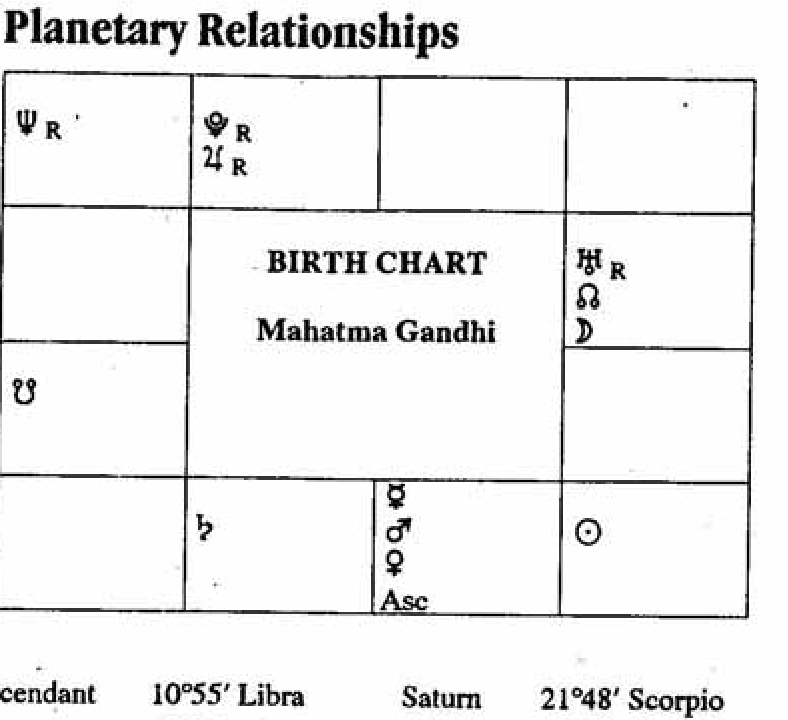 Mahatma Gandhi's birth chart — South-Indian square format; the Ascendant is 10°55′ Libra. Outer planets (Uranus, Neptune, Pluto) and the nodes are shown for reference, several retrograde ("R") (p125).
The chart's positions (AoS ch.5, p125): Ascendant 10°55′ Libra; Sun 18°23′ Virgo; Moon 29°38′ Cancer; Mars 27°51′ Libra; Mercury 13°13′ Libra; Jupiter 29°37′ Aries (R); Venus 25°54′ Libra; Saturn 21°48′ Scorpio; Rāhu 13°38′ Cancer; Ketu 13°38′ Capricorn; and (for reference) Uranus 27°04′ Aries (R), Neptune 27°50′ Pisces (R), Pluto 19°06′ Cancer (R).
The composite reasoning (AoS ch.5, p125–126):
- Sun in Virgo (a Mercury sign — natural neutral); temporally in the 12th, a friendly sign. Neutral + friend = friend.
- Moon in Cancer, its own sign.
- Mars in Libra (a Venus sign — neutral); temporally in the 1st, an inimical sign. Neutral + enemy = enemy.
- Mercury in Libra (a Venus sign — permanent friend); temporally in the 1st, inimical. Friend + enemy = neutral.
- Jupiter in Aries (a Mars sign — permanent friend); temporally 7th from Mars, inimical. Friend + enemy = neutral.
- Venus in its own sign (Libra).
- Saturn in Scorpio (a Mars sign — permanent enemy); temporally in the 2nd, friendly. Enemy + friend = neutral.
- Rāhu in Cancer (a Moon sign — permanent enemy); temporally 1st from the Moon, inimical. Enemy + enemy = great enemy.
- Ketu in Capricorn (a Saturn sign — permanent friend); temporally 3rd from Saturn, friendly. Friend + friend = great friend.
Planetary significators (the seven kārakas)
Another system unique to Vedic astrology turns the degrees a planet occupies in its sign into a hierarchy of life-significators (the chara kārakas). Take the seven major planets, ignore the signs, and rank them by degrees-and-minutes from highest to lowest (AoS ch.5, p126):
- Highest degrees → Ātmakāraka, "significator of the self." Like the Ascendant lord or a final dispositor, it may be the most powerful planet in the chart, the key to the soul's aspirations; especially read via its position in the harmonic-ninth (Navāṁśa) chart, often used as the Ascendant of the harmonic charts.
- Second → Amātyakāraka, "significator of the confidant" — the minister to the king, the one closest to us; inwardly the mind ("significator of the mind").
- Third → Bhrātṛkāraka, "significator of brothers" — inwardly will, energy, motivation ("significator of energy").
- Fourth → Mātṛputrakāraka, "significator of mother and children" — inwardly creativity ("significator of creativity").
- Fifth → Pitṛkāraka, "significator of the father" — inwardly one's role or dharma, the authority one follows, transmitted through the father ("significator of dharma").
- Sixth → Jñātikāraka, "significator of relatives" — inwardly our interchange with society ("significator of the world").
- Seventh → Strīkāraka, "significator of the wife/spouse" — inwardly our capacity for relationship, love, and affection ("significator of relationship").
One should examine each significator's condition for the domain it rules, especially in the harmonic charts (mainly the ninth, and the harmonic matching each kāraka — e.g. the brother-significator and the third harmonic); at minimum, examine the Ātmakāraka (AoS ch.5, p126–127).
Worked on Gandhi's chart by descending degree (AoS ch.5, p127): Moon 29°38′ → self (Ātmakāraka); Jupiter 29°37′ → mind; Mars 27°51′ → energy/brothers; Venus 25°54′ → creativity/mother-children; Saturn 21°48′ → dharma/father; Sun 18°23′ → world/relatives; Mercury 13°13′ → relationship.
The 27 lunar constellations (nakṣatras)
The chapter closes with the 27 nakṣatras, a cycle "quite different than that of the 12 signs." Each nakṣatra spans exactly 13°20′ of the zodiac (so 27 × 13°20′ = 360°). They are used more for the Moon, where the signs relate more to the Sun, though both can read any planet — and a planet benefits by being in its own lunar constellation (AoS ch.5, p128).
The nakṣatra list on p128 is plain typeset text (no diagram graphic), so it is reproduced in full below rather than cropped as a figure.
The 27 constellations with their extents and rulers (AoS ch.5, p128):
| # | Nakṣatra | Extent | Ruler |
|---|---|---|---|
| 1 | Aśvinī | 00°00′–13°20′ Aries | Ketu |
| 2 | Bharaṇī | 13°20′–26°40′ Aries | Venus |
| 3 | Kṛttikā | 26°40′ Aries – 10°00′ Taurus | Sun |
| 4 | Rohiṇī | 10°00′–23°20′ Taurus | Moon |
| 5 | Mṛgaśira | 23°20′ Taurus – 06°40′ Gemini | Mars |
| 6 | Ārdrā | 06°40′–20°00′ Gemini | Rāhu |
| 7 | Punarvasu | 20°00′ Gemini – 03°20′ Cancer | Jupiter |
| 8 | Puṣya | 03°20′–16°40′ Cancer | Saturn |
| 9 | Āśleṣā | 16°40′–30°00′ Cancer | Mercury |
| 10 | Maghā | 00°00′–13°20′ Leo | Ketu |
| 11 | Pūrva Phalgunī | 13°20′–26°40′ Leo | Venus |
| 12 | Uttara Phalgunī | 26°40′ Leo – 10°00′ Virgo | Sun |
| 13 | Hasta | 10°00′–23°20′ Virgo | Moon |
| 14 | Chitrā | 23°20′ Virgo – 06°40′ Libra | Mars |
| 15 | Svātī | 06°40′–20°00′ Libra | Rāhu |
| 16 | Viśākhā | 20°00′ Libra – 03°20′ Scorpio | Jupiter |
| 17 | Anurādhā | 03°20′–16°40′ Scorpio | Saturn |
| 18 | Jyeṣṭhā | 16°40′–30°00′ Scorpio | Mercury |
| 19 | Mūla | 00°00′–13°20′ Sagittarius | Ketu |
| 20 | Pūrvāṣāḍhā | 13°20′–26°40′ Sagittarius | Venus |
| 21 | Uttarāṣāḍhā | 26°40′ Sagittarius – 10°00′ Capricorn | Sun |
| 22 | Śravaṇa | 10°00′–23°20′ Capricorn | Moon |
| 23 | Dhaniṣṭhā | 23°20′ Capricorn – 06°40′ Aquarius | Mars |
| 24 | Śatabhiṣak | 06°40′–20°00′ Aquarius | Rāhu |
| 25 | Pūrvabhādra | 20°00′ Aquarius – 03°20′ Pisces | Jupiter |
| 26 | Uttarabhādra | 03°20′–16°40′ Pisces | Saturn |
| 27 | Revatī | 16°40′–30°00′ Pisces | Mercury |
Notice the ruler-sequence Ketu, Venus, Sun, Moon, Mars, Rāhu, Jupiter, Saturn, Mercury repeats three times (this nine-planet cycle is the basis of the Viṁśottarī daśā). The 27 come in three groups of nine: Aśvinī–Āśleṣā rule the first third of the zodiac, Maghā–Jyeṣṭhā the second, Mūla–Revatī the last (AoS ch.5, p128).
By precession, Vedic astrologers now place the vernal equinox in Uttarabhādra (no. 26); earlier records put it successively in Ashwini, Bharani, Krittika, Rohini, Mrigashira, Punarvasu, and perhaps further back, as the equinox moves backward through the zodiac in the precessional cycle (AoS ch.5, p128–129). A 28th nakṣatra, Abhijit, is sometimes inserted between Śravaṇa and Dhaniṣṭhā (nos. 22 and 23) (AoS ch.5, p129).
The chief use of the nakṣatras is determining the planetary periods (daśās); they are also used (like Western Sun signs) for personality types, and in marriage-compatibility, Horary, and Electional astrology to find favorable times for action (AoS ch.5, p129).