Home / Astrology of the Seers / Chapter 10
Medical Astrology
The book prints the Venus deity plate facing the opening of Part III (PDF p203):
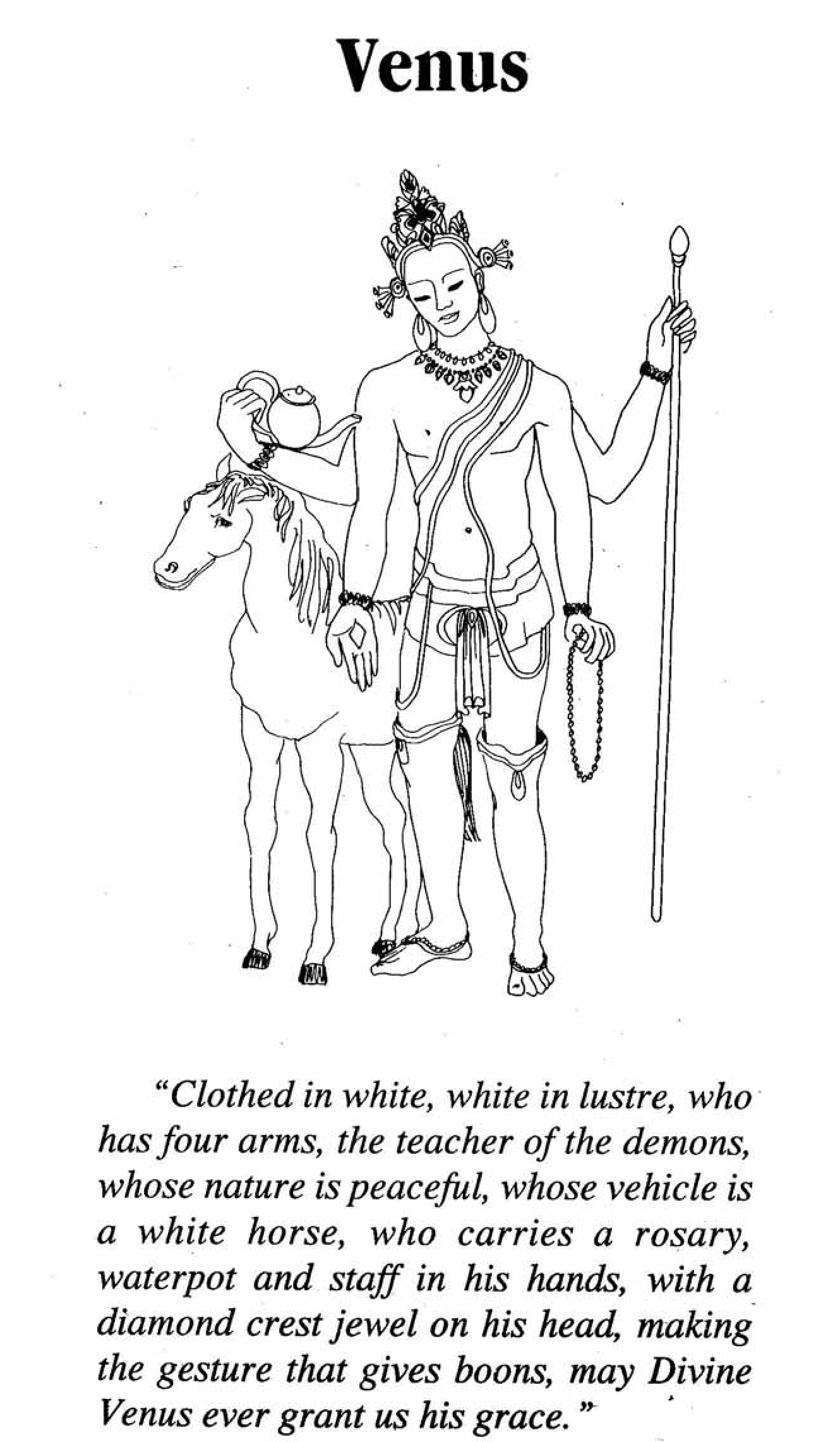 Venus (Śukra): "Clothed in white, white in lustre, who has four arms, the teacher of the demons, whose nature is peaceful, whose vehicle is a white horse, who carries a rosary, waterpot and staff in his hands, with a diamond crest jewel on his head…" (PDF p203). [classical]
This chapter opens Part III of the book, "The Application of Astrology," with its most practical branch: the astrology of healing. It is the first place Frawley brings Vedic astrology together with Āyurveda, the classical medical tradition of India, and the reader should keep in mind that the two are presented as sister sciences, not as one explaining the other. The doctrine here is mainstream Jyotiṣa and Āyurveda; where Frawley reports his own clinical experience or his mapping of the outer planets, that is tagged.
Āyurveda
Āyurveda is the classical medical tradition of India, its natural healing system, going back to the same ancient Vedic culture and science as Vedic astrology and standing in close relationship with it. Its scope is vast — it contains within it all forms of healing, from herbs and surgery to Yoga and psychology — and it aims not only at curing and preventing disease but at rejuvenation and the transformation of the mind. Its foundation is a system for determining individual constitution: ascertaining the unique nature and health needs of each person, and giving methods of treatment by which each individual can take responsibility for their own health, including many forms of self-care (AoS ch.10, p209).
Āyurveda and astrology
Āyurveda and Vedic astrology are related aspects of one Vedic science, "the all-comprehensive cosmic science of Yoga." Many astrologers in India have practiced Āyurveda, and many Vaidyas (Āyurvedic doctors) have been astrologers; even when not formally trained in the other discipline, each kind of practitioner refers to it. Frawley reports that he has studied and trained in both and found them to supplement each other well. Astrology gives the broader understanding of our energy patterns across the whole of life and all aspects of our nature — it is "a subtler healing science than any form of physical medicine" — while Āyurveda supplies astrology with an applicable, energetic system of medicine (diet, herbs) that uses the same model. He adds a working caution: anyone practicing medical astrology should have some training in a medical system, because astrology reads our nature so broadly that the specifics of daily or monthly fluctuations in physical problems may be hard to discern through it alone (AoS ch.10, p209–210). [modern: Frawley]
Astrology examines disease because it considers the entire life of man and all aspects of our being — body, mind, soul, and spirit — and there is a special branch of medical astrology dealing specifically with health problems, though never limited to the physical body in its examination or treatment. Health is the basis of all human endeavor; without it we lack the energy to accomplish anything, which is why health and longevity are often the first things examined in a chart. From the chart an astrologer can determine the basic physical constitution (appearance, the predominance of elements in the nature), calculate basic health, longevity and disease tendencies, and see which planets have the power to cause disease, what kinds of disease are likely, what parts of the body are likely to be affected, and when (AoS ch.10, p210).
Medical astrology
Medical astrology is one of the main branches of astrology, and — because it includes remedial measures for harmonizing planetary influences on body and mind — the most practical branch as well. It comprises the entire astrology of healing, and is useful not only for ordinary disease conditions but for diseases not curable by usual medical methods, giving a better picture and methodology for disease that comes from internal causes. Diseases, like all disharmonies in life, are associated with negative planetary influences, and there are several methods for balancing and harmonizing those influences (AoS ch.10, p210).
The foremost remedial method is gem-therapy, often allied with the color therapy from which it derives: the gem corresponding to a planet is used to redirect that planet's influence in a positive way. Alongside gems are mantras (words of power), yantras (power diagrams), and special rituals — pūjās and homas — and other Yogic methods of modifying planetary forces. These latter work more directly on the level of the mind and are particularly effective for mental and psychic disorders (on which most mental disorders are really based); they strengthen the aura and the immune system and clear out negative occult influences, which Frawley lists as ranging from past-life karma and the negative thoughts of others to subtle environmental pollutants like low-level radiation (AoS ch.10, p210).
Because the planets represent the basic energies operating in the cosmos — the prime qualities at work in all life — all of life can be arranged to counteract the negative planetary influences in a chart: the right diet, herbs, place to live, livelihood, and spiritual practices can all balance planetary forces. The worked example: Mars is a hot planet, and if too strong it causes heat disorders — fever, inflammation, infection — as well as traumas and injury; its influence is countered by cooling food, herbs, climate, colors, and the gems and mantras special to Mars (AoS ch.10, p210–211).
The three humors — location and function
Āyurveda classifies individuals and body types according to the three biological humors, each corresponding to the predominant element in the person (AoS ch.10, p211):
- The Air humor is Vāta, literally "what blows," the wind. It governs all movement in the body; directing the nervous system from the brain, it is responsible for the discharge of all impulses, and as the directing force it moves the other two humors. It allows for sensitivity, agility, and facility in the action of body and mind.
- The Fire humor is Pitta, "what cooks." It governs all transformation in the body from its primary seat in the small intestine as the digestive fire; it is responsible for heat and light (including all chemical reactions) and governs perception, judgement, and discrimination.
- The Water humor is Kapha, "what sticks." It governs all form and substance in the body from its primary seat in the stomach and lungs; it is responsible for weight, cohesion, and stability, and provides proper lubrication and the easy discharge of secretions.
Each humor also has a site of accumulation where its excess condition develops and from which it causes disease. Vāta (air) deranges from the colon, where it accumulates as toxic gas and spreads through the body deranging motion and nervous function, creating "wind" diseases like arthritis, paralysis, and other nervous disorders. Pitta (fire) accumulates in the small intestine as hyperacidity or excess bile, then enters the blood and spreads as toxic heat, causing inflammatory and infectious disorders. Kapha (water) accumulates in the stomach and lungs as mucus and spreads to create diseases of excess phlegm, fat, and water — edema, asthma, and bronchitis (AoS ch.10, p211).
The characteristic types
Frawley then gives extended portraits of the three constitutional types — physical build, physiology, temperament, talents, and the planets that rule each — so the reader can recognize them. (This is Āyurvedic typology with the planetary correspondences woven in.)
Air types (Vāta)
Air types are usually tall or short, seldom average — often thin and bony, with poorly developed muscles and prominent veins. The skin is dry, cracked, rough, usually brown or dusky. The teeth are often not well formed, crooked, or spaced. Digestion is variable (great appetite at times, absent at others); they often do not realize they are hungry until starving, and may need to eat every two or three hours to stay grounded; they frequently suffer constipation, abdominal distention, and gas. Urine is scanty, perspiration slight. They are light sleepers prone to insomnia, restless dreams, and fearful nightmares, and are sensitive to cold, wind, and dryness — "in short, they are dominated and agitated by Saturnian influences" (AoS ch.10, p212).
Physically they are active and energetic, enjoying speed (running, flying, skiing), yet they tire easily and lack stamina; athletic in youth but lacking endurance, they easily get muscle spasms or stiffness and commonly develop arthritis (Saturn's influence on the bones and muscles). They are the weakest type physically, suffering quickly from overwork and prone to chronic disease and nervous disorders (the influence of Saturn and Rāhu). Mentally they are quick, agile, and often talkative, commonly highly intellectual and able to understand many points of view (their Mercury is often strong), though sometimes superficial and mechanical in talk; their will is usually indecisive, wavering among the many opinions they know. They make good schoolteachers, computer programmers, and media workers, and are good at thinking, writing, and organizing data (mercurial occupations) and at music (though oversensitive to sound). They can be highly social (strong Mercury), but when air is too high (Saturn and Rāhu) they become loners — usually because they have too much to say and don't know how to relate it, not from a truly solitary nature (AoS ch.10, p212–213).
Air types suffer most from fear — anxiety, depression, ungroundedness, instability. They get spaced-out, absent-minded, with short-term or erratic memory; not entirely present in their bodies, they can be clumsy (largely from susceptibility to Rāhu, the north node of the Moon). Yet when well developed they possess the greatest agility of body and mind. The rule for approaching them is "treat them like a flower": they easily feel frightened and withdraw if approached forcefully (AoS ch.10, p213).
Fire types (Pitta)
Fire types are usually of average height or build, with well-developed muscles and good (often flushed or red) skin color that is prone to acne, rashes, and inflammatory disorders and is usually oily. Their eyes redden or inflame easily and are sensitive to sunlight (they often need glasses). Hair is thin, tending to early greying or balding, and is often red or blond; gums are soft and bleed easily. They are sensitive to heat and prefer cooling things. Appetite is good, sharp, or excessive; discharges (feces, urine, mucus) tend to yellow and large, colored by an excess of bile, with loose stool or diarrhea more common; they sweat easily, with malodorous sweat and discharges, and bruise and bleed more readily than others. Sleep is moderate but not always good, with many violent or disturbing dreams — "in short, their nature is dominated by Mars" (AoS ch.10, p213).
Temperamentally they are prone to anger, may be aggressive or domineering, have strong wills and can be overly impulsive or self-willed (strong Sun and Mars); they like to lead but can be fanatic or insensitive, like the use of force, and may incline to argument or violence. They like color, drama, and passion (orators, singers, painters, dancers). They are very intelligent, perceptive, and discriminating — good scientists with a grasp of mechanics and mathematics, liking tools, weapons, and chemistry; with probing minds good at research and invention, and good psychologists, they may have the deep insight that goes with Ketu, the south node of the Moon. Most military persons and policemen are fire types (Mars being strong for them), good at law and punishment; most lawyers and politicians are of this type. Yet they may lack compassion and struggle to see another's point of view (AoS ch.10, p213–214).
They must be approached with tact — they dislike being directed or told what to do. One appeals to their native intelligence, discrimination, and logic; opposing them only feeds their aggression. They like to work in friendship or common alliance toward a goal, and it is by commonality of goal that they are guided (AoS ch.10, p214).
Water types (Kapha)
Water types are usually short and stocky (sometimes tall, but always large-framed), with thick skin and well-developed flesh, tending to corpulence or obesity and holding excess weight and water unless they work hard against it. Chests are well developed; eyes large, white, and attractive with large lashes; hair abundant and thick; teeth large, white, and attractive. They sleep easily, often excessively, and may be lazy; they suffer from cold and dampness but have strong endurance. They accumulate phlegm and suffer most from bronchial and pulmonary disorders, edema, and weak kidneys, and are most prone to overweight — from the influence of the Moon or Jupiter which rules them (AoS ch.10, p214).
Emotionally they have much love, devotion, and loyalty (the Moon and Venus), but also much desire and attachment, and may be greedy (Venus and lower Jupiterian influences); they are romantic, sentimental, may cry easily and superficially, and are possessive and clinging. They are conservative, traditional, and conventional, liking to belong and seldom rebelling; largely contented, stable, but apt to stagnate; they dislike change and find it hard even when wanted. Friendly with those they know and close to family, they have difficulty relating to strangers or foreigners and, while reluctant to hurt others, are often insensitive to others' needs and "do not take hints," frequently needing confrontation or criticism to get moving. Mentally slower than the other types but retentive (needing much repetition to learn), they are seldom creative or inventive but excel at carrying things out and making them practical — better at finishing ideas than developing them, and good at bringing things into form and creating institutions. They make good parents and providers (good mothers and wives, owing to the lunar influence), good cooks and homemakers (the men may be chefs); with their large chests and good voices they make good singers; they like to accumulate and hold wealth, excelling at real estate and banking. They must be approached firmly — shocked into action with force, determination, and consistency (AoS ch.10, p214–215).
Frawley closes the typology with an important qualification: astrology is not quite this general, because it has not three but nine types, relative to the influences of the nine planets, and its delineation of character and body type through the planets is more specific than the threefold humoral scheme (AoS ch.10, p215). [modern: Frawley]
The three humors and the four elements
Āyurveda employs three humors, essentially the same as the three elements Air, Fire, and Water. Astrology uses four elements (adding Earth); Āyurveda tends to include the Earth under the Water humor (AoS ch.10, p215).
Vedic astrology classifies the planets by the three humors as follows (AoS ch.10, p215):
- Vāta / Air — Saturn, Rāhu, Mercury
- Pitta / Fire — Sun, Mars, Ketu
- Kapha / Water — Moon, Venus, Jupiter
The distant (outer) planets are classified similarly by Frawley: Uranus is Vāta/air (a higher octave of Mercury), Pluto is Pitta/fire (a higher octave of Mars), and Neptune is Kapha/water (a higher octave of Venus) (AoS ch.10, p215). [modern: Frawley] As to which planets most cause each kind of disorder: Saturn and Rāhu are most responsible for Vāta (air) disorders, Mars and Ketu for Pitta (fire) disorders, and the Moon and Jupiter for Kapha (water) disorders (AoS ch.10, p215).
The humors of the signs — by element
The twelve signs are classified by the three humors, with the air, fire, and water signs generally representing the corresponding humors (AoS ch.10, p216):
- Air signs — Gemini, Libra, Aquarius
- Fire signs — Aries, Leo, Sagittarius
- Water signs — Cancer, Scorpio, Pisces
- Earth signs — Taurus, Virgo, Capricorn
The earth signs are divided among the three humors (though generally thought to possess all three), each assigned by reasoning from its quality: fixed earth, Taurus, is more commonly water (water being fixed in quality — and the watery Moon is exalted in Taurus); mutable earth, Virgo, is more commonly air (air being mutable); cardinal earth, Capricorn, is more commonly fire (fire being cardinal — and the fiery Mars is exalted in Capricorn). This yields the working order (AoS ch.10, p216):
- Biological Air humor (Vāta) — Gemini, Virgo, Libra, Aquarius
- Biological Fire humor (Pitta) — Aries, Leo, Sagittarius, Capricorn
- Biological Water humor (Kapha) — Taurus, Cancer, Scorpio, Pisces
The signs also carry secondary characteristics, and some are dual in nature. The first six signs are single and fairly clear; the second six are dual and can go either way (AoS ch.10, p216):
- Aries — Double Fire (primary and secondary fire)
- Taurus — Double Water
- Gemini — Double Air
- Cancer — General Water (represents the water element in the body in general)
- Leo — General Fire (fire in the body in general)
- Virgo — General Air (air in the body in general)
- Libra — Air and Water
- Scorpio — Water and Fire
- Sagittarius — Fire and Water
- Capricorn — Fire and Air
- Aquarius — Air and Fire
- Pisces — Water and Air
The humor of the signs — by ruling planet
By the general rule that planets matter more than signs for determining the nature of things (the signs indicating more the field of action, and often the site of disease), some astrologers classify the humor of each sign instead by its ruling planet (AoS ch.10, p216–217):
- Aries, Leo, Scorpio are Fire, ruled by the fiery planets Mars and the Sun.
- Taurus, Cancer, Libra, Sagittarius, Pisces are Water, ruled by the watery planets Venus, the Moon, and Jupiter.
- Gemini, Virgo, Capricorn, Aquarius are Air, ruled by the airy planets Mercury and Saturn.
Note the two schemes diverge — e.g. Scorpio is a Water sign "by element" and "by secondary" reading but Fire "by ruling planet" (Mars). Frawley does not fully reconcile them; he treats them as alternative emphases rather than a single fixed assignment.
From his own experience, Frawley adds that Scorpio, a water sign by element, is generally Pitta in nature, since in Āyurveda the fire humor Pitta has water or oil as its base; the Moon in Scorpio is usually Pitta (fiery and agitated) (AoS ch.10, p217). [modern: Frawley]
Determining the constitution astrologically
The single most important factor for individual constitution is the Ascendant (First house), which governs physical incarnation generally — people usually follow the Ascendant in their physical type — but this is only a general rule and other factors weigh in. Planets in the First house are important: Mars on the Ascendant, for example, often makes a person fiery, especially if it also aspects the lord of the Ascendant. One must also weigh the influences upon the Ascendant and upon its lord, and the Sun as the significator of the First house (AoS ch.10, p217).
It is good to examine the Sun more for men and the Moon more for women as indicating physical type; however, when the Moon is stronger than the Ascendant it may determine the type even for men. Conjunctions of planets with the Sun or Moon are significant — Mars conjunct the Sun often makes a person fiery. Planets in the Sixth house, or aspecting it and its lord, also affect the constitution by shaping the disease tendency and general digestive power (AoS ch.10, p217).
The main rule: the planet with the greatest strength of influence on the bodily factors — the First and Sixth houses, their lords, the Sun and Moon and their rulers — generally determines the physical type; and if two planets of the same humor (e.g. the Moon and Jupiter, both water) strongly affect these factors, the judgement is more assured. In other words, the Āyurvedic constitution usually follows the nature of the strongest planet in the chart, or the planetary type the person represents. Frawley stresses this is a complicated matter beyond the scope of the chapter, presuming knowledge of both astrology and medicine; one should be cautious in judging constitution from the chart alone — a photograph, medical history, or Āyurvedic questionnaire can be very helpful, since astrology considers far more than health, and it is often hard to know which chart factors most specifically affect the body (AoS ch.10, p217–218). [modern: Frawley]
Disease-causing planets
Malefic planets, whether natural or temporal, promote disease. The natural malefics, in order of their power to cause disease, are Rāhu, Saturn, Ketu, Mars, and the Sun. The temporal malefics, in order of their disease-causing power, are the lords of the Sixth, Eighth, Eleventh, Third, and Twelfth houses. Planets that are weak also cause disease, or become the sites of disease — benefics as well as malefics (AoS ch.10, p218).
Planets cause disease chiefly by occupying malefic houses, which (in order of power) are the Sixth, Eighth, Twelfth, Third, and Eleventh — planets in the first three of these being especially strong in this regard. Malefics are reckoned strong in the Sixth house, but that strength is mainly for power, prestige, and wealth; they can still cause disease, particularly under negative aspects (AoS ch.10, p218).
House location must be read together with a planet's strength by sign and by planetary relationship. The Moon in the Sixth in Cancer would give good health, but in Scorpio would more likely cause problems such as hyperacidity (a Pitta disorder); and the Moon in Cancer in the Sixth, weak in brightness and aspected by Saturn and Rāhu, would doubly cause disease, since both the Sixth house and its ruler would be strongly afflicted (AoS ch.10, p218).
Planetary lords
Malefic house-lords are strong to cause disease, each according to its house (AoS ch.10, p218):
- The lord of the Sixth causes injury, accidents, acute diseases, low vitality, poor digestion, and poor resistance.
- The lord of the Eighth causes poor vitality, chronic and wasting diseases, including premature death.
- The lord of the Eleventh functions like the lord of the Sixth, but with less power.
- The lord of the Third functions like the lord of the Eighth, but with less power.
- The lord of the Twelfth causes sorrow, grief, and emotional disorders, and shows confinement to a bed or hospital — often a chronically sick person.
Signs and houses — the parts of the body
The signs and the houses each correspond to certain parts of the body, in the standard head-to-foot order (AoS ch.10, p219):
| Sign | House | Body part |
|---|---|---|
| Aries | First | Head |
| Taurus | Second | Neck |
| Gemini | Third | Upper chest |
| Cancer | Fourth | Breasts |
| Leo | Fifth | Solar plexus |
| Virgo | Sixth | Navel region |
| Libra | Seventh | Lower abdomen |
| Scorpio | Eighth | Pubic region |
| Sagittarius | Ninth | Thighs |
| Capricorn | Tenth | Knees |
| Aquarius | Eleventh | Calves |
| Pisces | Twelfth | Feet |
The diagnostic rule: if both the sign and the house of the same number are afflicted, the bodily part corresponding to them is likely to be afflicted. For example, if Saturn aspects the ninth sign, the Ninth house, and their rulers, arthritis or paralysis of the hip is likely; if Saturn aspects the Fifth house, the Fifth from the Moon, and their rulers, there is apt to be infertility in women, with possible surgery or hysterectomy (AoS ch.10, p219).
Frawley then makes the correspondences more specific (AoS ch.10, p219–220):
- Aries / First — head, brain, and eyes (the front of the head down to the eyes, and the back to the base of the skull).
- Taurus / Second — face, the upper neck to the larynx, and the back of the neck to the shoulders, including the cerebellum.
- Gemini / Third — shoulders, upper arm, and upper chest, including the lungs.
- Cancer / Fourth — the front of the chest to the rib border and the elbows, including the stomach; the breasts are included here.
- Leo / Fifth — the solar-plexus region and the mid and upper back, including the small intestine, and bodily vitality in general via the heart.
- Virgo / Sixth — the mid-abdomen and the hands, including the colon; they govern the digestive system generally, as well as bodily health as a whole.
- Libra / Seventh — the lower abdomen and the lumbar region, including the kidneys and internal genitalia.
- Scorpio / Eighth — the sacrum, rectum, bladder, and external sex organs.
- Sagittarius / Ninth — the arteries, as well as the lower back, hips, and thighs.
- Capricorn / Tenth — the bones and joints, as well as the knees.
- Aquarius / Eleventh — the power of exhalation, the skin, as well as the calves.
- Pisces / Twelfth — the lymphatic system, as well as the feet.
The sixth sign and sixth house
The Sixth house and the sixth sign, Virgo — which govern the digestive nerves — are particularly important for determining disease potential. The Sun in Virgo with the Sixth house afflicted gives chronic poor digestion; the Sun in the Sixth house aspected by malefics likewise gives long-term digestive problems, as will any poorly placed planet in the Sixth; and Rāhu's aspect on the Sixth house and sixth sign gives variable, weak, and nervous digestion (AoS ch.10, p220).
The Sixth house and sign represent our basic health and purity. Afflicted, they show disease and the accumulation of waste materials; they indicate how we are connected to our bodies and the way we care for them. Afflicted, they show devitalization, which usually comes through our own wrong habits — bad diet, insufficient rest, excessive sexual indulgence — though they may also indicate congenital weakness (AoS ch.10, p220).
Virgo governs Vāta, the biological air humor, in the body in general. Because most diseases are of the air humor and arise through weak digestion, planets in this sign tend to cause disease; on the other hand, planets here that are more benefically disposed can make one a healer (sometimes our own diseases are what turn us toward healing). Virgo, in sum, shows service to the physical body — our own or that of others (AoS ch.10, p220). [modern: Frawley]