Home / Astrology of the Seers / Chapter 3
The World-Ages: The Cycles of the Yugas
This chapter steps back from the chart of an individual to the largest timescale Vedic thought works with: the yugas, the world-ages through which whole humanities rise and fall. It opens with a verse from the Ṛg Veda — "Who knows now and who can declare which are the paths that lead to the Gods. Only their lower habitations are visible, who dwell in regions of supreme mystery" (Ṛg Veda III.54.5) (AoS ch.3, p50). [classical]
Frawley's framing premise is that life on Earth is governed by "vast cosmic forces that originate from the stars" — not only the physical distances of modern astronomy but "distant recesses of the cosmic mind." Just as there are seasons in a year and stages from youth to old age, each person, nation, religion, humanity, and the planet itself runs through its own cycle of birth, growth, decay, and death — in mind and soul as much as in body. Yet the round is not merely mechanical: behind the cycle of time runs "an ongoing evolution of consciousness," so that like a tree advancing year by year through its seasonal cycles, all things grow inwardly life after life (AoS ch.3, p50). [modern: Frawley]
The lesser cycle of world-ages
The main cycle Frawley assigns to the human race is the precessional cycle — the slow wobble of the equinoxes — a period of "about 25,000 years" he proposes we treat as "one year in the life of humanity." Some Vedic astrologers, he says, read this period as the revolution of the Sun around a dark companion star: the Sun is taken to be a double star whose partner is a lightless dwarf. He notes that modern astronomers have postulated just such a distant body to explain irregularities in the orbits of Neptune and Pluto (AoS ch.3, p50–51). [modern: Frawley]
Alongside our own Sun, Frawley says, Earth receives light from the center of the galaxy — the "galactic Sun" — much of it in non-visible frequencies, possibly a central quasar-like source obscured by dust. In his synthesis this galactic light "nourishes and sustains intelligence in human beings" — not materialistic intellect but true intelligence, the capacity to perceive the Divine spirit in things and act according to the Divine Will (AoS ch.3, p51). [modern: Frawley]
The mechanism he proposes ties the two ideas together. When the Sun is on the side of its orbit where its dark companion comes between it and the galactic center, reception of that cosmic light is greatly reduced, producing a dark or materialistic age. When the Sun is on the opposite side, with open reception of the galactic Sun, there is a spiritual or Golden Age, and humanity acts in harmony with cosmic intelligence and the Gods. The dark companion thus acts like a "negative magnetic field" obstructing the galactic light, creating the cycles of advance and decline in civilization (AoS ch.3, p51). [modern: Frawley]
The length of the cycle, and the four ages
Frawley gives several figures for the precessional cycle:
- Modern astronomy: about 25,900 years (the rate of precession is not fixed, so this is approximate).
- Manu, the Vedic lawgiver, in the Manu Saṁhitā (I.68–71; cf. Sri Yukteswar, The Holy Science, p11): 24,000 years (2 × 12,000, or 100 × 240). [classical]
- Other Vedic astrologers: 25,920 years (108 × 240; 108 being "the occult or mystic form of the number 100").
The four legendary ages — the Golden, Silver, Bronze, and Iron — appear among the Greeks as well as the Hindus, though the Greeks gave no time period. In Sanskrit they are the yugas: Satya ("truth," also called the fourth age), Treta ("the third"), Dvāpara ("the second"), and Kali ("the first") (AoS ch.3, p51–52).
Manu fixed their durations as, respectively, 4000, 3000, 2000, and 1000 years, each with a transitional period of one-tenth of its own length both before and after it. Adding the two transitions to each age gives [classical]:
- Golden Age (Satya): 4000 + 400 + 400 = 4800 years
- Silver Age (Treta): 3000 + 300 + 300 = 3600 years
- Bronze Age (Dvāpara): 2000 + 200 + 200 = 2400 years
- Iron Age (Kali): 1000 + 100 + 100 = 1200 years
The four ages total 12,000 years, and two such cycles make up the 24,000-year precessional cycle (AoS ch.3, p52). The 4:3:2:1 ratio of the ages is the structural heart of the doctrine.
Ascending and descending halves
Each precessional cycle divides into two halves. In the ascending half the Sun moves toward the point of its orbit closest to the galactic center; in the descending half it moves toward the point farthest from it. So the full sequence runs: ascending Iron → Bronze → Silver → Golden, then descending Golden → Silver → Bronze → Iron. Crucially, in this system one does not jump straight from the dark age to the Golden Age (as some interpretations claim) but must pass through every intermediate age (AoS ch.3, p52). [modern: Frawley]
The level of true intelligence on Earth is said to diminish by one quarter for each age: 100% at the height of the Golden Age, 75% in the Silver, 50% in the Bronze, and 25% at the low point of the Iron Age. This is symbolized by the Bull of the dharma (truth), who loses one leg in each yuga (AoS ch.3, p52). [traditional]
Where we are now
According to some Vedic astrologers, the Sun's orbital point farthest from the galactic center fell around 500 A.D., when the vernal equinox sat at the first degree of the constellation Aries — "the point of greatest darkness on Earth," since which time the light has been gradually increasing. Variant views place this between 200 and 550 A.D., the same uncertainty as the ayanāṁśa (the precessional offset). Frawley notes this is later than the Western reckoning, which puts the equinox at the start of Aries around the time of Christ. Consequently, while many Western astrologers place us in the Age of Aquarius now, Vedic astrologers would put it up to 500 years in the future (AoS ch.3, p52–53). [modern: Frawley]
Following Sri Yukteswar's The Holy Science (p12–13), Frawley gives the historical dates of the four ages on their descending and ascending arcs (AoS ch.3, p53):
| Age | Descending | Ascending |
|---|---|---|
| Golden | 11,501 B.C. – 6701 B.C. | 7699 A.D. – 12,499 A.D. |
| Silver | 6701 B.C. – 3101 B.C. | 4099 A.D. – 7699 A.D. |
| Bronze | 3101 B.C. – 701 B.C. | 1699 A.D. – 4099 A.D. |
| Iron | 701 B.C. – 499 A.D. | 499 A.D. – 1699 A.D. |
Counting the transitional periods, there is an intermediate age between the Iron and Bronze Ages at 1599–1899 A.D. By this reckoning we are now in the ascending Bronze Age (Dvāpara Yuga) — "the New Age we have just entered," evidenced by the great advances in science and technology. It is no longer the dark Iron Age, as some still think, yet far from the Golden Age; and it is in its early stages, its full form perhaps not arriving for a few centuries, when the vernal equinox actually enters Aquarius. Until then the move into the new era brings difficulties — wars, pollution, famine, possible cataclysms. Frawley stresses the whole system is approximate but useful for understanding human history (AoS ch.3, p53). [modern: Frawley]
The greater cycle of world-ages
Against his own precessional model Frawley sets the more commonly known Hindu view: that humanity is in a Kali Yuga of 432,000 years, said to have begun in 3102 B.C. He treats this longer cycle skeptically — calling it "a speculation of medieval thinkers" with several problems, "not to mention how pessimistic it appears." His chief objection is historical: ancient texts name many kings and sages not only of the Bronze Age but of the Golden and Silver (Satya and Treta) Yugas; if the long cycle were meant, such people would have had to live hundreds of thousands or millions of years ago (AoS ch.3, p53). [modern: Frawley]
His worked example is Rāma, a figure of Treta Yuga (the Silver Age), placed in the Purāṇic king-lists some 35 generations before Kṛṣṇa. If a 432,000-year Kali Yuga began at 3100 B.C., Rāma would have had to live at least 868,000 years before that to fall in the long-cycle Treta — implausible. On the precessional reckoning of Sri Yukteswar, by contrast, Treta Yuga falls roughly 6700–3100 B.C., "which is much more likely" (AoS ch.3, p53–54). [modern: Frawley]
He reconciles the two by allowing cycles within cycles — as a day sits within a month within a year. Beyond the 24,000-year precessional cycle there are longer cycles of hundreds of thousands and millions of years. So we may indeed be in a greater Kali Yuga / Iron Age phase (perhaps 432,000 years, "though I am not certain that this is its duration"), while within it we sit in a lesser-cycle Bronze Age phase of some 2400 years (AoS ch.3, p54). [modern: Frawley]
Frawley reads the present as a greater dark-age phase on evidence of human consciousness: even in the lesser cycle's Golden and Silver Ages (as the Vedas attest), the great majority of people remained on a "materialistic or vital plane," concerned with family, wealth, and personal happiness; only a small "cultural elite" enjoyed the full benefit of the ages of light — just as today only a few really understand the secrets of science though all benefit from them. He adds that the greater Iron Age may not have begun in 3102 B.C.; we may lack the information to know when it started or how far in we are (AoS ch.3, p54). [modern: Frawley]
He blames much "occult" confusion of history on conflating the two cycles: H.P. Blavatsky and her line, basing themselves on the same Hindu texts that used the longer cycle without understanding precession, made ancient civilizations many times longer than they probably were — while modern historians, lacking spiritual sensitivity, make them many times shorter. The truth, he holds, is that ancient civilizations like India "go back at least ten thousand years" (AoS ch.3, p54). [modern: Frawley]
Cycles of humanity
A guiding principle: a culture cannot apprehend any culture higher than itself in the cycle of world-ages. Our recorded history really only reaches back to the Bronze Age cultures that began around 3100 B.C. — Egypt, Babylonia, Assyria, the matrix of Greek civilization, which were typical of the whole world then. Earlier Silver- and Golden-Age cultures existed but cannot be found because we do not understand the level on which they existed: highly spiritual but not so technologically advanced. Cultures of the previous precessional cycle, before 12,000 B.C., we are unaware of at all — their traces "largely eliminated by the Ice Age and the flood which followed its end" (AoS ch.3, p54–55). [modern: Frawley]
Such cycles of human cultures have recurred many times. Civilizations may have existed for tens of thousands of years, "probably for at least two hundred thousand years," and by some accounts it may take up to a million years of evolution for the average soul to pass through the human domain — making the human race possibly quite young even at several hundred thousand years (AoS ch.3, p55). [modern: Frawley]
Frawley argues that technology in its current polluting form is "a rare and transient phase," unable to last more than a century or two without destroying the planet; if earlier humanities had it, they passed through it quickly and the damage was cleaned up — which is why no remains survive. He holds that the majority of human cultures have always been religious and spiritual rather than materialistic, and that gross, environment-disrupting technology may be a temporary deviation from genuine human culture, "which is that of the spirit" (AoS ch.3, p55). [modern: Frawley]
Each precessional cycle marks a different age of humanity. The present one began with the end of the Ice Age over ten thousand years ago; its early Golden and Silver Ages are recorded in the hymns of the Ṛg Veda, the oldest scripture of India, with traces in mythologies worldwide and in the ancient solar religion. What archaeologists call the beginning of agriculture and civilization was probably merely a shifting of culture driven by geological and climatic change at the new age's onset (AoS ch.3, p55). [modern: Frawley]
On the Vedic view the Earth undergoes major changes of geography and climate, experienced by humans as cataclysms — earthquakes and floods recorded in books like the Bible and the Vedas, often dismissed as superstition but supported by physical evidence. Frawley cites recent archaeology finding the coast of western India sank up to 200 feet around 1500 B.C., and the now-dry bed of the Vedic Sarasvatī, traceable from aerial photographs, which once flowed "five miles wide" through what is now the Rajasthan desert. Such cataclysms usually coincide with changes of world-age, periodically clearing out the influences of previous humanities — another reason their traces vanish (AoS ch.3, p55–56). [modern: Frawley]
It is hard for one world-age's humanity to perceive a previous one. The present humanity, Frawley says, "originated with certain seed cultures in the Himalayas during the end of the Ice Age"; the previous world-age humanity was Atlantean. The existence of such prior ages is accepted only by students of the occult and is much disputed — some claims rest on "racial memories" that can be subjective — yet the existence of cultures long before our supposed beginnings of history is, to those of deeper perception, beyond doubt (AoS ch.3, p56). [modern: Frawley]
Ascending and descending cycles
The two halves of the precessional cycle differ in mentality: in the descending half spiritual energy is retreating from fullness; in the ascending half it is increasing from deficiency. It is hard for ascending cultures to understand descending ones (AoS ch.3, p56).
Descending cultures — like those of the Orient — are traditional, conservative, authoritarian, trying to preserve the light of truth from past ages. Ancient Egypt was typical: it grew so enmeshed in its cult of the past, which became a cult of death, that it perished of its own inertia. Ascending cultures are non-traditional, liberal, revolutionary, moving toward a future light not yet defined. Western culture rests on Greco-Roman influences that do not predate 500 B.C. and only fully surfaced at the Renaissance, so it cannot understand cultures from earlier worldviews. America is a more limited ascending culture, its origins only a few centuries old — "basically an ascending Bronze Age or Dvāpara Yuga culture," seeking light and truth but superficially (AoS ch.3, p56–57). [modern: Frawley]
This produces the natural hostility between descending/traditional and ascending/non-traditional cultures seen in the world today. Descending cultures rest on a higher spiritual truth that has often gone rigid and stereotyped, misrepresenting its origin (Frawley's example: the caste system in India); ascending cultures are open and creative, with freedom of inquiry, but often arbitrary and far from any real basis in truth — "immature, materialistic, and sensate oriented." What is needed is to combine both positively: the freedom and humanitarianism of the ascending mind balanced by the reverence and spirituality of the descending mind. The strong divisions of East and West, spiritual and material, ancient and modern, mark this challenge (AoS ch.3, p57). [modern: Frawley]
Beyond time
Within all these cycles runs an ongoing human evolution, "a spiral of growth": even if humanity falls for a time, it rises again with new force, and though we have fallen spiritually from early ancient cultures, what we have gained materially and intellectually may enhance our ascent back. Ultimately humanity moves toward the point of transcending all external influences and living in a perpetual Golden Age — a return to the inner Self that stands above time. No one can say when this leap will occur; it is possible at any moment but so far rare for individuals to transcend the times they live in. Some can see the potentials of our own world-age, fewer those of more advanced ages, fewer still "the eternal which is our real home" — but even one such soul becomes a beacon for all humanity and "shakes the foundation of the ignorance which rules us" (AoS ch.3, p57). [modern: Frawley]
Harmonization with the galactic center
Frawley flags "an important cosmic event occurring now": the winter solstice is in conjunction with the galactic center. He places the galactic center at 06°40′ Sagittarius sidereally (about 29° Sagittarius tropically), putting it presently one degree from an exact conjunction with the winter solstice — the conjunction becoming exact in 50–100 years (AoS ch.3, p58). [modern: Frawley]
This, he holds, should cause a slow harmonization of humanity with the Divine will transmitted from the galactic center. Much of the new spiritual thinking and the potential cataclysmic changes may belong to this attunement, which "insists we enter into a new ascending age of light." Some global shock and suffering must be endured, but the outcome can only be good; he urges faith in the Divine will rather than fear (AoS ch.3, p58). [modern: Frawley]
He sets this against a mirror event in the past: by Plato's account the flood that destroyed Atlantis (and probably ended the Ice Age) occurred about 9300 B.C. (9000 years before Plato), which appears to have been when the summer solstice was conjunct the galactic center — the point exactly opposite today's. Hence, he concludes, more reverence for the Divine and cosmic powers would benefit our culture; it was not mere superstition that made the ancients tremble before God, but possibly experiences of "global retribution" under cosmic laws we may yet see again (AoS ch.3, p58). [modern: Frawley]
The star Vega
Ancient and oriental astrology weights the pole star heavily, holding the north pole to be "the spiritual pole of the globe" from which higher influences enter the planet. But the pole star changes through the precessional cycle: at the opposite side of the cycle — the point of greatest light — the bright star Vega (alpha Lyrae) marks the north pole (AoS ch.3, p58). [traditional]
Vega belongs to a special Vedic constellation called Abhijit, "complete victory," said to be ruled by Brahmā, the cosmic creative power — and it is "the only one of the lunar constellations far from the zodiac." (In standard Jyotiṣa, Abhijit is an additional, intercalary nakṣatra beyond the usual twenty-seven, lying off the ecliptic.) (AoS ch.3, p58). [traditional]
Frawley adds that Vedic astrology shows a connection between our Sun and Vega: Vega may be "a controlling star for our Sun, its guide," or our Sun may revolve around it (or with it around some greater center). Vedic astrology looks back some fifteen thousand years ago when Vega was the north pole star. Apart from the galactic center, Vega may be the other point of light governing life and spiritual evolution on Earth. He closes with Kṛṣṇa's words in the Bhagavad Gītā: "Of the constellations, I am Abhijit" (AoS ch.3, p59). [classical]
The book prints the Mars deity plate at the close of Part I (PDF p61, facing the opening of Part II):
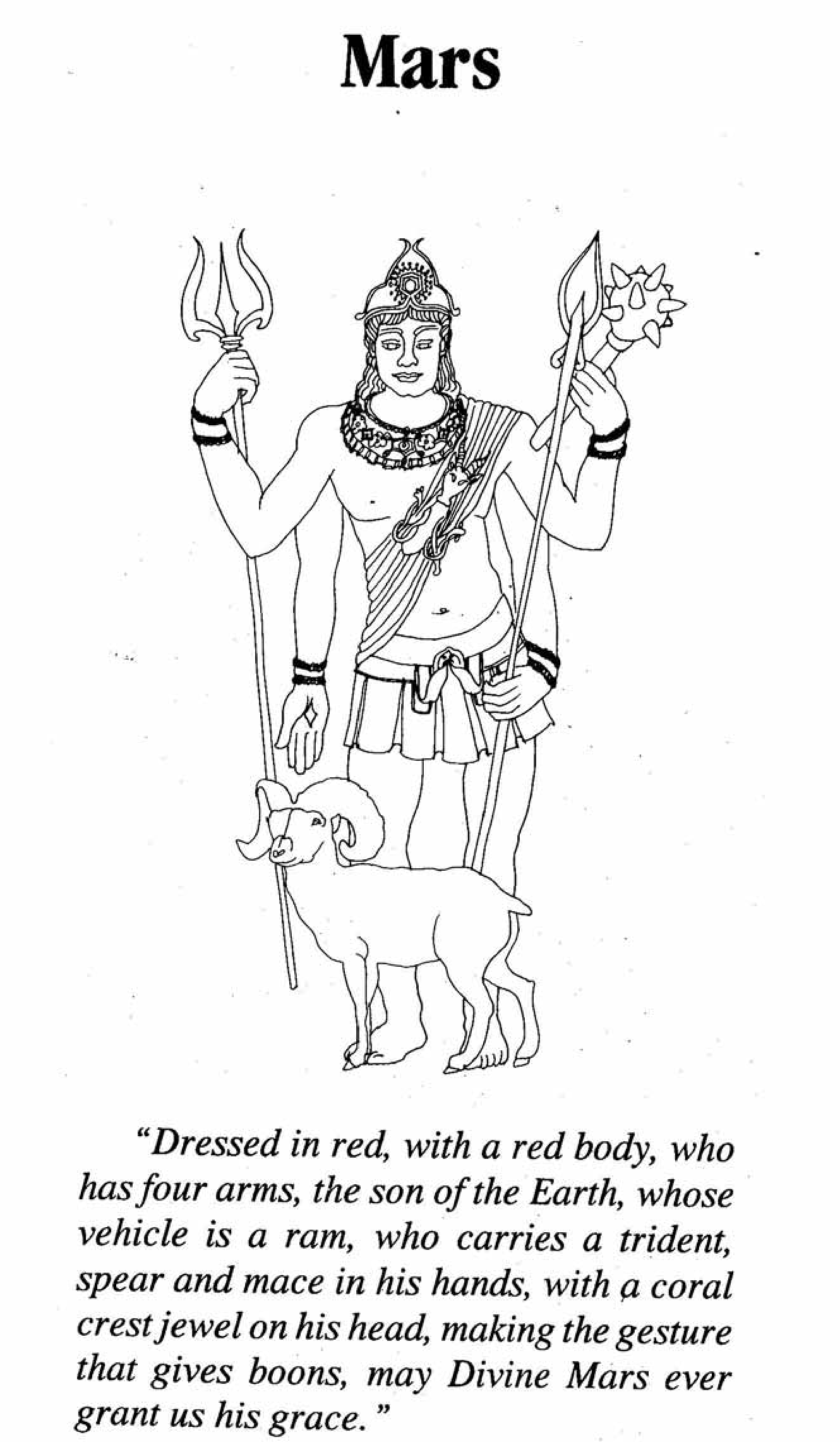 Mars (Maṅgala): "Dressed in red, with a red body, who has four arms, the son of the Earth, whose vehicle is a ram, who carries a trident, spear and mace in his hands, with a coral crest jewel on his head, making the gesture that gives boons…" (PDF p61). [classical]