Home / Astrology of the Seers / Chapter 12
Yogic Astrology
This short chapter is the spiritual climax of the book: astrology read inward, as a map of yoga. Its governing key is a correspondence between the outer Sun and the inner Sun — the inner Sun being the breath or life-force — by which the birth chart becomes a map of the subtle body through its seven chakras. Frawley presents it as foundational information only, "a study in itself," not the complete system, but enough to open what he regards as perhaps the most significant and spiritual application of astrology (AoS ch.12, p224). [modern: Frawley]
Planets and the chakras
The six chakras — the energy centers of the subtle (astral) body — reflect the seven planets. Just as the outer world has a solar system that regulates it, so we have an inner solar system that guides the psyche; indeed, Frawley holds that the outer solar system is a reflection of the inner. The sequence of correspondences follows the orbits of the planets around the Sun, beginning from the Sun as the third eye or head center, with the Sun and Moon counted as one planet (AoS ch.12, p224). [modern: Frawley]
The correspondence runs from the highest of the six centers down to the lowest, each chakra carrying a ruling planet and the two zodiac signs that planet rules:
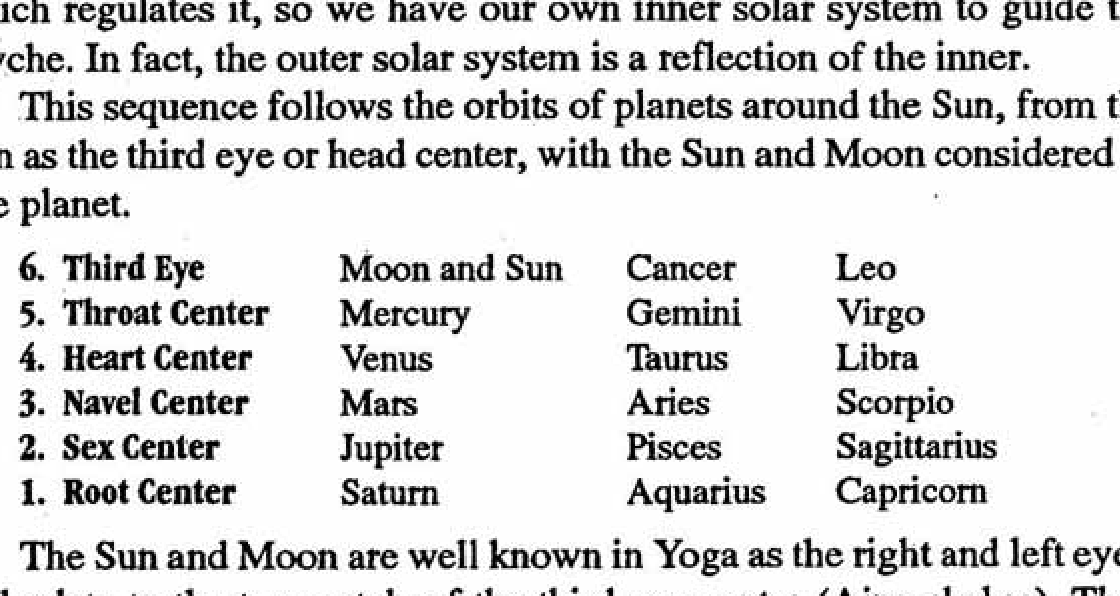 Planets and the chakras. Third Eye (6) — Moon and Sun — Cancer, Leo; Throat (5) — Mercury — Gemini, Virgo; Heart (4) — Venus — Taurus, Libra; Navel (3) — Mars — Aries, Scorpio; Sex (2) — Jupiter — Pisces, Sagittarius; Root (1) — Saturn — Aquarius, Capricorn (p224).
Frawley explains each correspondence from the planet's known nature (AoS ch.12, p224):
- The Sun and Moon are well known in yoga as the right and left eyes, and relate to the two petals of the third-eye center (the Ājñā chakra). They show our basic consciousness as masculine and feminine, will and feeling, reason and emotion.
- Mercury is the well-known ruler of speech and intellect — the throat center.
- Venus relates to love and the heart, to our affections.
- Mars rules the navel or fire center — our energy, drives, and passions.
- Jupiter rules the reproductive system and the creative energy at the sex center — our potential to expand.
- Saturn rules elimination and support at the root center, the coarsest of the planetary influences — our potential to contract.
Prāṇa rising and falling: the lunar and solar halves of the zodiac
The breath itself moves through this scheme. The energy — breath, prāṇa, or chi — moves up the spine following the six signs of the zodiac from Aquarius to Cancer. This governs inhalation and the development of lunar energy: it is cooling in nature and builds up the tissues of the body. Frawley calls it "the lunar half of the zodiac." The energy moving down the spine follows the six signs from Leo to Capricorn — "the solar half of the zodiac" — governing exhalation and the development of solar energy: it is warming in nature and promotes functional activity. In this way the birth chart can be drawn up relating each planet to its appropriate chakra (AoS ch.12, p225). [modern: Frawley]
The seventh center: the Sun beyond time
The seventh or head center — the Sahasrapadma, the thousand-petalled lotus — lies outside this system. It transcends the six chakras and the movement of time. It is the state of the Sun beyond time, "when the breath no longer rises or sets, the perpetual day of pure consciousness spoken of in the Vedas and Upanishads." Frawley quotes the Chāndogya Upaniṣad (III.10.3): "For him the Sun does not rise, nor does it set; it is a perpetual day, for one who knows the secret spiritual teaching." (AoS ch.12, p225) [classical]
The ancient yogas described in the Vedas and Upaniṣads — and suggested in the solar religions of the whole ancient world — aim at the resurrection of the Sun out of darkness, the building up of the circle of the Sun: taking the life-force and intelligence, our soul or inner Sun, out of the cycle of time and the breath and into the superconscious, breathless state. This can be approached in several ways — by yogic practices that direct the prāṇa through the chakras in different combinations; by meditation or knowledge teachings that build up the different aspects of direct perception; and by devotional teachings that approach the chakras through different deities (AoS ch.12, p225).
Chakras and the exaltation of the planets
The same relationship between signs and chakras explains the exaltation of the planets — the rationale for which Frawley calls one of the great mysteries of astrology. It shows that even where astrology appears arbitrary there is a deep inner order and mathematical structure to it; he claims there is probably nothing else in astrological literature that explains so clearly why planets are exalted in certain signs (AoS ch.12, p225–226). [modern: Frawley]
The exaltation table adds, to each chakra, its lunar sign and solar sign, and shows which planet is exalted where (the parenthetical numbers mark the chakra that the exalted planet itself rules):
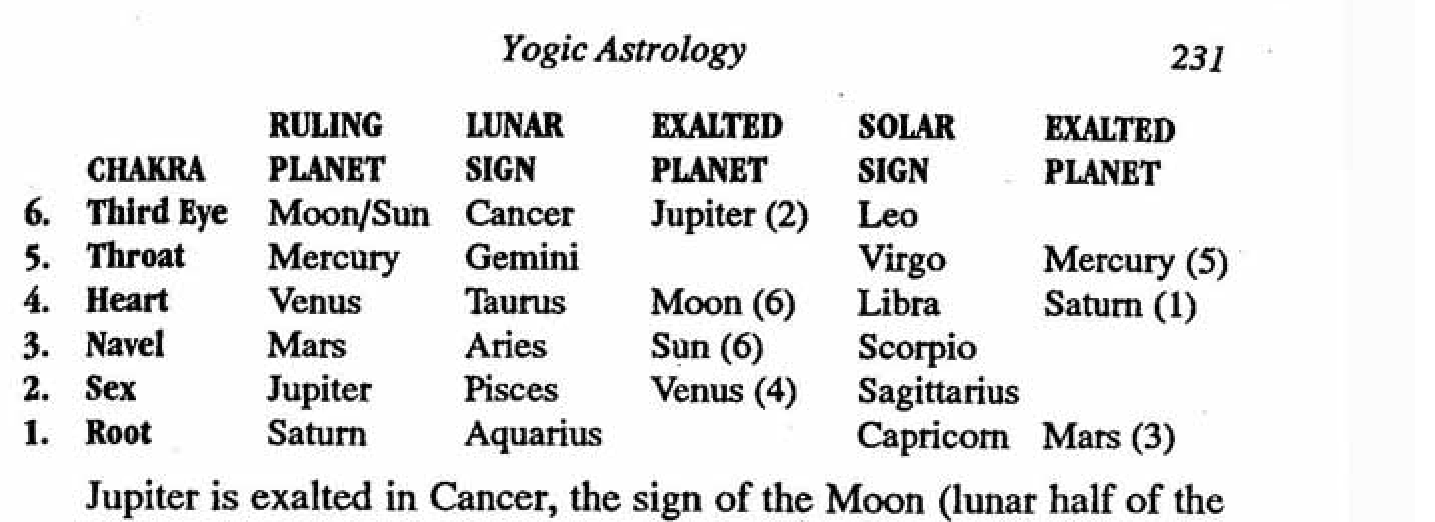 Chakras and exaltation. Third Eye — Moon/Sun — Cancer: Jupiter(2) exalted — Leo. Throat — Mercury — Gemini — Virgo: Mercury(5) exalted. Heart — Venus — Taurus: Moon(6) exalted — Libra: Saturn(1) exalted. Navel — Mars — Aries: Sun(6) exalted — Scorpio. Sex — Jupiter — Pisces: Venus(4) exalted — Sagittarius. Root — Saturn — Aquarius — Capricorn: Mars(3) exalted (p226).
Frawley reads each exaltation as a placement of the planet's energy into the chakra where it must be integrated (AoS ch.12, p226):
- Jupiter is exalted in Cancer, the sign of the Moon (lunar half) and the third eye. As the end of the lunar half of the zodiacal cycle, this is the point of maximum potential of the water energy and of the creative, anabolic processes of the body. It shows the spiritual side of Jupiter and its function as the guru or guide, the teacher of the solar system, our indicator of faith and law — the point of maximum aspiration in life.
- Mercury is exalted in Virgo, its own sign (solar half) and the throat chakra. The solar half relates more to expression, where Mercury's energy is most essential — the place of speech, and also our place of greatest vulnerability, showing how we take in and release things through the mouth.
- The Moon is exalted in Taurus, the sign of Venus (lunar half) and the heart. The Moon's connection with the heart is well known; this is the place of greatest receptivity and openness.
- Saturn is exalted in Libra, the sign of Venus (solar half) and the heart. Here Saturn represents the higher principles of justice, order, and detachment, necessary for using the heart energy rightly, without attachment or bias.
- The Sun is exalted in Aries, the sign of Mars (lunar half) and the navel center or solar plexus, well known as a site of solar and fire energy. The solar energy of the head must be integrated with the vital will here.
- Venus is exalted in Pisces, the sign of Jupiter (lunar half) and the sex center. This explains the connection of Venus with sex, and shows the need to keep our creative energy in harmony with love and aspiration.
- Mars is exalted in Capricorn, the sign of Saturn (solar half) and the root center. As the end of the solar half of the cycle, it is the point of maximum potential of expression of the fire energy: here, on the most outer level of our being, we need energy to work and accomplish things.
The symmetry of the exaltation scheme
The whole arrangement is symmetrical about the center. For exaltation, the Sun and Moon are located in the center — the navel and heart chakras — along with Saturn, whose signs are opposite theirs in the zodiac. Above them, in the throat and third eye, are Mercury and Jupiter, also opposite each other by sign. Below them, in the sex and root centers, are Venus and Mars, again opposite each other in the zodiac (AoS ch.12, p226–227). Jupiter and Mercury — the two planets that represent the mind in its abstract and concrete, general and specific function — stand above, where they should be for their best functioning. The two planets in the center (taking Sun and Moon as one, the Sun–Saturn pair) represent the basic duality of self and not-self, Spirit and Matter. Below are the two planets of the emotional, vital, and sensual nature, Venus and Mars, in their proper place (AoS ch.12, p227). [modern: Frawley]
The numbers in parentheses beside each exalted planet refer to the chakras those planets rule, in the order of chakra–sign rulership. Frawley adds that the scheme can also be read through the standard planetary numerology of the days of the week: Jupiter–5, Moon–2, Sun–1, and Venus–6 fall on the lunar side of the cycle; Mercury–4, Saturn–7, and Mars–3 on the solar side — and both sides total 14. From this cycle he extrapolates that Jupiter also functions well in Gemini, Mercury in Leo, Saturn in Scorpio, Venus in Aquarius, and Mars in Sagittarius (AoS ch.12, p227). [modern: Frawley]
Exaltation versus sign-rulership
Frawley draws an interpretive lesson from the fact that the exaltation cycle has the Sun ruling the solar plexus rather than the head. This leads him to believe that the exaltation status of a planet reflects its function in the vital or lower astral plane, whereas ordinary sign-rulership reflects its action in the mental or higher astral plane. Exaltation is a center-oriented symbolism; sign-rulership is a top-oriented symbolism. The exaltation order shows how the planets function once their energy is properly integrated into our lower nature (AoS ch.12, p227): [modern: Frawley]
- The solar energy from the head must be integrated with the vital energy in the navel/fire center (Aries).
- The martial energy of the navel must be made concrete in action at the root center (Capricorn).
- The lunar receptive mind from the head must be integrated into the love energy of the heart (Taurus).
- The venusian love energy of the heart must be integrated into the jupiterian creative energy of the sex center (Pisces).
- The jupiterian creative energy of the sex center must be brought to the top of the head (Cancer).
- The saturnian detaching or negating energy of the root center must be brought up into the heart (Libra).
- Mercury, the throat-chakra energy, needs simply to be stabilized where it already is (Virgo).
Chakras and the houses
In the same way, a house chart can be drawn relative to the chakras, simply by using the houses that correspond to the signs. The fourth and fifth houses (like the fourth and fifth signs Cancer and Leo) represent the third eye; the third and sixth (Gemini and Virgo), the throat center; the second and seventh (Taurus and Libra), the heart; the first and eighth (Aries and Scorpio), the solar plexus; the ninth and twelfth (Sagittarius and Pisces), the sex center; and the tenth and eleventh (Capricorn and Aquarius), the root center (AoS ch.12, p227–228). [modern: Frawley]
The house table also marks each house's ascending (lunar) and descending (solar) chakra, tracing the same upward and downward movement of the breath through the twelve houses:
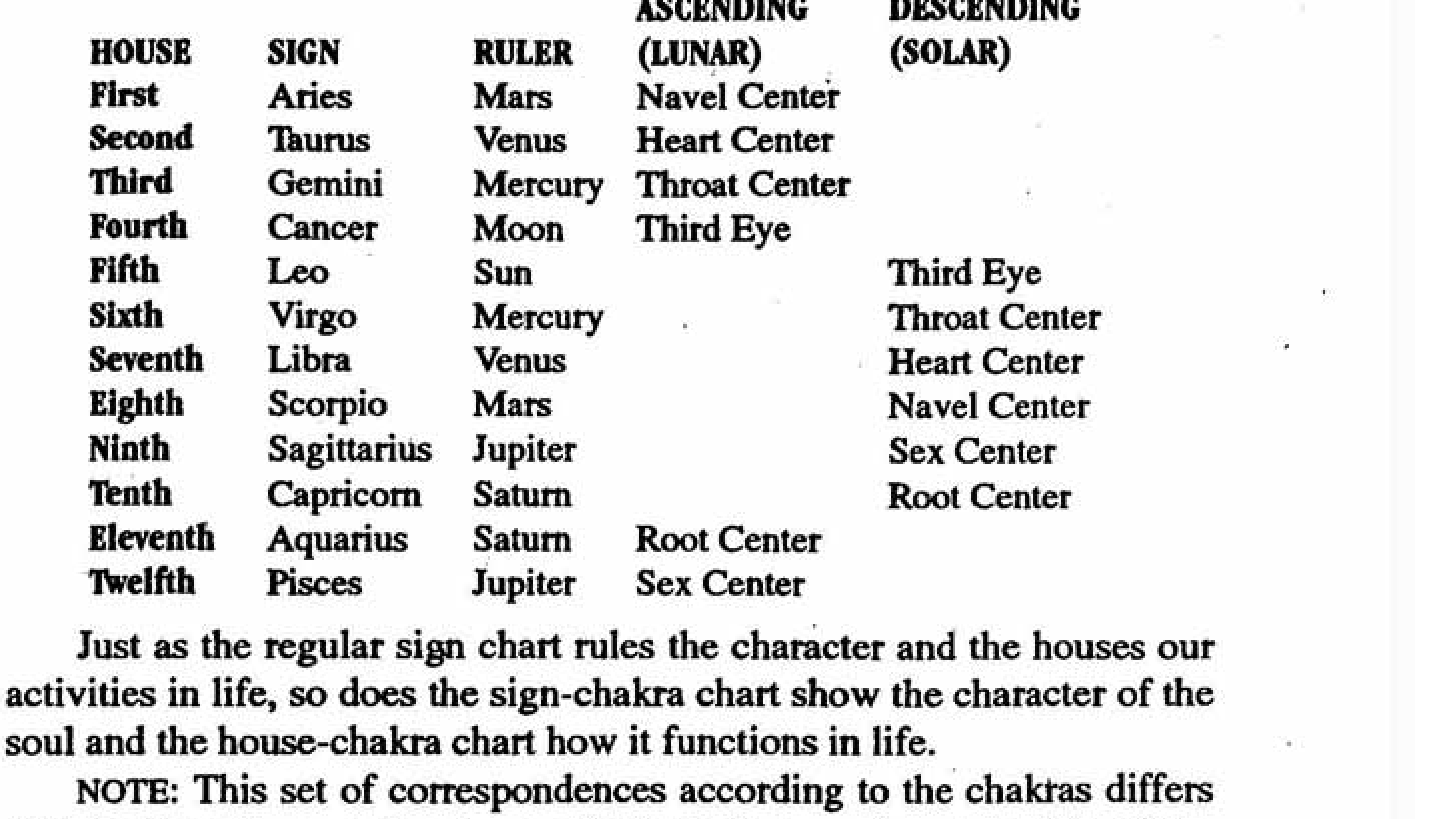 Chakras and the houses. First — Aries — Mars — Navel (asc.); Second — Taurus — Venus — Heart (asc.); Third — Gemini — Mercury — Throat (asc.); Fourth — Cancer — Moon — Third Eye (asc.); Fifth — Leo — Sun — Third Eye (desc.); Sixth — Virgo — Mercury — Throat (desc.); Seventh — Libra — Venus — Heart (desc.); Eighth — Scorpio — Mars — Navel (desc.); Ninth — Sagittarius — Jupiter — Sex (desc.); Tenth — Capricorn — Saturn — Root (desc.); Eleventh — Aquarius — Saturn — Root; Twelfth — Pisces — Jupiter — Sex (p228).
Frawley sums up the parallel: just as the regular sign chart rules the character and the houses our activities in life, so the sign–chakra chart shows the character of the soul, and the house–chakra chart how the soul functions in life (AoS ch.12, p228). [modern: Frawley] He closes with a caution: this set of correspondences according to the chakras differs slightly from the usual order, particularly in regard to the rulership of the elements — because it is working on a more subtle level (AoS ch.12, p228).
Open note: Frawley flags that the chakra-based correspondences depart from the standard element-rulership order without spelling out the divergence here — he leaves it as a sign that this scheme operates "on a more subtle level."
Chapter-end deity plate: Saturn
As elsewhere in the book, the chapter ends with a devotional plate of a planetary deity — here Saturn (Śani) — with a Sanskrit-style dhyāna (meditation verse) (AoS ch.12, p229). [classical]
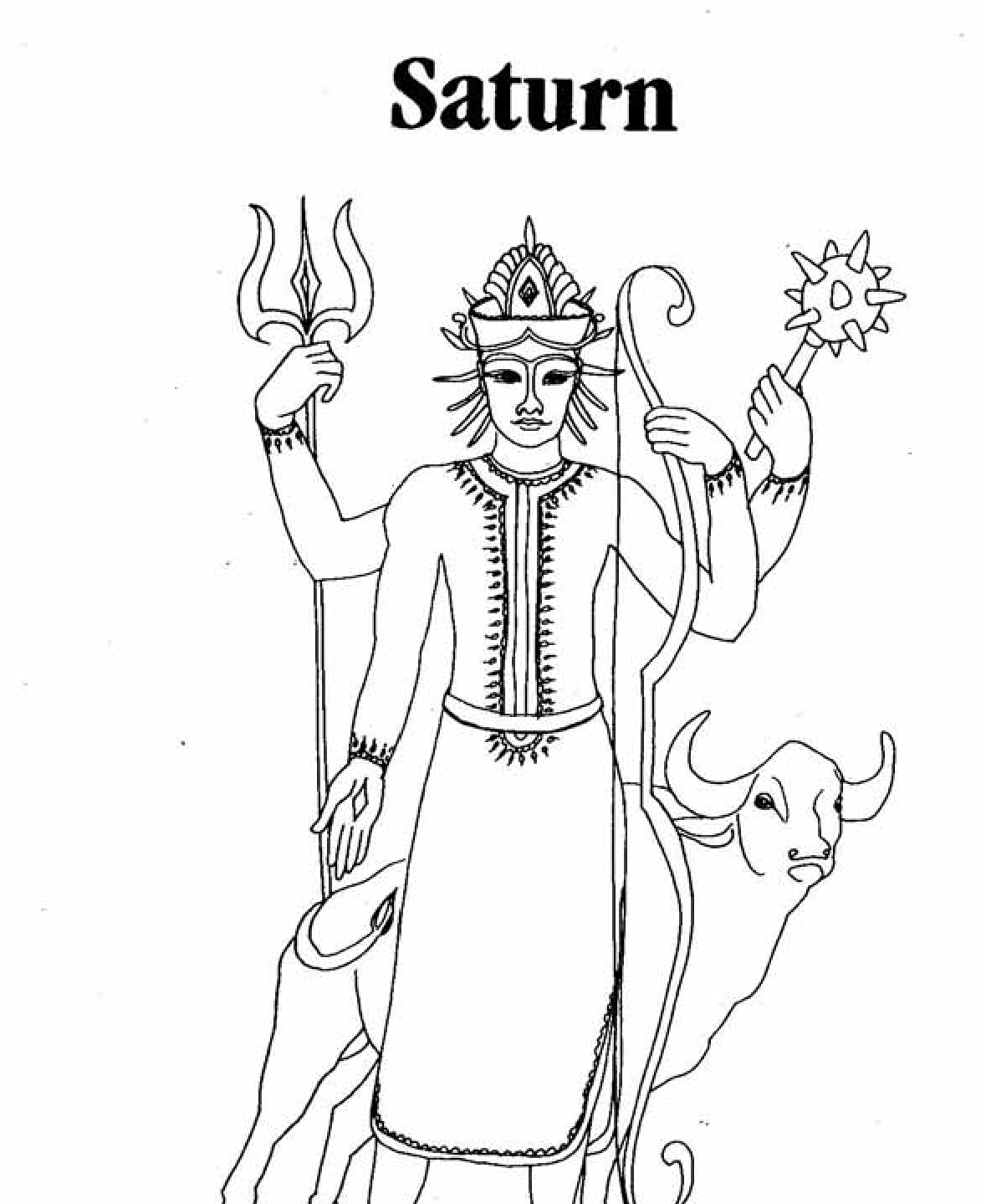 Saturn. The verse reads: "Dressed in blue, dark blue in color, who has four arms, the son of the Sun, who appears fearful, whose nature is peaceful, whose vehicle is an ox, who moves slow, who carries a trident, bow and mace in his hands, with a blue sapphire crest jewel on his head, making the gesture that gives boons, may Divine Saturn ever grant us his grace." (p229).