Home / Astrology of the Seers / Chapter 7
Planetary Aspects and Combinations
This chapter (Part II, ch. 4 of the book) turns from the natures of individual planets to the relationships between them — how planets reach across the chart to influence one another and the houses. Every system of astrology, East and West, builds its predictions on aspects: by the theory of aspects, a planet projects its influence to certain points away from its own zodiacal position, the targets fixed by the angle of arc of the zodiacal circle between the two positions. Picture the zodiac as a circle and each planet as a point on it; draw lines from two planets to the center and the angle between them — measured in degrees — defines the aspect. Particular angles (90°, 120°, 180° and others) count as aspects in the various systems (AoS ch.7, p162).
Aspects in Western astrology
Western astrology weighs the exact degrees between planets. It has major aspects — the square (90°) and trine (120°) — and minor aspects like the semi-sextile (30°). An aspect counts as effective only if the two planets fall within a certain orb of the exact angle: roughly 8° for major aspects, 1°–3° for minor ones. The aspect is mutual — it exists equally whether one planet is ahead of or behind the other, and both planets are taken to affect each other. Western astrologers have pushed this to great minuteness, and aspects are arguably the most important single consideration in the system. Western astrology also assigns each aspect its own nature: some are intrinsically malefic or difficult (the square), others benefic or easy (the trine), regardless of which planets form them (AoS ch.7, p162).
Aspects by sign
Vedic astrology uses aspects too, but in a way that can be hard to grasp coming from the West: it judges an aspect by sign, not by exact degree of angle. In the main Vedic aspect — the opposition or 180° — a planet aspects the whole sign opposite it, not just the opposite degree. The aspects run from a planet, via the sign it occupies, to other signs and to whatever those signs contain (AoS ch.7, p162–163).
So Jupiter in Aries, by its opposition aspect, aspects the sign Libra, the house ruled by Libra, and any planets sitting in Libra. If Jupiter is at 5° Aries and Saturn at 25° Libra the aspect still counts in full — even though, being 20° from an exact opposition, Western astrology would reject it as too wide. Some Vedic astrologers do still regard an aspect as stronger the nearer it comes to exact arc, and will even allow an aspect that exists by degree but not by sign: if Jupiter is at 1° Aries and Saturn at 29° Virgo the planets are not in opposite signs, yet the angle is 178° — close enough to a true opposition to count, though the orb for such a non-sign aspect is small, perhaps under 5° (AoS ch.7, p163).
Frawley gives two analogies for thinking by sign. Imagine the twelve signs as keys on a piano: each planet is a finger striking a key, and as long as it stays in a sign it sounds the whole of that sign. Or imagine each sign as a separate room and the planets as lights: wherever the light hangs in the room it lights the whole room. The first and last degrees of a sign are like doorways — at those junctures a planet can influence both the sign it is in and the adjacent one, but once past the doorway it has little reach into neighboring signs. And just as different pressures of the finger sound the keys differently, planets affect signs differently according to their own natures. The basis of Vedic astrology is thus harmonic, like music, with the twelve signs as the main harmonic division. [modern: Frawley] (AoS ch.7, p163)
A practical consequence: aspects by sign are easy to figure and need no knowledge of exact degrees, so they require no separate calculation beyond the chart itself — which is why Vedic charts carry no aspect list of the kind Western charts need. Counting by sign, the Vedic system uses fewer aspects, usually only a handful of major or full ones. It does have a subtler way of grading aspectual strength by exact degree-distance, but that is a special tool, not the everyday view. The many minor and special aspects now popular in the West — quintiles, semi-sextiles, quincunxes — are scarcely used or used only in special cases (AoS ch.7, p163–164).
Aspects as reflecting planetary nature
The decisive difference: Vedic astrology assigns no quality to the aspect itself. Aspects differ only in strength (major or minor); every aspect is simply a relationship between planets, and the character of that relationship comes from the natures of the planets, not the type of aspect. An opposition or square is not "bad," a trine is not "good." An opposition involving a badly disposed Sun (in its fall in Libra) can be very difficult; the same opposition with the Sun exalted in Aries can be very beneficial. A square from Mars in Aries (own sign) to Jupiter in Cancer (its exaltation) can be excellent, because both planets are well placed. Major vs. minor changes the strength of the relationship; it does not change its quality (AoS ch.7, p164).
It follows that everything learned about judging a planet's nature feeds directly into reading its aspects. An aspect from a great malefic like Saturn tends to be difficult whatever its geometry; one from a great benefic like Jupiter tends to help. Once you have fixed a planet's nature and how it acts across the domains of life, its aspects will mirror that (AoS ch.7, p164).
Special aspects
Beyond the general scheme, Vedic astrology grants certain aspects only to certain planets as full aspects, where other planets would have them only as minor ones (AoS ch.7, p164):
- The trine (120°) is a special full aspect for Jupiter alone.
- The square (90°) is a full aspect only for Mars (forward in the zodiac) and Saturn (backward).
Frawley suggests this may even be the root of the Western judgment that trines are good and squares hard: trines belong to the benefic Jupiter, squares to the malefics Mars and Saturn. [modern: Frawley] So in the Vedic view, aspects do not change the qualities of planets, but some planets change the power of aspects (AoS ch.4, p164).
Aspects thrown only forward in the zodiac
Where Western astrology sees an aspect radiating from both planets, the Vedic system throws a planet's aspect only forward in the zodiac. Western astrology counts a 90° square whether the second planet is ahead of or behind the first; the Vedic system counts (for example) Mars's square only on planets 90° in front of it, not on those 90° behind. Aspects are therefore reckoned by degrees forward from the planet's position: if Saturn is at 3° Gemini and Mars at 3° Pisces, then Saturn has a 270° aspect to Mars, and Mars a 90° aspect to Saturn — the same separation, but each planet "looks" only forward, so the two see each other at different angles (AoS ch.7, p165).
Aspects to signs and houses
In Western astrology aspects run only between planets, or from planets to special points (Ascendant, Midheaven, sometimes Descendant and Nadir). In the Vedic system planets aspect houses too, even empty ones, by aspecting the sign on that house's cusp; such an aspect can improve or damage the affairs of the house according to the planet's nature (AoS ch.7, p165).
The governing rule of chart judgment is to examine any matter through three things: the house that rules it, the lord of that house, and the house's significator (kāraka) — and to do this both from the Ascendant and from the Moon, weighing the aspects on all of them. For spirituality, say, one looks at the Ninth house, its lord, and Jupiter, and the ninth from the Moon. Vedic astrology therefore reads not just planet-to-planet aspects but the whole network of aspectual influence on every chart factor bearing on a question — and may treat aspects upon houses as more decisive than aspects between planets. Afflictions to the fifth sign and Fifth house, for instance, may weigh more than afflictions to their rulers (the Sun, or the Fifth lord), though those are considered too (AoS ch.7, p165).
Aspects East and West — a comparative view
From a Western standpoint the Vedic aspects look general and imprecise: a few major aspects by sign against the Western diversity of degree-aspects each with its own quality. A Western astrologer may wonder how Vedic astrology can be accurate with so little. Frawley grants the point in part: Vedic astrology does not use birth-chart aspects in such a primary way, and in this one area Western astrology may be more developed and precise — indeed its specialization on aspects may be the chief source of its accuracy (Western sidereal astrology uses the same aspects as Western tropical and can serve as a model here). [modern: Frawley] (AoS ch.4, p165–166)
But the comparison must not overlook that Vedic astrology also reads aspects across its series of minor or harmonic charts (the vargas), which yields many subtler aspects and a finer reading of exact degree relationships. Where Western astrology may find twenty-plus major and several dozen minor aspects in the birth chart, Vedic astrology may note perhaps ten major aspects in the natal chart — but multiplies them across up to sixteen harmonic charts. And aspects are only one part of a larger Vedic apparatus for judging planetary relationships: planetary friendship and enmity (already covered), the special strengths and weaknesses of Shadbala, and above all the Yogas (planetary combinations) treated later in this chapter. Taken whole, the Vedic system is intricate, complex and precise, and carries more calculations than Western astrology — though in particular areas each tradition is better developed than the other. [modern: Frawley] (AoS ch.7, p166)
Major planetary aspects (full aspect)
The full aspects by planet are:
| Planet | Full aspects (counting the planet's own sign as the 1st) |
|---|---|
| Sun, Moon, Mercury, Venus | 7th |
| Mars | 4th, 7th, 8th |
| Jupiter, Rāhu, Ketu | 5th, 7th, 9th |
| Saturn | 3rd, 7th, 10th |
The primary rule is that every planet aspects the seventh sign from its own — the equivalent of the Western opposition / 180° aspect (AoS ch.7, p166).
The three distant planets — Mars, Jupiter, Saturn — and the two Lunar Nodes — Rāhu and Ketu — possess special aspects in addition to the seventh (AoS ch.7, p167):
- Mars also aspects the 4th and 8th signs. The fourth aspect is like a Western square (90°), of an approaching nature. The eighth aspect is like a quincunx (150°), but thrown only on planets behind it in the zodiac — so the real angle is 210°.
- Jupiter, Rāhu and Ketu have special aspects on the 5th and 9th — the trines (120°) — operating both forwards and backwards in the zodiac.
- Saturn has special aspects on the 3rd and 10th. Its third aspect is like a sextile (60°) but operates only on planets in front of it. Its tenth aspect is a square (90°) operating only backwards, so its real angle is 270°.
For most purposes only full aspects are used. Some astrologers also count a full aspect from a planet located in the tenth from another — worth weighing, since by that view planets in the Tenth house fully aspect the Ascendant (AoS ch.7, p167).
Sambandha
When two planets are in mutual full aspect, they are in Sambandha — "complete connection." This complete connection arises by other means as well (AoS ch.7, p167):
- Exchange of signs (parivartana / mutual reception). When two planets sit in each other's signs — Jupiter in Aries (Mars's sign) while Mars is in Pisces (Jupiter's sign) — they form a complete connection equal to a mutual full aspect. This "mutual reception" is one of the most powerful connections two planets can have.
- Mutual quadrants. Some practitioners count planets in Quadrant houses together (1, 4, 7, 10) as in full aspect — e.g. Venus in Taurus in the Fourth and Jupiter in Leo in the Seventh — even where no technical major aspect exists. Some extend this to mutual trines (1, 5, 9), and some reckon such quadrant/trine relationships from the Moon as well as the Ascendant. Frawley notes these may hold, especially when the Moon is as strong as or stronger than the Ascendant, but says he does not usually grant aspectual power to these house relationships — though they matter for judging the chart's strength through house position. [modern: Frawley] (AoS ch.7, p167)
The graded strength of aspects
Beyond the full aspects, every planet casts partial aspects whose strength is graded by the target sign and the exact arc. All planets aspect the 7th sign with full sight (100%); the 4th and 8th with three-quarters (75%); the 5th and 9th with one-half (50%); the 3rd and 10th with one-quarter (25%). The special aspects raise particular planets to full: Mars's normally three-quarter aspects become full; Jupiter/Rāhu/Ketu's half-aspects become full; Saturn's quarter-aspects become full; the planet's remaining aspects behave like everyone else's (AoS ch.7, p169).
Minor aspects (including the three-quarter ones) are usually not used in everyday reading; their main role is as an input into planetary-strength calculation (part of Shadbala). Crucially these graded aspects have no orbs but increase proportionally with arc: a planet in exact opposition (180°) has the full 100% aspect; one exactly in the eighth sign (210°) has 75%; one in between at 195° has 87.5% aspectual strength — a smooth interpolation, not an on/off orb (AoS ch.7, p169).
The chapter prints these strength curves planet-class by planet-class:
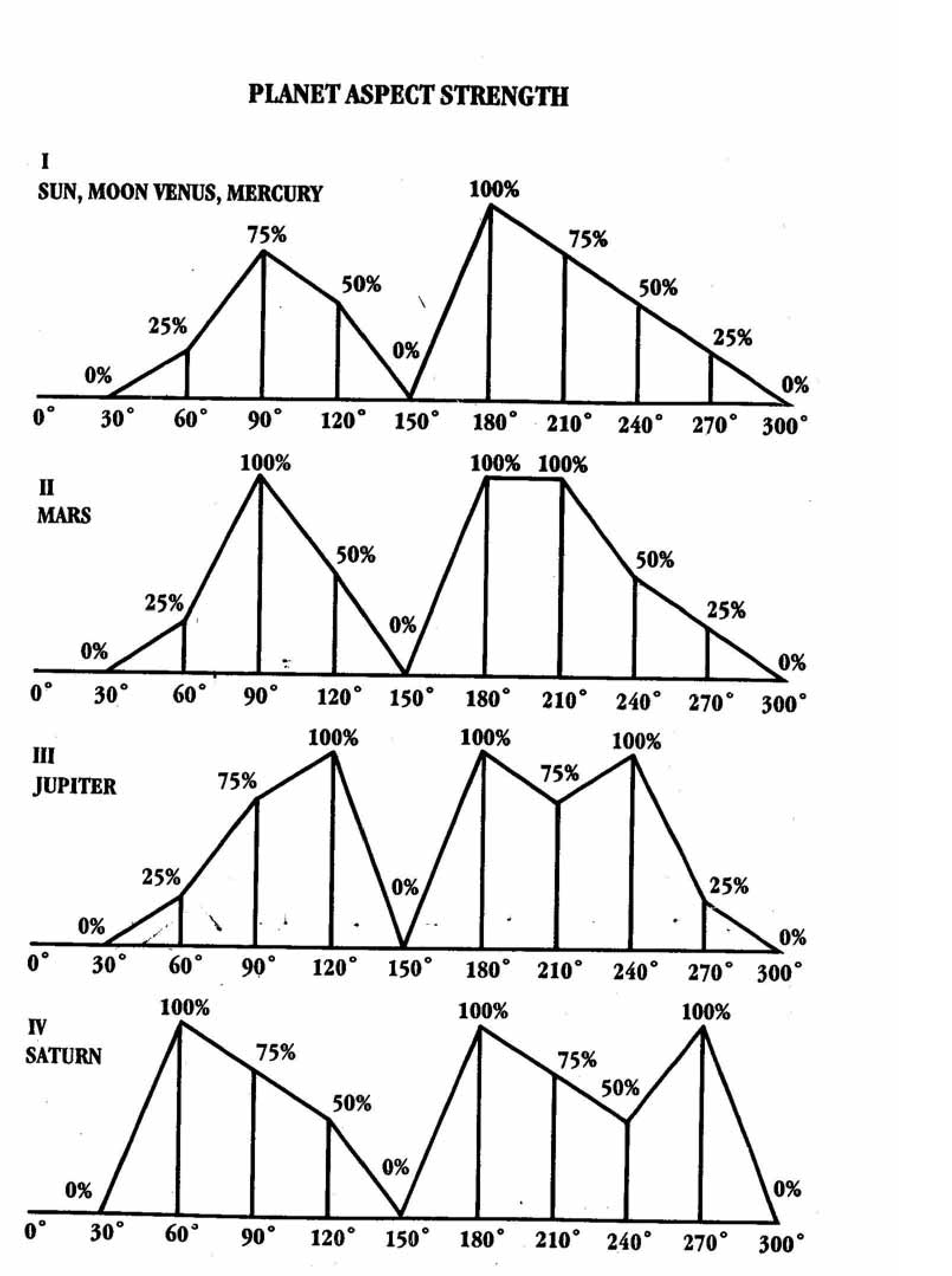 PLANET ASPECT STRENGTH (p168). Row I — Sun, Moon, Venus, Mercury: 25% at 60°, peaks 75% at 90°, drops then rises to 100% at the 7th (180°), 50% at 240°, 25% at 270°. Row II — Mars: 100% peaks at 90° (4th) and at the 7th–8th band (180°–210°), with 50% at 120° and 240°. Row III — Jupiter: twin 100% peaks at the 5th (120°) and 9th (240°) flanking the full 7th, with 75% shoulders. Row IV — Saturn: 100% peaks at the 3rd (60°), the 7th (180°) and the 10th (270°), with 50% troughs between. The curves interpolate strength between signs rather than using fixed orbs.
Conjunction
Planets in close proximity are in conjunction — an intimate association. Western astrology counts conjunction as a full aspect with an orb of about 10°. In Vedic astrology conjunction is not an aspect at all (aspects require a certain distance between planets), yet it is counted alongside aspects as a full planetary relationship — a relationship like a mutual full aspect, and it too constitutes Sambandha. Conjunctions are reckoned by sign like aspects, but the closer in degrees the two planets, the stronger the effect — especially in relation to the Sun (AoS ch.7, p169).
Aspects for Uranus, Neptune and Pluto
Because the outer planets are not part of the classical Vedic system, no aspect doctrine exists for them; one may ignore them entirely, though Frawley finds them useful. If used, they should at least carry the universal seventh aspect (opposition) plus conjunction as a full interchange. He prefers to count them by degree (orb of 10° or less) rather than by sign, since as distant bodies their effect may be weak. He is unsure whether they deserve special aspects and usually withholds them: arguably they should have them (like the other trans-Earth planets), but arguably they are too distant. One could grant special aspects by resemblance — Uranus like Saturn (3rd/10th), Neptune like Jupiter (5th/9th), Pluto like Mars (4th/8th) — or like the Nodes (5th/9th). But giving them special aspects hands them great power and risks unbalancing rather than fine-tuning the reading, unless those aspects are treated as minor. [modern: Frawley] (AoS ch.7, p169–170)
Combust
A planet in close conjunction with the Sun becomes combust — "burnt up," weakened, possibly rendered powerless. The orb of combustion differs by planet (AoS ch.7, p170):
- Mars, Jupiter, Saturn: 8° 30′
- Moon: 15° (a larger body)
- Venus: 4°
- Mercury: 2°
A favorable sign or house can greatly mitigate combustion, and a planet in the same sign as the Sun is still counted in full relationship (sambandha) with it even when not technically combust — often to its benefit. Generally all planets work better at some distance from the Sun; this is especially so for the Moon, Mercury and Venus, which wax and wane — just as the Moon is strongest when full and weakens toward the Sun, so Mercury and Venus are strongest at maximum elongation and weaken as they approach it (and to a degree this holds for the others too). The logic of combustion: near the Sun a planet's rays are overpowered by the solar light, so conjunction with the Sun is generally a negative for any planet's energy (AoS ch.7, p170).
Planetary war
When two planets stand in conjunction of one degree or less, they are in a state of "war" — a clash of their respective rays. The planet with the lower degree of longitude wins. If Mars is at 23° 35′ Sagittarius and Venus at 23° 17′, Venus wins the war. A benefic that loses a war to a malefic can be rendered very weak; a benefic that wins against a malefic becomes much stronger (AoS ch.7, p170–171).
Planetary war does not apply to the Sun (where the rules of combustion govern instead) or to the Moon (conjunction with the Moon is usually benefic). Rāhu and Ketu, possessing retrograde motion, exert a stronger effect on the degree above a planet but are likewise exempt from the war rules. And if a planet that technically loses a war is retrograde, the damage it suffers is considered less (AoS ch.7, p171).
Hemming in of planets (papakartari)
A planet with malefics in both adjacent signs is "hemmed in by malefics." If the Moon is in Libra with Saturn in Scorpio and Mars in Virgo, it is hemmed in on both sides; though not technically an aspect, this acts with the force of a major aspect, putting the Moon strongly under those planets and weakening it by their malefic nature. Were the flanking planets Jupiter and Venus, the Moon would be hemmed in between benefics, protecting and strengthening it. (For real accuracy one must weigh the full nature of the flanking planets, not just their natural benefic/malefic status; the example is schematic. Such formations enter into many Yogas.) (AoS ch.7, p171)
A weaker version of the same can be built by aspect: if Libra holds the Moon while Scorpio and Virgo each receive the full aspect of malefics only, the Moon is again hemmed in between malefic influences — but because the pressure is indirect, it is not as strong. A planet hemmed in by malefics can be greatly countered by a full benefic aspect, and conversely a planet hemmed in by benefics can be spoiled by a malefic aspect (AoS ch.4, p171).
Separative planets
Five factors are separative — they remove us from the matters they touch: the Sun, Saturn, Rāhu, Ketu, and the ruler of the Twelfth house from the Ascendant. When several of these aspect a chart factor, separation from that area of life becomes likely (AoS ch.7, p171–172):
- Aspecting the marriage factors — the Seventh house, its ruler, and the partner-significator (Venus for a man, Jupiter for a woman) — makes divorce easy and lasting relationships hard.
- Aspecting the Tenth house and its ruler: loss of job or inability to hold steady employment.
- Aspecting the Second house and ruler plus Mercury: living away from one's parents as a child.
- Aspecting the Fourth house, its lord, the Moon and Mercury: danger of being "separated from one's mind" (going crazy).
- Aspecting the Fifth house, its lord and Jupiter: separation from children — more likely an inability to have them at all, with possible reproductive surgery for women.
If the same houses counted from the Moon are similarly afflicted, these results grow more likely. Each separative factor has its own flavor: the Sun creates independence or burns things up; Saturn brings loss, alienation, detachment; Rāhu disperses and draws one toward the foreign and distant; Ketu makes us contract and brings negativity; and the Twelfth lord projects that house's energy of loss and retreat. Frawley calls this rule very useful and says it should be memorized. [modern: Frawley] (AoS ch.7, p172)
Retrograde
A planet can appear to move retrograde (backward through the zodiac) because of differing orbital rates relative to Earth. Western astrology usually reads retrograde as difficulty, delay, or obstacle — a retrograde Mercury, for instance, causing communication problems. Vedic astrology usually reads retrograde as a sign of strength: retrograde Jupiter, for example, is held good for having children even if otherwise weak (AoS ch.7, p172).
Retrograde is sometimes taken to reverse a planet's energy: an exalted planet loses strength when retrograde, while a debilitated one gains it. Retrograde also internalizes a planet's energy — a retrograde Mercury makes the intellect introverted, drawn to history or the occult, and when afflicted can give nervousness, speech difficulty, or hesitancy in communication. Retrograde planets often indicate a karmic result, an influence carried from the past: the native does not move forward with that planet's energy but must take it backward or inward, to consolidate or limit it (AoS ch.7, p172–173).
Planetary Yogas
Often more important than aspects are the planetary Yogas — complex combinations weighing sign, house and aspect together. Yoga means "combination." Many Yogas are defined purely by houses: if the lord of the Second (income) sits in the Twelfth (loss) while the lord of the Twelfth sits in the Second, that is a Yoga for poverty; many such Yogas need an exchange of signs between two planets but no aspect between them (AoS ch.7, p173).
Hindu texts list these Yogas at great length and astrologers memorize them — yet even when a Yoga is present it may need other supporting factors to take real effect. Frawley urges grasping the principle behind Yogas over memorizing them: all chart interpretation, being a synthesis of indications, is itself a building-up of Yogas. The more independent factors point to the same result, the likelier it is to occur; what matters is the habit of "Yogic thinking" — the capacity to draw connections. Some very powerful charts have no simple or classical Yoga at all but draw strength from other planetary combinations, and the simpler Yogas are not always as strong as more complex formations that integrate many planets. [modern: Frawley] (AoS ch.7, p173)
Lunar Yogas
Many Yogas involve the Moon, a sensitive, gregarious, motherly planet who dislikes being alone. An unassociated Moon is generally inauspicious — often so even when otherwise well placed: the Moon in Cancer or Taurus may not help if no benefic is near or influencing her. She suffers more if aspected only by malefics, if in the difficult Sixth, Eighth or Twelfth houses, or if in her fall in Scorpio or in unfriendly signs (AoS ch.4, p173).
The Moon does well conjunct benefics or with benefics in adjacent signs, and better still when Jupiter stands in an angle from her — the configuration called Keshari Yoga. Aspected or hemmed in by malefics (especially Saturn and Rāhu), the Moon suffers, and with her our mind and emotions. The same issues arise when the Ascendant is similarly influenced (AoS ch.7, p173).
Mahāpuruṣa Yogas
Among the most common and useful are the Mahāpuruṣa Yogas, the combinations that make "great people." A Mahāpuruṣa Yoga forms when a planet is in its own sign or exalted and at the same time in an angle (quadrant) from the Ascendant or the Moon. Only the five major planets form them (not Sun or Moon, though those benefit from such positions too). Such a placement magnifies the planet's qualities and stamps the whole chart with its nature; people with these Yogas often even take on the planet's physical type (AoS ch.7, p174):
- Mars — Ruchaka Yoga ("radiant combination"): courage, daring, force of will, decisiveness, independence, leadership, power of action and achievement — common for military leaders, generals, politicians, lawyers, scientists, executives. Gives much success, but the Tamasic side of Mars may surface as domination and violence (AoS ch.7, p174).
- Mercury — Bhadra Yoga ("auspicious combination"): powers of speech, communication, commerce, intellect, wit, humor, mental sensitivity, humanism, balanced psychology — common for intellectuals, teachers, writers, businessmen. May augment Mercury's Rajasic, acquisitive side — the mind grasping life in names, forms and quantities (AoS ch.7, p174).
- Jupiter — Hamsa Yoga ("swan combination," the swan being the Vedic bird of spiritual knowledge): an ethical, moral, philosophical or religious nature, optimism, creativity, health, faith, prosperity, affluence — common for religious people, teachers, liberal leaders, some entertainers. Gives joy, compassion and possible spirituality, but may only make one self-promoting (Jupiter on a superficial level) (AoS ch.7, p174).
- Venus — Malavya Yoga: comfort and prosperity, command of vehicles and material resources, beauty, charm, grace, artistic talent — common for artists, beautiful women, the wealthy and socially influential, sometimes politicians. Lower or higher Venusian effects follow placement; at its highest it gives powers of devotion (AoS ch.7, p174–175).
- Saturn — Shasha Yoga: power over people, positions of authority, control of material resources, strong work and achievement capacity — common for political and business leaders. Since Saturn is cruel, unless the Moon or Jupiter is strong the native may be selfish, ruthless or destructive (Saturn in an angle is itself eyed with some suspicion). Well placed, it gives detachment, spiritual insight, and the capacity for silence (AoS ch.7, p175).
These Yogas are prominent in famous charts but are not rare — many charts hold at least one. To really work they must be well placed: stronger when the planet is in the Tenth (the best angle), or when the Yoga forms both from the Ascendant and from the Moon; it also helps if the planet is the final dispositor or rules many other planets, or combines with friendly or like-natured planets (Mars with the Sun, Jupiter with the Moon). Poorly aspected, such a Yoga can show the destruction of the planet's qualities (planet and sign both ruined). And while they confer worldly strength they do not guarantee spiritual knowledge or ethics — strong malefics in a Mahāpuruṣa Yoga (Mars, Saturn) can create tyrants (Frawley cites Hitler's chart for such a Mars Yoga). [modern: Frawley] (AoS ch.7, p175)
A key principle: a planet often gives stronger effects by exchanging signs with another than merely by sitting in its own sign, because the two planets' powers are then more integrated. Compare a Saturn–Moon opposition with Saturn in Capricorn and Moon in Cancer (each in its own sign) against one with Saturn in Cancer and Moon in Capricorn (the two exchanged) — the exchange version is the stronger. Frawley notes the Raja Yoga in Napoleon's chart is stronger for just such an exchanged placement than it would have been with the planets in their own signs; this is why some charts are very powerful even without any Mahāpuruṣa Yoga. [modern: Frawley] (AoS ch.7, p175)
Kuja Doṣa
Mars in certain houses harms harmony in marriage and relationship — heavily stressed in Hindu astrology. The afflicting positions are Mars in the First, Fourth, Seventh, Eighth and Twelfth houses, with these sign exceptions that cancel the doṣa (AoS ch.7, p175–176):
- First house — if the sign is Aries
- Fourth house — if Scorpio
- Seventh house — if Capricorn or Pisces
- Eighth house — if Cancer
- Twelfth house — if Sagittarius
Such a Mars shows potential conflict in relationship or trouble in the spouse's life, and a person with Kuja Doṣa should generally marry another who also has it. Mars in the Seventh seems the most difficult (though it often brings social success); Mars in the First or Eighth is often hard too. Each placement reads differently: Mars in the First makes one aggressive or contentious; in the Seventh, conflict and a drive to dominate the partner; in the Eighth, a strong sex drive or the early death of the partner; in the Fourth, an aggressive subconscious or emotional nature; in the Twelfth, hidden passion or the wasting of vital energies. A strong Mars in a woman's chart is held difficult for marriage in the traditional view — she may dominate her husband and (in extreme readings) indicate his ill health or death (AoS ch.7, p176).
Frawley cautions against reading these simplistically: many charts carry Kuja Doṣa to some degree, and it should be confirmed by other afflictions to the Seventh house, its lord, and the marriage significator. He also reframes it for the modern world — the doctrine reflects a more passive social role for women that may no longer apply; a working woman may actually need the stronger Mars these positions give, so Kuja Doṣa for her may mean only that she needs a more independent marriage, perhaps her own career and no children. And afflictions to the relationship factors from other malefics (Sun, Saturn, Rāhu, Ketu) can give relationship trouble even without Kuja Doṣa. [modern: Frawley] (AoS ch.7, p176)
Shadbala — planetary power ratios
Shadbala ("six-fold strength") is an elaborate computation for grading planetary strength and weakness — perhaps the most sophisticated and reliable such system. It is not necessary for an accurate reading but is useful, and because the math is so complex a computer program is essential; Frawley only outlines it (AoS ch.4, p176).
A planet strong in Shadbala will act powerfully in the chart — for good or ill, depending on its nature; one weak in Shadbala can do little and may bring disease or difficulty. Shadbala does not replace a full reading of signs, houses, aspects and Yogas: it tells you whether a planet has enough strength to fulfill its role, while the chart tells you what that role is and whether it will be ordinary or extraordinary (AoS ch.7, p176–177).
The six factors of Shadbala are (AoS ch.7, p177):
- Positional Strength (Sthāna Bala)
- Directional Strength (Dig Bala)
- Temporal Strength (Kāla Bala)
- Motional Strength (Cheṣṭa Bala)
- Natural Strength (Naisargika Bala)
- Aspectual Strength (Drik Bala)
1. Positional Strength has five sub-factors: Exaltation Strength (Ucha Bala) — nearness to the exaltation point; Divisional Strength (Saptavargaja Bala) — residential strength across the seven harmonic charts; Odd/Even-Sign Strength (Ojayugmarāśyaṁśa Bala); Quadrant Strength (Kendra Bala) — strength by house position; and Decanate Strength (Drekkāṇa Bala) — strength by decanate (AoS ch.7, p177).
2. Directional Strength is one of the main measures, showing where each planet is powerful by direction (quadrant): Mercury and Jupiter are strong in the east (Ascendant / First house); the Sun and Mars in the south (Tenth house / Midheaven); the Moon and Venus in the north (Fourth house / Nadir); Saturn in the west (Seventh house / Descendant). Each is correspondingly weak in the opposite house. This factor shouldn't be over-weighted alone — any of these planets does better in any quadrant than in other houses — but it tells you which quadrant each prefers (AoS ch.7, p177).
3. Temporal Strength combines nine time-based factors keyed to the birth moment (hour, day, month, year): Day-Night Strength (Nathonnatha Bala), Monthly Strength (Pakṣa Bala), Four-Hour Strength (Tribhāga Bala), Lord-of-the-Year Strength (Abdādhipati Bala), Lord-of-the-Month Strength (Māsādhipati Bala), Lord-of-the-Day Strength (Vārādhipati Bala), Lord-of-the-Hour Strength (Hora Bala), Declinational Strength (Ayana Bala), and Planetary War Strength (Yuddha Bala) (AoS ch.7, p177–178).
4. Motional Strength is the most complicated, relating to the planets' motion around the Sun, including retrogression (AoS ch.7, p178).
5. Natural Strength is the same in every chart — a fixed ranking by apparent brightness as seen from Earth: Sun (strongest), then Moon, Venus, Jupiter, Mercury, Mars, Saturn (AoS ch.7, p178).
6. Aspectual Strength is the net of incoming aspects, figured by the extended (graded-arc) aspect rules. It is not meant to substitute for calculating the chart's aspects, nor to be taken as a reliable measure of their influence on its own (AoS ch.7, p178).
The chapter closes, as each does in this book, with a deity plate and verse for the planet — here Jupiter (Guru / Bṛhaspati):
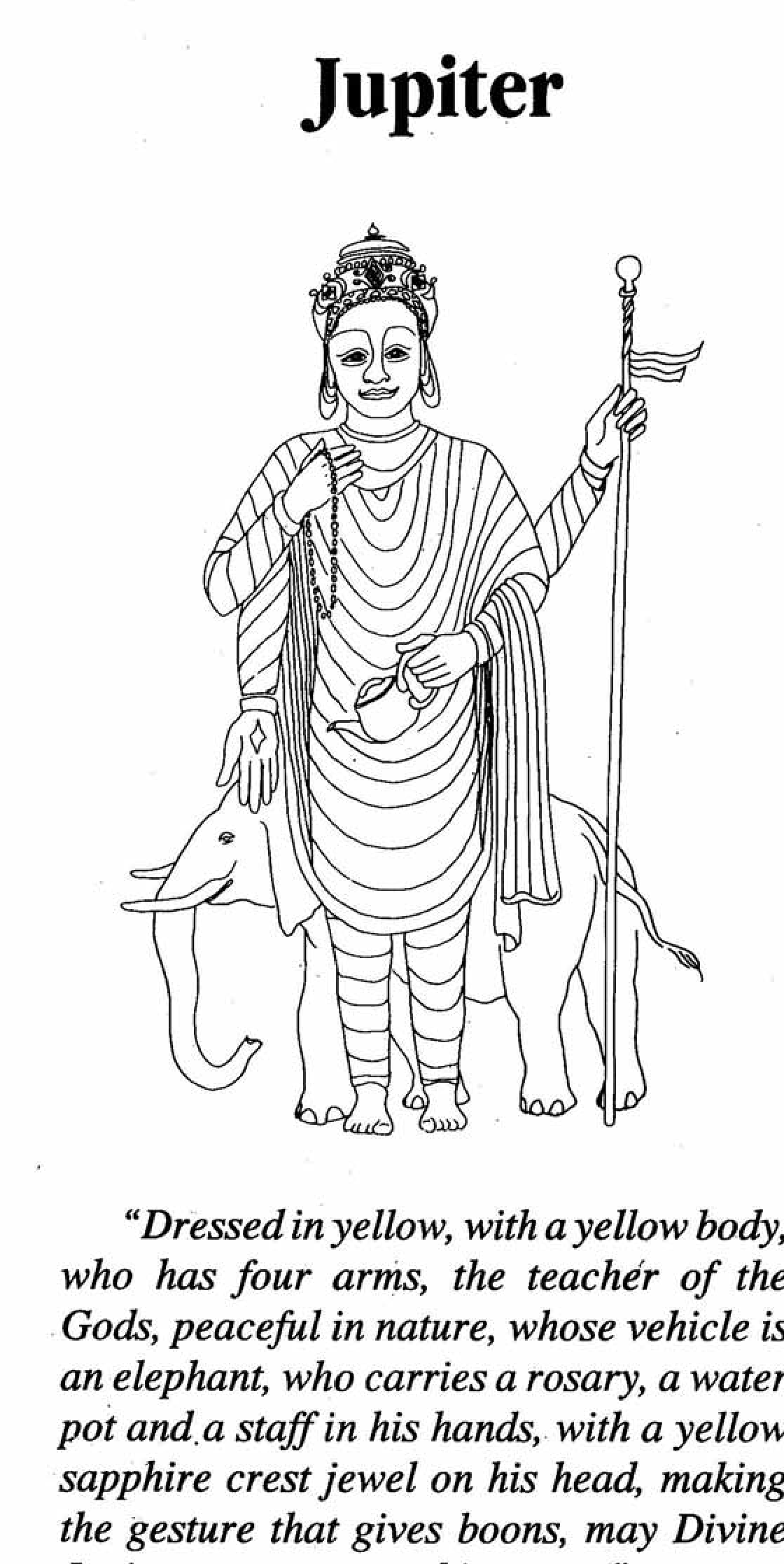 Jupiter, with his closing verse (p179): "Dressed in yellow, with a yellow body, who has four arms, the teacher of the Gods, peaceful in nature, whose vehicle is an elephant, who carries a rosary, a water pot and a staff in his hands, with a yellow sapphire crest jewel on his head, making the gesture that gives boons, may Divine Jupiter ever grant us his grace." [classical]