Home / Vāstu: Breathing Life into Space / Chapter 10
Building from the Ground Up
The best Vāstu space is one you build from the ground up. This chapter covers the whole arc — from the aesthetic philosophy (dharma → rūpa → bhāva → rasa), through choosing an architect by who you are, to the long, careful business of finding and reading a piece of land.
 The book's chapter-opener motif — a figure within a grid (p243).
Dharma, rūpa, bhāva, rasa
Nature co-creates your home when your hand is guided by four linked principles. Dharma is function ("what you are born to do"; a building's dharma is its task). Rūpa ("form") is the shape that best incarnates that function — Vāstu agrees that "form follows function" (and, with Frank Lloyd Wright, that "form and function are one"). Bhāva ("state, condition") is the atmosphere that arises from the form — both the home's and your inner state within it. And from bhāva flows rasa ("juice, essence, flavor") — your life's flavor. A truly satisfying life is rasātmaka, brimming with refreshing emotion; the home is "one cauldron in which we stew our bhāvas into rasas," harmonious forms making cordial bhāvas and ever-deeper sukha (Svoboda ch.10, p243–244). [traditional]
The nine rasas of life: śṛṅgāra (romance), hāsya (mirth), karuṇa (compassion), raudra (fury), vīra (heroism), bhayānaka (fear), adbhuta (awe), bībhatsa (disgust), and śānta (peace) — peace being the ground on which all the others should ideally resolve. We're drawn to call a thing beautiful, de Botton notes, when it carries "the correct dose of our missing virtues," restoring the golden mean between life's opposites (Svoboda ch.10, p244–245).
Building, step by step
A building, like Kipling's Ship that Found Herself, "coalesces into harmony" when its parts align. To build from scratch, proceed in order (Svoboda ch.10, p245–246):
- Establish the need for a building — a real need, not a whim ("keeping up with the Joneses" won't bring sukha); do it right, within a realistic budget, fitting your neighbors.
- Select an architect — first choice a Vāstu-fluent one; otherwise one who plans for utility, stability, and beauty ("the greatest utility is a space in which your soul has room to grow"). Buildings should both shelter and speak (Ruskin/de Botton) — beauty signals "a material articulation of our ideas of a good life." Beware architects who bully clients into their own theories.
- Investigate and select the land (below).
- Fix boundaries, buildable area, location, and orientation.
- Select materials, design the building, set prime dimensions.
- Groundbreaking and first entrance.
Before meeting the architect, ponder "what can materialize in this space?" through three lenses (Svoboda ch.10, p249–250): your puruṣārtha (chief life-goal — dharma/artha/kāma/mokṣa); your varṇa ("color," your innate pattern of activity — brāhmaṇa (knowledge), kṣatriya (managing/fighting), vaiśya (trade), śūdra (physical work) — each calling for a different Vāstu "palette"; Svoboda notes the varṇas originally meant innate nature, not birth-caste, before the concept was made rigid); and your āśrama (life-stage — brahmacarya (learning), gṛhastha (householder), vanaprastha (semi-retreat), sannyāsa (renunciation)), since each stage needs a different methodology.
Investigating and selecting the land
The land should be secure — free of natural hazards, flood, war, pollution, and noise; not crowded by busy public institutions (too much rajas) or "rogues and scalawags" ("choosing your neighbors carefully is good Vāstu"). Beauty matters but isn't essential: Vāstu evaluates beauty from the inside out — from prāṇa and soul, not the site's "skin." Consult a jyotiṣi (even before searching — does your chart promise land, and when?) or another trusted adviser to audit your judgment, lest infatuation with a property mislead you. Outcomes depend on the match of land and owner: when both are apposite and aligned, sukha is likely; when they're mismatched and both deficient, the residence will be inhospitable. Choose a moderate climate for your constitution (pitta people beware the tropics/Deep South; vāta the windy West; kapha the humid NE/NW) (Svoboda ch.10, p251–253).
Topography
"Ground that is soft, even, of sweet smell and taste, abounding in excellent herbs, trees and creepers, and not hollow underneath confers all-round prosperity…" — Bṛhat Saṁhitā 53:88 [classical]
The ideal plot is smooth and gently sloping (gentle contours = gentle prāṇa). In the northern hemisphere Vāstu likes a natural slope from south→north, west→east, or southwest→northeast — so the southwest is the high point and the northeast the low, with "backing" (boulders, hills, tall trees, big buildings) on the S/SW/W and openness (or water) on the N/NE/E. This lets "sattvic light and fresh prāṇa stream in through the northeast portal, flow up against the mountain of tamas in the southwest, then lap at the other quadrants." But a gentle grade beats correct direction — a sheer drop behind a house drains its prāṇa; if you can't have SW high, at least keep the highest ground at the building's back (Svoboda ch.10, p253–255).
Soil
Read the soil from what already grows there: gentle birds, flowering plants, fragrant herbs, and fruit trees attest fertility; rocks, anthills, biting insects, and thorny/poisonous plants mark a "harsher personality" (best avoided), as is land reclaimed from water. The soil should be soft, sweet-smelling, sweet-tasting, and resonant when struck. Classic tests: graze cattle (spirited bulls = fertile land); sow grain (sprouts in 3 days = good, 5 = middling); the pit test — dig a ~2½-ft cube at the center and refill it: leftover dirt = dense, good ground; exactly filled = acceptable; not enough = poor; the water test — fill the hole, walk 100 paces and back: no drop = good. Buried ashes or bones mean a lingering energy hard to digest — replace the top six feet of soil where refuse is pervasive (Svoboda ch.10, p255–256). [traditional]
Site shape
Vāstu prefers square or rectangular sites; triangular, circular, L-shaped, and other irregular plots are generally disapproved (the apsidal gajapṛṣṭa — square + semicircle — is sometimes allowed). A triangle concentrates fiery, often-indigestible energy at its focus — fitting for a fort (Allahabad, at the Ganga– Yamuna junction) or New York's Flatiron Building, whose very name "irons flat" all who pass beneath its prow.
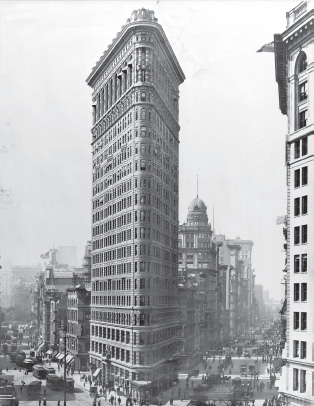 Flatiron Building, New York City (p257) — a triangular site whose apex meets traffic-energy "breaking on the building's point like a bow wave."
The wisest move with a triangle is usually to trade apices for stability — square it off:
 Turning a triangular plot into a regular square or rectangle by "bartering apices for stability" (p258).
Extensions of a square into the north or east (from the NE corner) are auspicious; "no one likes extensions into the southwest." Remedy a bad extension by adding land alongside it, or by trimming it off (also the classic fix for a wide-fronted "tiger-mouthed" plot, and for a plot wrongly aligned to the directions — the alignment gained outweighs the land lost):
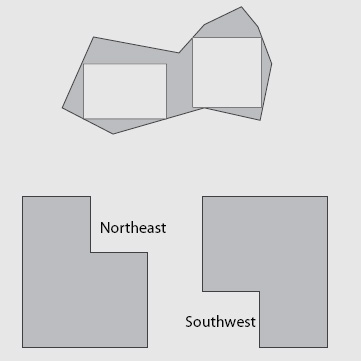 Extensions: welcome toward the northeast, unwelcome toward the southwest (p259).
 Trimming an irregular, wide-fronted plot down to a buildable rectangle (p260).
Roads
Most sites need good road access; the longest wall usually runs parallel to the main road — except when that road is to the south. A site's "gender" can modify the rule: a plot longer north-south is "female," longer east-west is "male." For the front door, prefer east, then north, then west, then south; the best site has roads on its north and east (open, lower ground there). Corner lots are good (especially the NE corner of an intersection); a "bound-angle" corner uses its two roads as protective "moats."
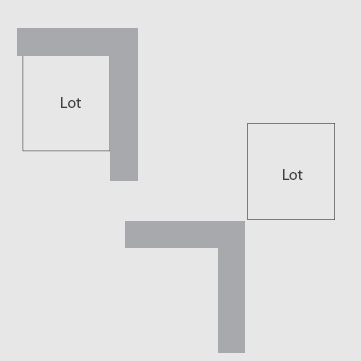 Corner lots — two fronting roads can act as energy "moats" that keep prāṇa contained (p261).
The danger is the vīthi śūla ("road-spear"): a road that T-junctions or dead-ends at a site "skewers" it with overactive prāṇa, breeding destabilizing vāta (dead-end streets, conversely, stagnate prāṇa). A spear pointed at the building's heart is the problem; spears glancing the N/E of NE, S of SE, or W of NW are tolerable, but multiply spears and even tolerable ones turn bad (Svoboda ch.10, p262–265).
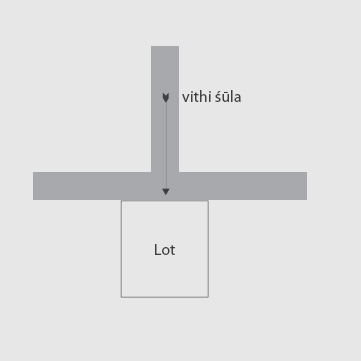 A T-junction acts as a vīthi śūla — a "spear" of road-energy aimed at the lot's heart (p262).
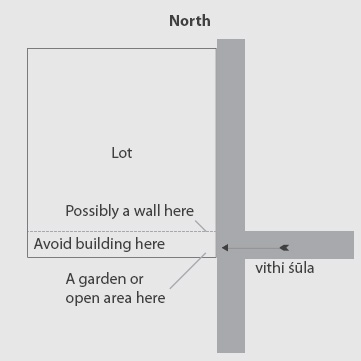 Remedying a vīthi śūla: keep the speared strip as a garden or open area, set a wall, and avoid building in the spear's path (p263).
Patterns and the genius of the place
A site is a meta-pattern, a "pattern of patterns" (A Pattern Language); your imagined building must fit the patterns around it (the jarringly modern Law Courts beside Winchester's ancient Great Hall is the cautionary opposite). Practice "balanced individualism" — fit graciously into your environs (the Korean scholar Yi On-chock's house that "swam into the surrounding land… with no hint of the man's ego"). "Consult the Genius of the Place": each site has a guiding intelligence; sit quietly on the land, let go of your own perspective, and let it "spill its secrets" — an omen, a felt pattern, a gut sense of whether it likes you. Watch for subtle hazards: power lines, and land nāḍīs / marmas (building on a land-marma destabilizes both); and energy permanently marked by intense events (former temple ground, sites of fire, lightning, death, or a graveyard nearby — best eschewed). Troubled energy can sometimes be "nailed down" — the Tibetans use stūpas (kīla, "pins"), as near the Potala Palace — but there's no guarantee; usually it's wiser to choose a less afflicted site (Svoboda ch.10, p265–269). [traditional]
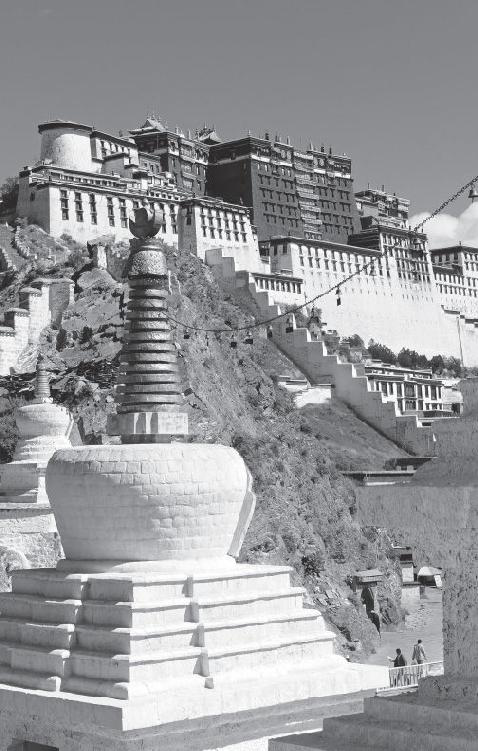 Potala Palace in Lhasa (p270) — Tibetan stūpas serve as "pins" that nail down unstable energy in a landscape.
The last word. "Nothing is beautiful from every point of view" (Horace) — the ideal plot is rare. So Varāhamihira's verdict stands: "Any site becomes auspicious for a person, provided that it gladdens his heart" (Bṛhat Saṁhitā 53:95). [classical] With diligence you can learn to coexist with a site you simply can't let go of (Svoboda ch.10, p269).