Home / Vāstu: Breathing Life into Space / Chapter 11
Ordering Your Space
The closing chapter walks through actually building and ordering a space — orienting the site, laying out the buildable square, choosing materials and proportions, placing the key features, applying Vāstu at work, performing the construction rituals, and welcoming a deity — before a conclusion that gathers the whole book into a single image: the home as a temple, and a person, that breathes.
 The book's chapter-opener motif — a figure within a grid (p272).
Orient the site
First find true north/east — by a gnomon (a post's shadow), a compass (add ~2½° SE of magnetic east in the northern hemisphere), or Polaris (face it and you face north). Then orient the building to the cardinal directions, never the intermediate ones (not even the beloved northeast); an east-facing front wall and door work best. (Mānasāra notes true east suits mokṣa, while eṣa prāci — slightly north of east — better supports dharma/artha/kāma.) In modern small lots orientation is set by the road — let the building face both its road and the center of the square you inscribe. A south-facing plot needs care for its "Martian oomph": ring it with a high wall and put the gate in an auspicious segment, or — as Vimalananda advised — run a long driveway up the eastern edge so the de facto entrance comes from the northeast (Svoboda ch.11, p273–274). [traditional]
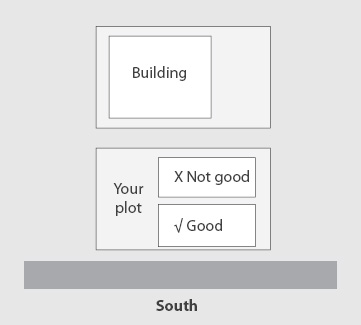 Remedying a south-facing plot — placing the entrance in a better (more easterly) segment rather than straight onto the southern road (p274).
Lay out the buildable square
Keep about half the land as unbuilt "residue," always reserving some for wild nature. Whatever the plot's shape, inscribe a square for the developed area, with more open space to the east and north than to the west and south (some say ≥ 50% more). Quarter that square: build in the northeast quadrant (best direction; leaves the SW free to keep wild) or the southwest quadrant (leaves the NE, which most needs to stay open, free to clear). The building should face both its road and the square's center — so it sits in the SW quadrant to face N/E, or the NE quadrant to face S/W. The center-points of a site and its building should coincide only rarely (and never for a private home — it makes the prāṇa "too active"). Then generate a Vāstu Puruṣa Maṇḍala for the main structure and smaller ones for garden and outbuildings, and keep each Brahma Sthāna inviolate — ideally an open courtyard, atrium, fountain, or skylit center (Svoboda ch.11, p274–276). [traditional]
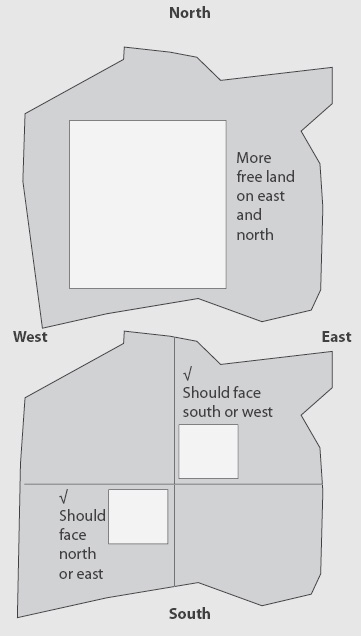 Placing the buildable square: more open land to the east and north, the building set in the SW quadrant (to face N/E) or the NE quadrant (to face S/W) (p277).
Materials, climate, and proportions
Vāstu is agnostic on materials — use whatever is local, abundant, renewable, and suited to the climate's most excessive element. Earthen materials are favored (adobe, brick, stone, wood; water-formed stone like sandstone over igneous granite, since Water's energy soothes more than Fire's), while all-metal and reinforced-concrete buildings interrupt prāṇa. Climate shapes architecture — England's damp made the home a castle and gardening a passion; the desert's heat drove Arab homes inward to cool courtyards (like the compass termites who air-condition their towers to within a degree). Svoboda turns this into a plea for sustainable, human-scaled building: "Accept limitation willingly, and the world will cooperate with you" (Svoboda ch.11, p276–279).
For proportions, start from the minimum reasonable size (he commends the Small House Movement), then fix a side-ratio of 1:1¼, 1:1½, 1:1¾, or 1:2 (Mayamata allows 1:2½–1:3 for monasteries); set the height as a proportion of width, or as a whole multiple of the module (the smallest square of your chosen maṇḍala — a 63-ft 9×9 grid has a 7-ft module, so heights of 7 or 14 ft give "full cubic modular spaces"). A home's absolute dimensions are classically fixed by the Ayadi calculations, which calibrate them to the moon in the owner's horoscope and to the building's yoni (its directional orientation): a Vāstu house is a living organism, and the owner is in effect "wedded" to it by Ayadi means. Rooms should be module-multiples; square rooms suit the metaphysically-focused spaces (shrine, study, even the kitchen). Keep windows/doors square or rectangular opening up/out (Vāstu favors facing windows for cross-ventilation, where Feng Shui warns against it); never build on the marma points (diagonal-crossings, room centers); keep every center open; and provide private nooks and ample storage (Svoboda ch.11, p279–281). [traditional]
Placing the features
- Fire. A home fire has "no worthy substitute" — the fire pit in the central courtyard (tropics) or in the kitchen/den/living area (temperate), kept central and visible from other rooms (pair it with a striking object or vista for when it's unlit) (Svoboda ch.11, p281–282).
- Water. Wells and tanks in the north or east (quality trumps location); a pool in the northeastern triangle; bath fixtures on any wall but the NE — never a toilet or drain in the NE corner (Svoboda ch.11, p282).
- Upper rooms, lower levels. Basements under the whole house or its NE/N/E; a smaller upper floor on the S/W (one room → SW corner); don't make the attic your main storage (clutter blocks air and prāṇa).
- Stairs. Good in the SE and NW, acceptable SW, never in the NE, the center, or opposite the main entrance; spiral stairs should rise clockwise (Svoboda ch.11, p283).
- Front door — the house's "mouth." Threshold at or above ground (never below); height 2–3× its width; not in the center of the wall (that would act as a śūla "wounding" the Brahma Sthāna) but in a flanking segment ruled by an agreeable planet (see chapter 7). Best made of hardwood, decorated, and "making pleasing sounds." Opinions vary on aligning front/back doors and on door counts (even numbers are said to bring respect and wealth) — "let your gut be your guide" (Svoboda ch.11, p283–285). [traditional]
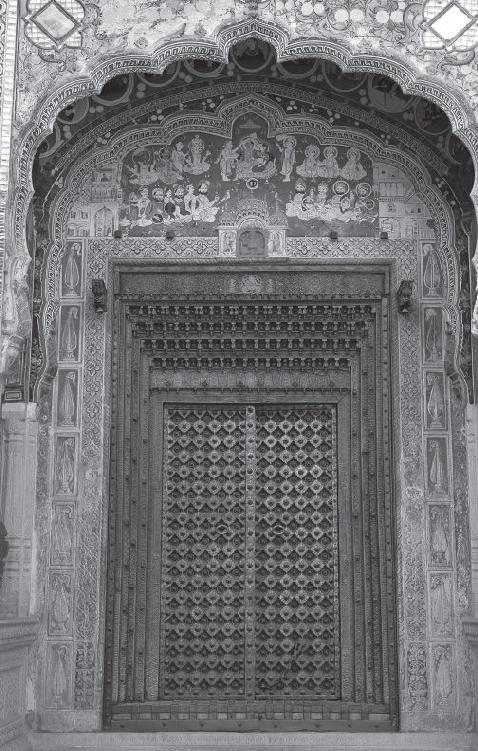 An opulent portal (p286).
- Transitions. Keep stairs, baths, and toilets in the veranda/porch transition zone outside the core; verandas are best on the NE. A tenant becomes part of your "residue" — keep the S/W for yourself, rent the N/E (with separate NE entries); a rented outbuilding goes SE or NW; the garage SW (never NE).
- Boundary walls. Higher and thicker on the south and west (solid stone/brick there, especially against a road-spear); open "segment fences" on the N/E. Set any building back from the wall by at least the Paiśāca Vīthi width (one-ninth of the squared plot) (Svoboda ch.11, p285–287).
Vāstu at work
The same principles serve the workplace. A factory mirrors the Vāstu Puruṣa's body: control systems (head) in the NE, electrical substation (right arm) SE, administration (feet) S/W with the heaviest machinery, manufacturing lines flowing clockwise N→S and E→W, waste cleared through the SW, the shipping dock (left arm) NW. In an office: reception NE, accounts N, senior staff SW; safes north, heavy furniture S/W, computers SE/NW; keep each office's NE and Brahma Sthāna empty. Decorate by the planet of your business (conservative dark for Saturn, bold for the Sun, quirky for Rāhu, rich for Venus), keep all five elements happy, and lavish the most care on the reception — "the face your company shows to the world" (Svoboda ch.11, p287–289).
The rituals: groundbreaking and first entrance
Vāstu marks the critical junctures of construction with worship — above all groundbreaking, laying the foundation, raising the main door, and first entrance — to keep your creative goal "in plain view." Because nāmarūpa means "name and form," your words shape reality; mantras can "materially assist your building to take form" (Svoboda ch.11, p289–290). [traditional]
- Groundbreaking (Vāstu / Bhūmi Pūjā), performed in the site's northeast facing N/NE/E, aims to awaken the Five Elements of the site, accentuate the Ten Directions' positive tendencies, and reduce negative subtle energies left by prior residents. Do it in any idiom you relate to; in the Indian one you might honor Śeṣa, the serpent who supports the earth — "the residue that becomes a residence once it is bound down" — by driving a peg to fix the structure's center (Svoboda ch.11, p290–291).
- First entrance (gṛha praveśa) symbolizes the arrival of prāṇa — a finished building is "like a baby about to be born," windows for eyes and nostrils, the door for its mouth, your first step its first breath. Mark it with ritual (perhaps garbha nyāsa, burying a casket of metals and gems for the Nine Planets) and a feast whose guests' blessings nourish the endeavor (Svoboda ch.11, p291–292).
Deity images
Rūpa-saubhāgyād dhyāna-bhāvo jāyate — "By a harmonious form, a meditative mood is induced." — Vāstusūtra Upaniṣad II:23 [classical]
A deity image (or yantra) near the front door can safeguard the whole home — but the image is "a gateway to the actual cosmic force," so an insult to it is an insult to the Universe. Popular are Sarasvatī (learning), Lakṣmī (wealth), Viṣṇu, Śiva, and above all Gaṇeśa, the elephant-headed Remover of Obstacles — lord of the Earth element (firmness), embodiment of mahat (discernment), and lord of the Mūlādhāra cakra and the sleeping Kuṇḍalinī. Treat such an image as an honored guest (Svoboda's anecdote of the neglected, unfed Gaṇeśa atop a milk-dispenser is the warning): "If you welcome a deity and then ignore or insult it, do not be surprised if things go consistently wrong" (Svoboda ch.11, p292–294). [traditional]
Conclusion
The whole of "Vāstu speech" — shapes, patterns, colors, textures, light — is yours to compose into sentences that say who you are. "A work of art is incomplete until enjoyed"; a building is incomplete until the person who lives in it enjoys a "mutually nourishing, reciprocally supportive relationship" with it, drawing a sweet rasa from their shared bhāva. Begin by studying your own prakṛti and condition, find your "sweet spots," and align body, breath, and brain. The Indian ideal of cultivated space is the temple — "a person constructed of stone, whose indwelling soul is the Lord" — and a well-built home blesses its occupants the same way. Meanings change; where an ancestral home no longer "jibes" with you, Vāstu can recreate the concordance (Svoboda ch.11, p294–295).
The last word is, once more, Varāhamihira's:
Tat tasya bhavati śubhadaṁ yasya ca yasmin mano ramate — "Any site becomes auspicious for a person, provided that it gladdens his heart." — Bṛhat Saṁhitā 53:95 [classical]
And the Vāstu Vidyā's unchanging prayer for all builders (Svoboda ch.11, p295–296):
May all enjoy sukha! May all be free of illness! May all perceive auspiciousness! May no one ever have to suffer misery! May each of us strive ever to live up to this ideal!
 The book's closing motif (p296).