Home / Vāstu: Breathing Life into Space / Chapter 7
Planets and Confluences
The directions give space its qualities; the Nine Grahas (planets) of Jyotiṣa add the time axis, overlaying the directional map with a richer, more specific astrological reading. This chapter introduces the nine planets and their meanings, the master principle of confluence, the jyotishical analysis of the front door, and — most practically — a quadrant-by-quadrant guide to what each part of a space is for.
 The book's chapter-opener motif — a figure within a grid (p163).
The Nine Grahas
Jyotiṣa predates the telescope, so its Nine Grahas are the lights the ancients could see: the two luminaries (Sun, Moon), the five visible planets (Mercury, Venus, Mars, Jupiter, Saturn), and the two lunar nodes (Rāhu and Ketu, the invisible eclipse-points). Graha comes from a root meaning "to grasp": a planetary pattern, once established in you, "grips" you so that you see and act as it does — and graha shares its root with gṛha, "house," for a house too grips your life (Svoboda ch.7, p163–167). [traditional] Vāstu's usual planet-to-direction scheme (which echoes the dikpālas of chapter 6):
| Direction | Planet | Direction | Planet | |
|---|---|---|---|---|
| East | Sun | West | Saturn | |
| Southeast | Venus | Northwest | Moon | |
| South | Mars | North | Mercury | |
| Southwest | Rāhu & Ketu | Northeast | Jupiter |
Two zodiacs. Western astrology uses the tropical zodiac (0° Aries fixed at the vernal-equinox sun); Jyotiṣa almost always uses the sidereal zodiac (0° Aries fixed against the stars). Because Earth's axis slowly wobbles, the two drift apart; the gap (the ayanāṁśa, ~24° today, by the common Lahiri value) is subtracted from a tropical position to get the sidereal one — which is why most people's "sign" shifts back one in Jyotiṣa. The two are simply different languages; you can be an Aquarius in one and a Capricorn in the other "without any inconsistency in being who you are" (Svoboda ch.7, p163–166).
Planetary significations
Each graha is "a pattern of qualities that can illuminate us or cast us into darkness." Numbers map to planets by weekday order (1 Sun, 2 Moon, 3 Mars, 4 Mercury, 5 Jupiter, 6 Venus, 7 Saturn, 8 Rāhu, 9 Ketu). A compact reference to the patterns (Svoboda ch.7, p169–175): [traditional]
| Planet | Dir. | Day | Color | Doṣa | Guṇa | Signifies / rules |
|---|---|---|---|---|---|---|
| Sun | E | Sun | deep dark red, orange | pitta | sattva→rajas | the soul; father, rulers; firmness, nobility, authority, leadership |
| Moon | NW | Mon | milky white | vāta+kapha | sattva→rajas | senses & emotions; mother, caregivers; receptivity, imagination, memory |
| Mars | S | Tue | bright red | pitta | tamas | strength; siblings, soldiers, surgeons; courage, energy, the competitive spirit |
| Mercury | N | Wed | green | tri-doṣa | rajas→sattva | the rational mind & speech; students, accountants; intellect, wit, dexterity |
| Jupiter | NE | Thu | yellow | kapha | sattva | knowledge & fortune; children, teachers, judges; wisdom, optimism, generosity |
| Venus | SE | Fri | radiant white, varied | vāta+kapha | rajas→tamas | desires; spouse, artists; love, harmony, grace, refined sensuality |
| Saturn | W | Sat | black, indigo, blue | vāta | tamas→sattva | sorrows; elders, laborers, monks; discipline, endurance, realism |
| Rāhu | SW | — | ultraviolet | vāta | tamas | eccentrics, the inspired; originality, insight — and confusion, delusion, addiction |
| Ketu | SW | — | infrared | pitta | tamas | renunciates, the possessed; intuition, spirituality, self-sacrifice — and explosiveness |
Each planet has a "bright" face (its positive traits) and a "shadow" (its negatives), and you express whichever you can "digest" well: emphasize a planet's direction, color, metal, gem, plants, or animals in a space and you amplify its whole pattern — including its temperament — in your life. So develop the quadrants of planets that agree with you, and be cautious about strengthening the heavy, tamasic rulers of south, southwest, and west (Mars, Rāhu/Ketu, Saturn) (Svoboda ch.7, p175–176).
Confluence
Confluence — fundamental to all the vidyās — is the principle that when many factors of similar character gather, they powerfully reinforce one another. A west-facing door of black wrought iron is a triply confluent Saturn; positive confluence builds "good space," negative confluence multiplies imbalance (the horror-movie castle is "hyper-confluent Saturn": ancient, lonely, cold, stone, steel, dark). The same holds in the body: a vāta constitution + a vāta-aggravating Saturn/Rāhu + a windy-desert climate + vāta-provoking food + autumn vigils = an "overpowering confluence for vāta imbalance" (Svoboda ch.7, p176–177). Many idioms — planets, dikpālas, doṣas, guṇas, elements — are all valid; use the one that agrees with you, but always check a judgment against the "gut feeling of your prāṇa" (Svoboda ch.7, p178–179).
The jyotishical door
Vāstu has long been taught within Jyotiṣa, and its first concern is the front door, which "activates one of the Nine Grahas" every time it opens. Beyond the door's direction (Sun for east, Mars south, Saturn west, Mercury north), the precise wall-segment it occupies has a magnified influence. To find the door's ruling planet, divide the front wall into nine equal segments and assign a planet to each — starting from the north corner for east/west-facing houses, or the east corner for north/south-facing houses (Svoboda ch.7, p179–181):
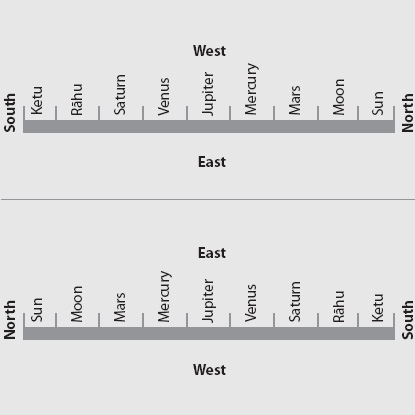 The nine planetary wall-segments for east-facing and west-facing houses (wall running north–south) (p180).
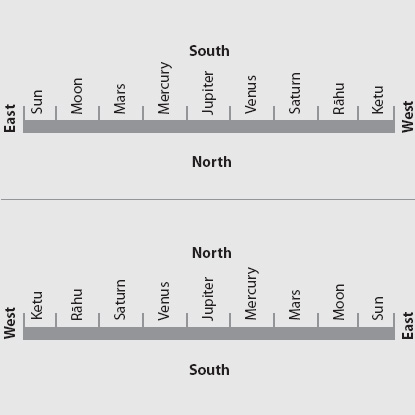 The nine planetary wall-segments for north-facing and south-facing houses (wall running east–west) (p181).
As a rule the door should fall in a segment ruled by an auspicious planet — Moon, Mercury, Jupiter, or Venus (Svoboda ch.7, p182).
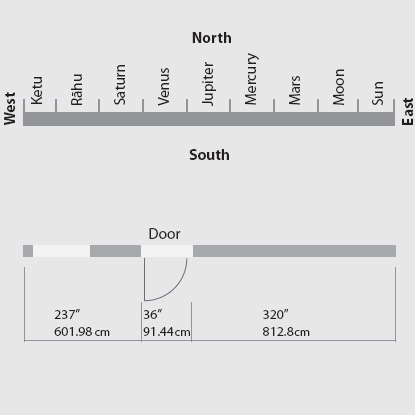 Marie's front door (p182): her ~49 ft north wall divided into nine segments; the 36-inch door falls in the sixth — the Venus segment.
Marie's door illustrates a double benefit: it faces north (Mercury's direction) and sits in the Venus (sixth) segment — both auspicious planets, a confluence of positive indications promising Venusian sukha (delight in music, art, food, sociability). A door in the Mercury segment would have given a stronger specifically Mercurial confluence — good only if the family can digest concentrated Mercury (her accountant husband might; another member might not), which is why she's wiser to keep an amicable balance among the planets than to over-pump any one (Svoboda ch.7, p183–184). Conversely, a door in a malefic segment (Ketu, Rāhu, Mars, Saturn) dims sukha — but don't panic and rebuild: the dire effects emerge only under clear negative confluence (a Saturn door + west-facing + stone walls), which you simply refrain from feeding (Svoboda ch.7, p184).
The front door. "It is unfavorable for a door to be pierced by a road, tree, corner, well, pillar, or watercourse" (Bṛhat Saṁhitā 53:67a). [classical] The door is the home's "prima donna" — keep it unobscured by hedge, boulder, or heavy shadow, and keep nothing inauspicious in its inside line of sight (toilets, drains, stairs, the laundry's "open maw" — screen them or keep their doors shut). A road that T-junctions at the house acts as a śūla, an energy "spear" aimed at its heart (so can driveways, poles, and the sharp corners of buildings opposite); block the spear's view with a hedge or fence, or place a yantra near the door. Indian doors are decorated with leaves, flowers, or rangoli; a foyer where shoes come off is a useful transition zone (Svoboda ch.7, p185–186).
Confluence in the conference room
A long worked example (reddening a boardroom to "motivate") shows confluence in action. Red is Mars's color: mild Mars gives vitality and courage, but over-stoked Mars turns competition into conflict — and piling on a southern room, red dress, Tuesday meetings, and a south-facing building creates a Martian confluence so extreme you'd "install metal detectors." The takeaways for choosing a conference room (Svoboda ch.7, p186–189): northeast (Jupiter) is best — philosophical, optimistic, fair (deep yellows, Thursdays); southeast (Venus) is good but tends toward socializing over working; north (Mercury) brings communication skill (but office politics); west (Saturn) breeds suspicion and isolation; south (Mars) breeds conflict; and southwest (Rāhu/Ketu) — the worst — breeds confusion and meetings that "break up before they begin" (though it can suit a brainstorming "think tank," since Rāhu rules ingenuity).
What goes where — the four quadrants
The chapter's practical payoff. The Vāstu Puruṣa's stance gives the scheme: northeast = the future we face (vision), southeast & northwest = the present (action), southwest = the past at our back (consolidation) — like sitting in a jungle with open sight ahead, a boulder behind, and hands free (Svoboda ch.7, p190–191).
Northeast — Water · sattva · Jupiter. The most auspicious quadrant; its light is "the flavor of Soma, Nectar." Best place for sattva enhancement — a prayer/meditation "serenity nook" — and for a water feature (stream, pond, well, fountain promote inspiration in the whole space). Paint it mild yellow/gold (Jupiter) for graciousness; add saffron-red (Sun) to turn ideas into action, or green (Mercury) for discussion (Svoboda ch.7, p191–192).
Southeast — Fire · rajas · Venus. Fire's true home: put the kitchen stove, fireplace, and "fiery" electronics (computer, TV) here. The right quadrant for dynamic, creative, sensuous activity — cooking, music, painting — done in a "merry, carefree Venusian fashion." Radiant white or gaily-hued; white fragrant flowers and blossoming trees (Venus) (Svoboda ch.7, p192–193).
Southwest — Earth · tamas · Nirṛti / Rāhu & Ketu. The hardest energy to digest, so Vāstu encourages inactivity here: the place for the master bedroom (heavy bedstead, sleep = tamas), storage, and heavy furniture. It rules the ancestors and the past — keep photos of parents and grandparents here, and use a southwest bedroom for the bedtime reflection that "deconstructs" the day. But don't work here: it breeds nostalgia and "misremembering." It rules minerals — the spot for rock gardens, crystals, heavy sculpture (Svoboda ch.7, p193–194).
Northwest — Air · rajas · Moon. The quadrant of perpetual movement and flux. The Bṛhat Saṁhitā puts the treasure-room and granary here — "temples of transience" that stay full through constant in-and-out flow — so it suits the guest bedroom, the medicine chest, the phone/fax, and a TV you "dip into" without becoming captive. Paint it white (Moon); living greenery strengthens both Moon and Mercury (Svoboda ch.7, p194–196).
In every space — dining room, bedroom, kitchen, office — planetary patterns matter. Minor changes (repaint a wall, shift furniture) rarely revolutionize a life on their own, "but they may act as easy first steps on the road to good space," each positive change nourishing sukha through confluence (Svoboda ch.7, p189).