Home / Vāstu: Breathing Life into Space / Chapter 6
Directions
With the Vāstu Puruṣa Maṇḍala in hand, this chapter gives the directions their meanings. Centrality begets axiality, and axiality begets directionality: a space "learns" the qualities of the directions it aligns with, so Vāstu wants buildings squared to the cardinal directions, each of which carries a distinct character that shapes the lives lived inside.
 The book's chapter-opener motif — a figure within a grid (p143).
The four cardinal directions
East is the first, key direction — "orientation" once literally meant "aligning with the east." It is the direction of the rising sun, on whose light and heat life depends, and which gives us our most direct image of the Ultimate. Most importantly, the Sun gives us our prāṇa — "by the rays of that Sun all these creatures are endowed with vital breaths" — and the central Brahma Sthāna of a Vāstu diagram symbolizes that Sun. As the sun's daily birthplace, east stands for beginnings: youth, strength, freshness, hope. Pūrva (east) means "that which comes first" — among the four directions, east is best (Svoboda ch.6, p144). [classical]
West is where the sun "dies"; its light wanes through the afternoon. West (paścima, "that which comes after") is the direction of endings, decline, departure, and detachment — facing a building west "educates" it toward disconnection (toward spirit or toward materialism alike — witness California). Think twice before setting your front door, "the portal through which you greet the day," to face west (Svoboda ch.6, p144–145).
North and south are subtler, keyed to the sun's yearly swing between the solstices. The half-year of lengthening days (Dec 21 → Jun 21) is uttarāyaṇa, the "advancement toward the north" — the year's "morning," when the sun's strength grows; the other half is dakṣiṇāyana. Since "Time is indeed God" (Kālo hi bhagavan), tradition times major life events to uttarāyaṇa, the waxing half. North (uttara) means "that which is better" (Svoboda ch.6, p145–146). [traditional]
South is the year's waning, tamasic side. East being so central to sukha, the word for south, dakṣiṇa, means "the right side" — implying you stand facing east, with south on your right. West and south are the directions of sunset and the past; southwest (south + west) epitomizes tamas — all that is dark, heavy, shady, nocturnal. India's heat reinforces south-tamas / north-sattva, as does the magnetic pull seers observed, and the fixed polestar Polaris (Dhruva, "the immovable") anchoring the northern sky (Svoboda ch.6, p146–147). [traditional]
The influence of climate
North and east (and northeast) are Vāstu's preferred directions, "particularly for a structure's main entrance" — the Bṛhat Saṁhitā puts the Vāstu Puruṣa's head in the northeast. But this is calibrated for India's latitude: in the temperate or subarctic north, south is rightly revered as the source of warmth and light (the Chinese axis placed the red phoenix of summer in the south, the black tortoise of death in the north). In India a south door invites "death by baking," yet some dogmatists insist south is wholly evil and all south entrances everywhere must be closed — which Svoboda calls preposterous: experience must always supersede theory, and even in India some have done well with south-facing homes (Svoboda ch.6, p147–148).
The four puruṣārthas — choosing your door by your goal
Prāg-dvāraṁ sukhadaṁ vidhi paścimaṁ puṣṭi-vardhanam | Dhanadañ ca uttara-dvāraṁ yāmyañ ca mokṣadam — "An eastern door gives sukha, a western door development, a northern door abundance, a southern door mokṣa." — Traditional Vāstu saying [traditional]
One way to choose a door-direction is by which of the four goals of life (puruṣārthas) you most pursue (Svoboda ch.6, p148–149):
- Dharma (doing what you are born to do; overall sukha) → face east.
- Artha (legitimately accumulating wealth) → face north.
- Kāma (satisfying legitimate desires; growth, prosperity) → face west.
- Mokṣa (liberation, disengagement from the world) → face south (good for a retreat or hermit's hut; the least productive for those who want to engage the world).
The Vāstu Puruṣa and the Five Great Elements
Square a building to the cardinal directions and the four intermediate directions appear at the corners, taking their meaning from the sun's seasonal rising/setting points. Northeast (north + east) is doubly auspicious; southeast (east + south) is mixed; northwest semi-desirable; southwest (south + west) doubly negative. Adding up (sky, celestial deities, spirit) and down (earth, body, appetite) completes the ten directions in three dimensions. Orienting the round compass into the square maṇḍala "squares the circle of the sun's rotation" (Svoboda ch.6, p149–150).
Quartering the maṇḍala (head in the northeast) arranges the Five Elements in space:
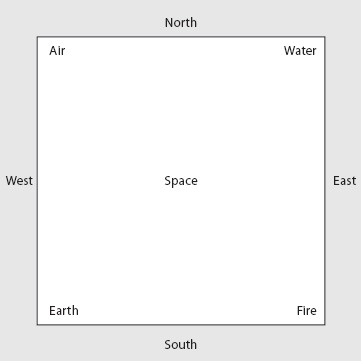 The Five Great Elements in the quadrants of the maṇḍala — Fire (SE), Air (NW), Water (NE), Earth (SW), and Space at the stable center (authorities differ on whether SW is Earth or Space; the fifth sits at the center) (p151).
Because the southwest joins two heavy influences, Space and Earth "tamasically refuse to cooperate" there — Space's restless force meeting Earth's immovable inertia. Vāstu's remedy is to side with Earth's stability: place extra heavy, tall things (trees, hills, closets, cupboards) in the southwest to anchor and steady it (Svoboda ch.6, p151–152).
The Vāstu Puruṣa and the three guṇas
The dynamic tension between tamas (the problem) and sattva (the potential) is rajas; directionality makes the three guṇas predominate in different parts of the maṇḍala, and the whole turns clockwise — the sun's daily path — so the grid becomes a space-time diagram:
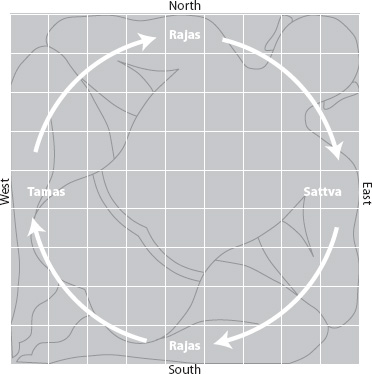 The three guṇas circulating clockwise around the maṇḍala — sattva → rajas → tamas → rajas → sattva, mirroring the sun's daily round (p153).
The caduceus, the yin-yang, and the svastika all symbolize the "good space" that opposing forces in harmonious endless motion create (svastika ≈ "Let this be good!") — movement about a fixed, unmoving center. A svastika can be inscribed in any of Vāstu's three basic shapes (Svoboda ch.6, p153–154). [traditional] (Svoboda notes the Nazis "took the svastika hostage"; efforts continue to restore its honor.)
 The svastika inscribed in Vāstu's three basic shapes — square, octagon, and circle (p154).
The circulation of elements and traits
The day's energies rotate through the quadrants. The northeast holds the pre-dawn hours — the most sattvic, meditative time. At dawn the focus moves to the east (rajas waking); rajas peaks at solar noon in the south; tamas gathers through the afternoon into the southwest (the day's low, opposite the pre-dawn sattva peak); at sunset in the west tamas accelerates back toward rajas, which maxes in the northwest before bed; then north, northeast, and round again. The lesson for arranging a space: maximize sattva, minimize tamas — so the pre-dawn hours and a north/east/northeast seat are best for prayer and meditation, ideally in the home's northeastern quadrant. Of the two rajasic corners, southeast (following sattvic northeast, and home of Fire) gives better-focused, more nourishing action than the lunar northwest (following tamasic southwest, home of Air) — which is why cooking, done with Fire, belongs in the southeast kitchen (Svoboda ch.6, p154–156).
Doṣa circulation
Because both direction and doṣa reduce to the Five Elements, orientation influences the doṣas: Fire sits in the southeast and in pitta, so dwelling mostly in the southeast tends to raise pitta; Air sits in the northwest and in vāta (northwest raises vāta); Water sits in the northeast and in kapha (northeast raises kapha); the southwest, mixing Earth and Space, tends to raise vāta through obstructed prāṇa. Time compounds this — northeast feeds kapha in kapha-hours, southeast feeds pitta at midday/midnight, and so on (Svoboda ch.6, p156–157). [traditional]
Time and doṣas. Kapha predominates in early morning and early evening, in spring, in childhood/ growth, and just after eating. Pitta predominates at midday and midnight, in summer, in adulthood, and during digestion. Vāta predominates at dawn and dusk and pre-dawn, in autumn, in old age, and during assimilation/excretion (Svoboda ch.6, p157–158). [traditional]
Dikpālas — the regents of the directions
The ten directions (dik) are innate properties of Space, and so are themselves substances — "space's attire" (a naked holy man is digambara, "clad in the directions"). The Vedic seers personified the directional energies as dikpālas, the Regents of the Ten Directions; the roster varies by text, but the most common is (Svoboda ch.6, p158–159): [traditional]
| Direction | Sanskrit | Regent |
|---|---|---|
| East | pūrva | Indra, king of the devas |
| Southeast | āgneya | Agni, Fire personified |
| South | dakṣiṇa | Yama, lord of dharma and death |
| Southwest | nairṛtya | Nirṛti, power of chaos and dissolution |
| West | paścima | Varuṇa, lord of Truth, Order, and Vastness |
| Northwest | vāyavya | Vāyu, Air personified |
| North | uttara | Kubera, god of wealth |
| Northeast | īśānya | Īśāna (or Soma), associated with Water |
| Above | ūrdhva | Brahmā the Creator (and Brahman, the Absolute) |
| Below | adhas | Ananta / Śeṣa, the thousand-headed serpent |
Śeṣa (the downward serpent) means "residue" — a residue that becomes a residence "once it's bound down." When a foundation stone is laid, an astrologer finds where Śeṣa lies and a peg is driven to "nail down" the serpent — fixing position, establishing directions, "making the chaotic cosmic" and the world stable. This echoes the pinning of the Vāstu Puruṣa himself (one Tibetan story merges them into an "earth-bellied snake deity"). The regents of south, southwest, and west — Yama and Varuṇa with their nooses, Nirṛti — all carry themes of binding, measuring, and termination, which is why those directions leave most people ill at ease. So the Vāstu Puruṣa lies face-down, head bowing into the northeast, toward Īśāna "the Great Lord," whose energy is life — and Vāstu prefers most buildings to face the life-giving east or north, squared to the directions (Svoboda ch.6, p159–160). [traditional]
When a building is not squared to the directions, its energies "leak" and it struggles to ingest clear directional energy. Measure how far the façade is off true north: under 20° off counts as northern; more than 25° toward east or west counts as northeast or northwest; the 20°–25° "twilight zone" is an ambiguous "neither this nor that" — remedy it with bright colors, clear lines, spare furnishing, well-drawn Vāstu Puruṣa Maṇḍalas inside and out, or a properly aligned northeast extension (last resort: move) (Svoboda ch.6, p160–161).
Here too, confluence
Generally, excess kapha benefits from the stimulation of southeast/northwest, vāta from the northeast's calm and the southeast's warmth, pitta from the northwest's challenge and the northeast's coolness — and the southwest is as broadly unbalancing as the northeast is harmonizing. But only generally: direction is one factor among many. A diet of "spiced sausages, coffee, tequila, and tobacco" will spike pitta no matter how faithfully you meditate in your northeastern chair. When you can't realign a space ideally, return to basics — live in concordance with prāṇa: know your own doṣa and guṇa leanings, experiment to find what works (diet for some, color for others), avoid fixing an alignment "before you're certain it's worthy of becoming permanent," and in all cases "look to prāṇa, the ultimate source of your sense of sukha" (Svoboda ch.6, p161–162).