Home / Vāstu: Breathing Life into Space / Chapter 3
Elemental Space
This chapter lays the conceptual groundwork the rest of the book builds on. Before any rule about directions or rooms, Svoboda wants you fluent in the raw materials of Vāstu thought — the body and its doṣas, the five elements, the three guṇas, and the "I-making" force that binds a space together. It is discursive and woven through with prāṇa and consciousness; that framing is the book's own, not imposed here.
 The book's chapter-opener motif — a figure within a grid (p54).
Vāstu training
No traditional vidyā (body of knowledge) was meant to be learned from a book alone. Each text assumed a guru to explain it. Books can transmit facts about Vāstu, but only a sthapati — a "master builder" who has received the living, energetic transmission from his or her own teacher — can transmit the Vāstu system itself (Svoboda ch.3, p54).
The principles in the book are time-tested and reliable, but they are rules of thumb: they work much, not all, of the time. To make every pronouncement come true would require a siddhi, an extraordinary attainment reached only through stringent spiritual practice (sādhana) under an adept (Svoboda ch.3, p54–55). Svoboda illustrates the rare gift with an elderly farmer from the Nilgiri Hills who glanced at a building, disliked it, and declared its owner would soon be in trouble — the owner, a politician, was arrested for corruption the next day (Svoboda ch.3, p55).
Such precision is the exception. Vāstu cannot explain every misfortune, though people try to force it to: he recounts a Kerala "expert" who blamed two deaths in a family on a portico built eighteen inches too long — "an absurd misuse of Vāstu." Even when a principle seems to foretell calamity, you should not put much stock in the prophecy unless other principles reinforce it — a confluence. Evaluate even a master builder's advice through your own breathing, heart, common sense, gut, and reason (Svoboda ch.3, p55–56). Until a true guru appears, the task is to learn to access your own "Vāstu intelligence" (Svoboda ch.3, p56).
Cleaning house
You connect with the Vāstu Vidyā better if you first put your bodily "home" in order — just as you tidy a house before guests arrive. A clean physiology makes the senses balanced and acute and makes the breath, gut, heart, and mind reliable as indicators of Vāstu fitness (Svoboda ch.3, p56). No fanaticism is required: eat modestly, exercise, drop addictions, sleep well and at the right times, detoxify; breathing exercises and yoga clear "grime" from the inner channels through which prāṇa moves; prayer and meditation purify the mind (Svoboda ch.3, p56).
A good way to keep the mental house tidy is the yogic yamas (restraints) and niyamas (observances). Patañjali, in the Yoga Sūtras, lists five of each [classical] (Svoboda ch.3, p56–57):
- Yamas (restraints): non-violence (ahiṁsā), truthfulness (satya), non-stealing (asteya), control of the senses (brahmacarya), non-covetousness (aparigraha).
- Niyamas (observances): purity (śauca), contentment (santoṣa), austerity (tapas), study of the Self (svādhyāya), surrender to the Supreme (īśvara praṇidhāna).
You need not follow these perfectly; accepting them as goals and trying sincerely is enough to open yourself to the Vidyā (Svoboda ch.3, p57).
Exercise — The Body Container. Lie on your side (the right, if possible), breathing deeply and slowly, then over several minutes turn very slowly onto your back, attending to the fluids, solids, and prāṇa shifting within the abdomen, thorax, and head; continue to the left side, rest, and reverse. Notice how right-to-left differs from left-to-right. The point is to build awareness of your inner spaces (Svoboda ch.3, p57–58).
Āyurveda
Understanding a little Āyurveda makes it easier to feel your internal spaces and how external spaces affect them. Its core precept is "like increases like" [traditional]: lie in warm sun and you warm; eat fat and you store fat. At extremes the opposite waits (sunburn then chill; an icy plunge then a rush of warmth), but most of the time an environment's qualities stimulate the same qualities in you — an arid house dries you out, a humid one makes you soggy (Svoboda ch.3, p58–59).
Three patterns of qualities describe almost any physiological state (Svoboda ch.3, p59):
- Dry pattern — dry, cold, light, unstable, clear, rough, subtle.
- Hot pattern — oily, hot, intense, light, fluid, liquid.
- Heavy pattern — oily, cold, heavy, stable, viscid, smooth, soft.
These span Āyurveda's three pairs of opposites (Dry–Wet, Hot–Cold, Heavy–Light) and exist in us as the three doṣas [traditional]: vāta engenders the Dry pattern, pitta the Hot, kapha the Heavy. Strengthened by diet and activity, they can act almost autonomously. Vāta (nervous system) controls all movement; kapha (musculoskeletal system) gives stability and lubrication; pitta (endocrine and enzymatic systems) governs the balance of building-up and breaking-down. Health is their equilibrium; losing it invites disease (Svoboda ch.3, p59–60).
Constitution and condition. Your prakṛti (constitution) is the inborn doṣa pattern fixed at conception; your vikṛti (condition) is your current state. Āyurveda prizes knowing your constitution, but in Vāstu it is often your current condition that matters most. Tell-tale signs: heavy vāta — quick and impulsive, energy in bursts, fast to learn and forget, light/broken sleep, sensitive to cold, pain, and noise, anxious under stress, erratic. Heavy pitta — intense, hot-tempered but controlled, sharp memory (especially for slights), keenly logical, competitive, impatient, strong-willed. Heavy kapha — steady and well-paced, kind, change-averse, prone to complacency and sentimentality, heavy-boned, sound long sleep, slow to decide but firm once decided (Svoboda ch.3, p60–61).
Climate, season, age, strength, mood, and habit all move the doṣas, but the greatest influence is usually the qualities of what we consume and do — everything increases the qualities "like" it and decreases the "unlike." Live in a dry space long enough and vāta's Dry pattern unbalances you; overheat and pitta "goes ballistic"; wallow in damp and kapha swamps the rest. In Āyurveda sukha means good health (and "good space"); duḥkha, ill health (literally "bad space"). Balance is health, restored by applying contrary substances and actions — grounding yoga to settle vāta, equalizing practice to calm pitta, lifting practice to rouse kapha (Svoboda ch.3, p61–62).
Crucially, even space is a substance: every space you inhabit shapes your inner patterns, and your condition stamps itself back onto your space — so one can sometimes "read" the doṣas of a household by how its members arrange their rooms (Svoboda ch.3, p62). To sharpen this perception, reduce your toxin load, e.g. by fasting or by taking the classic preparation Triphala (Svoboda ch.3, p62).
Triphala ("three fruits") is a gentle Ayurvedic detoxifier and rejuvenative, often called its panacea — usable as a laxative and wash, and as eye/nose/ear drops. It is harmless but can mobilize stored toxins faster than a weak system clears them, causing a transient rash; if so, stop, let it clear, and resume at half dose (Svoboda ch.3, p63).
The Five Elements
Vāstu still follows the Vedas in using simple acts of veneration to focus prāṇa and intention. Align your own prāṇa and the environment begins to cooperate — things arrive when needed, obstacles resolve. Approach the world reverentially and it grows well-disposed; try to command it and it turns unfavorable (Svoboda ch.3, p63–64). "Good space" is drawn to whoever respects how space holds and directs prāṇa. One popular, nonsectarian way to court it is to make offerings to the Five Great Elements (pañca mahābhūta) — Space, Air, Fire, Water, Earth — the building blocks of everything in the manifested universe, bodies included [traditional] (Svoboda ch.3, p64).
These are best understood as the five great states of material existence: Earth = the solid state, Water = the liquid state, Air = the gaseous state, Fire = the transformational principle that converts one state into another, and Space = the field from which matter manifests and the arena in which events occur (Svoboda ch.3, p64).
The breath-science of Svarodaya assigns each element a shape, taken from the vapor your breath leaves on a mirror when that element predominates in you [traditional]: Earth is a square (the breath covers the whole flat "ground"), Water a crescent (concave side up), Fire a triangle (the shape of flame), Air an oval, and Space a scatter of small dots (presence with almost no form) (Svoboda ch.3, p64–65).
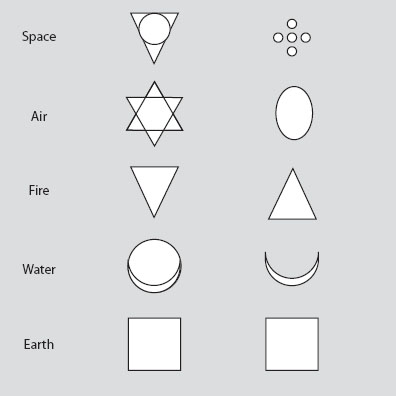 Fig. 3.1 — Symbols for the Five Great Elements (p66). The right-hand column is the Svarodaya breath-vapor set described above (Earth square, Water crescent, Fire triangle, Air oval, Space dots); the left-hand column gives the more elaborate yantra-style symbols.
The human body is made of all five: bones are Earthy, the fluids Watery, the digestive juices Fiery, the nervous system Airy, and the body's vacant cavities (lungs, heart, intestines, the brain's ventricles) are Space (Svoboda ch.3, p65). The three doṣas themselves condense out of the elements: vāta from Air + Space, pitta from Fire + Water, kapha from Water + Earth. Each doṣa is denser than prāṇa yet subtler than the elements — a "joint" formed where two elements meet, which is exactly why the doṣas, though made of elements, can move the elements around (Svoboda ch.3, p65). Each element can nourish, balance, or disturb its doṣa offspring — Earth gives firmness or petrifies; Water makes life "juicy" or "gummy"; Fire grants clarity or cunning; Air brings vigor or exhaustion; Space gives bliss and illumination or the ache of hollowness (Svoboda ch.3, p66).
Worship ritual
Even dense matter is to some degree sentient; build a rapport with it and the material world starts to meet your needs unbidden. One way is ritual reverence (pūjā). Because the Five Elements are nonsectarian, your invocation need follow no particular sect, only your own way of seeing (darśana) (Svoboda ch.3, p66–67).
Pañcopacāra Pūjā — the five-offering ritual. Clean the spot and bathe; set a small altar. Gather pure water, incense, a fragrant paste or oil, a bell, a lamp or candle, fresh flower(s), and a little sweet food — all fresh, never reused or pre-tasted. Remove your shoes and sit facing east or north-east. Visualize a golden circle around you, sealing off "worship space and time." Offer incense to the ten directions, clockwise. Then offer to each element in turn: sandalwood paste/oil for Earth, food for Water, the lamp for Fire, incense for Air, the flower for Space (some reverse the order), visualizing a purifying current entering you with each. Close with a prayer for all beings, partake a little of each offering, bow, and leave the circle [traditional] (Svoboda ch.3, p67–69).
Getting to know the Five Elements
To "see" the elements you must first feel them. Earth: rock-climbing or walking barefoot on grass (it grounds you). Water: a waterfall, "moon-bathing" under the full moon, meditating on a river. Air: wind-bathing in a breeze, a massage, flying. Space: stargazing, chanting, singing, uplifting music. Fire (the transformational element the ancient seers worshipped): gazing at the rising sun or a flame, building and meditating on fires, Sun Salutations. A single warm, fragrant oil massage delivers all five at once — its fragrance and heaviness are Earthy, its fluidity Watery, its warmth Fiery, its movements Airy, and by exalting the tissues it enhances the Space you occupy (Svoboda ch.3, p69–71).
The book marks each element here with a small pictorial emblem (p70–71):
 Earth (p70).
 Water (p70).
 Fire (p71).
 Air (p71).
 Space (p71).
"Vāstu eyes," he says, are like a gardener's eyes — they see life and its potential for growth; such sight came more easily when people lived on farms than it does amid zoos and specimen parks (Svoboda ch.3, p71).
Exercise — Messages from the Elements. Each morning, on first leaving home, note the first thing that most viscerally reminds you of one element (a dumped heap of sand = Earth; a gale or runaway kite = Air), then watch for that element all day. Your Vāstu study is a "Rosetta Stone" for reading the messages the elements strew in your path (Svoboda ch.3, p72).
Do not be bullied by "experts" who warn that your life is in danger unless you instantly close a south-facing entrance or re-measure every room. Transform your environment as your constraints allow; each judicious change adds to sukha and builds momentum for prāṇa's healthy flow. Vāstu is the quest for "good space," and sukha is ease — the "architectural music" of well-decorated rooms, benign façades, and well-proportioned buildings that please residents and onlookers alike (Svoboda ch.3, p72–73).
Conscious space
Vāstu invites us to view the world from the standpoint of Space — the field from which all arises, within which all interacts, and into which all dissolves. We are time-obsessed and space-neglectful (we even give directions in minutes, not distance). Yet "empty" space is permeated by a vacuum energy that spawns countless virtual particles each instant [modern: Svoboda] (Svoboda ch.3, p73–74). Space (ākāśa) both hosts and gives birth to particles; space-time bends under gravity yet keeps the universe from collapsing. Some physicists call Space "quintessence" (the Greek "fifth element") — a dynamic quantum field that repels gravitationally, interacts with matter, and evolves with time; Ervin Laszlo's Science and the Akashic Field draws the parallel with ākāśa [modern: Svoboda] (Svoboda ch.3, p74).
So Space is itself a subtle form of matter — neither empty nor inert, a field that can "learn," shaped by and shaping its contents. This resembles the ancient ākāśa, but ākāśa is richer: Reality is said to shine through Space's gossamer fabric as awareness (the word ākāśa comes from a root meaning "to shine"). In a fundamental sense, ākāśa is Vāstu, and Vāstu is ākāśa: Vāstu is nothing more than evaluating a location's attributes and adding or subtracting characteristics to create the attributes you want. Space is alive — like the other four elements it carries and responds to prāṇa, and where there is prāṇa there is awareness, subtler than waking consciousness and therefore able to affect us more pervasively than we realize (Svoboda ch.3, p74–75).
Akashic confoundment. Svoboda debunks the popular notion that "akashic" means "giant library." In truth the ākāśa of a place retains the traces of every event that happens there — the "akashic records" — stored in the fabric of Space itself, not in any building (Svoboda ch.3, p75).
Vāstu awareness
The deepest split between the sciences of East and West: modern science holds that consciousness arose from matter; traditional Indian science holds the reverse — that consciousness pre-exists matter, and matter in all its forms derives from it. In that view the gross material world is merely the densest of many interacting domains, at whose core sits pure, unqualified consciousness; everything other than that One Reality is material and can be influenced (Svoboda ch.3, p75–76).
So all matter holds a kind of life, from atom to galactic cluster, and consciousness expresses itself ever more fully through minerals, plants, animals, and — most effectively so far — human beings; even the tiniest particle carries "a tiny dollop of consciousness." The Five Elements can learn to respond to you precisely because they are faintly conscious. Vāstu is a way of awakening the dormant awareness of the elements within a well-defined region, building a cooperative relationship on the basis of the one consciousness all matter shares. To read a space, look down its core to its "Indwelling Spirit" (Svoboda ch.3, p76–77).
The three guṇas
Like every vidyā, Vāstu studies guṇa dharma — the innate characteristics of things. The most fundamental qualities of individualized consciousness are the three guṇas [traditional]: sattva (equilibrium), rajas (activity), and tamas (inertia). Sattva is the reflective consciousness that models and illuminates the world, the source of the thinking mind and the ten senses (five of perception, five of action). Rajas is restless, active awareness, always seeking something to attach to. Tamas is consciousness veiled in materiality, evolving into the five subtle sense-objects (sound, touch, form, taste, smell), which in turn evolve into the Five Elements (Svoboda ch.3, p77).
The guṇas act, like the doṣas, by mutual suppression: whichever rises temporarily quiets the others. A sattva-led mind perceives accurately and responds aptly; a rajas-led mind craves constant change; a tamas-blanketed mind clutches at objects and resists even necessary change (Svoboda ch.3, p78). Every substance and action promotes some mix of guṇas — a lotus documentary feeds sattva, loud music videos feed rajas, tired sitcoms feed tamas. So each space and its contents should promote the guṇa that belongs there: the bedroom a modest tamas (for sleep), the game room rajas (for activity), and every space ultimately sattva, with the meditation room the most sattvic of all — your "sattva storehouse" (Svoboda ch.3, p78–79).
Relative to sattva, all five elements are tamasic. Earth carries the most tamas, then Water, Fire, and Air with decreasing tamas and increasing rajas; Space is the most sattvic. But Vāstu has its paradoxes: Space, though sattvic, also fosters tamas by being the least changeable element; Air is rajasic; Fire is both sattvic and rajasic; and Water and Earth, though heavy and tamasic, are the easiest to shape and stabilize, so when harmoniously arranged they actually promote sattva (Svoboda ch.3, p79).
Ahaṁkāra
Your perspective at any moment is governed by ahaṁkāra, the innate "I-creating" power. Out of prakṛti, ahaṁkāra unfolds into the three guṇas, the mind and senses, and finally the five elements; it generates "I-ness" in everything, especially living beings. It aggregates your building blocks into the "you" that you know, identifying ceaselessly with each of your trillions of cells; when it falters, immunity and self-confidence fall together; when it fails entirely, you die (Svoboda ch.3, p79–80). Ahaṁkāra also brings perception, and so experience, into being. Every created thing, atom to galaxy, has its own ahaṁkāra — its "force of cohesion" — and the relationships between things (especially items in a space) are fundamentally relationships between their ahaṁkāras (Svoboda ch.3, p80).
Exercise — Prāṇa, Tejas, Ojas. Perform trāṭaka: gaze steadily at a candle flame's tip until the eyes water, then close them and breathe in its golden light. Learn to distinguish the breath from the energy it carries — that energy is prāṇa — and direct surplus prāṇa to wherever it feels obstructed. Follow prāṇa down into the cells: prāṇa (the subtlest form of Air) enkindles tejas/agni (the subtlest Fire, the "flame of life" that transforms all we consume); use well-kindled tejas to "cook" ojas (the subtlest Water — the glue that integrates body, mind, and spirit, producing the aura and governing immunity) by visualizing each cell coated in warm ghee, then honey [traditional] (Svoboda ch.3, p80–82).
Filling space
Ahaṁkāra defines space, time, and energy too — in Vāstu these are as much substances as brick and fabric. Boundaries and contents "educate space into I-ness" by confining, defining, and filling it (Svoboda ch.3, p82). Any space is predominantly filled (reflecting the self-identity of its contents) or empty (reflecting the self-identity of its margins and partitions); well-designed filled spaces almost always grow out of well-demarcated empty ones. For any moment there is an apt amount of detail, and concinnity (fitting harmony) comes more readily to simple, regular spaces filled with simple objects than to cluttered, irregular ones. Two design questions follow — what items should fill the space and how arranged, and what qualities should they have — and both depend on a prior one: how full, and how empty, should this space be? (Svoboda ch.3, p82–83).
Exercise — Addition and Subtraction. Sit quietly in a room (facing east) and feel its effect on your prāṇa. Remove furniture one piece at a time until it feels too empty; then add back until it feels too full. The gap between those points is the room's "differential fill potential" — larger in better-shaped rooms, giving you more freedom to decorate. Note, too, that each object has its own ahaṁkāra and its own room-and-neighbor preferences: a rocking chair is supremely adaptable, a recliner a tamasic "throne" that belongs by the entertainment center (Svoboda ch.3, p83–84).
A thing's ahaṁkāra is its personality; we weigh a room's many ahaṁkāras through discernment. Behind ahaṁkāra stands mahat ("the gigantic"), the overarching power to discern, which poses the fullness/emptiness and proportion questions and the deeper one still: what can materialize in this space, and how? (Svoboda ch.3, p84–85). Some spaces (a laundry) define themselves; most are malleable, and you, as the home's creator, decide which becomes bedroom, library, study, or shrine. That creative act is governed by the Law of Karma — which Svoboda equates with Newton's Third Law: every creative act limits the next, as one chosen color or shape constrains those that follow ("as you sow, so shall you reap"). Before you take it on, a home is just a dream; once you do, every act concretizes it — so form a clear intention first and keep the goal in sight. As his teacher Vimalananda put it, "Cause is effect concealed, and effect is cause revealed." The chapter closes on the image of a building as a symphony in stone (Svoboda ch.3, p85–86).
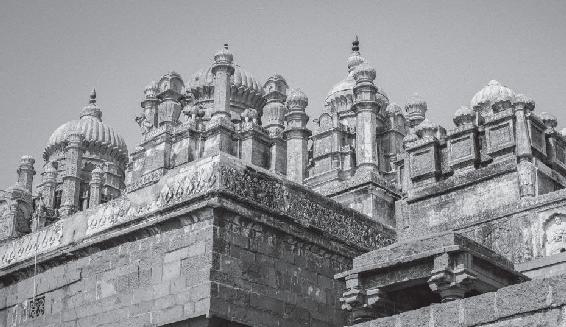 Symphony in stone (p86).