Home / Vāstu: Breathing Life into Space / Chapter 1
Encouraging Space to Cooperate
The opening chapter sets out everything the book will develop: that a space can actively help or harm whoever lives in it, that the thing being measured is the flow of prāṇa (life-force), that the goal is sukha ("good space"), and that Vāstu is the practice of aligning our inner and outer spaces so prāṇa circulates freely. Svoboda teaches it through stories from his teacher Vimalananda.
 The book's chapter-opener motif — a figure within a grid (p10).
The tiger's mouth and the cow's mouth
Svoboda's introduction to Vāstu came when Vimalananda asked him to read a plot of land. The ashram before them sat on a Vyāghra-mukhī Bhūmi, a "tiger-mouthed tract" — wider at the front than the back, like a tiger's broad head and narrow hips. Such a plot, Vimalananda said, "will eat up all your resources and give you very little in return." Better is a Go-mukhī Bhūmi, a "cow-mouthed tract," narrower in front and wide at the back: like a cow it costs little to keep and returns milk, dung, and devotion (Svoboda ch.1, p10–11). [traditional]
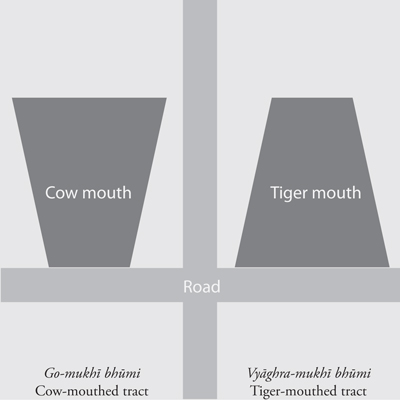 The two plot shapes: Go-mukhī bhūmi (cow-mouthed, narrow at the road) vs Vyāghra-mukhī bhūmi (tiger-mouthed, wide at the road) (p12).
This is "just one factor among many," but a major one: land itself can be beneficial or detrimental to its owner, and poor placements can often be remedied — here, shifting the entrance from the long side to the short side would turn a tiger-mouth into a cow-mouth, or partitioning off two triangles would square the plot. The ashram's devotees dismissed all this as superstition and built to their own taste; it has been "eternally penniless" ever since. Indians, Vimalananda noted, obsess over time (pestering astrologers for auspicious moments) but almost nobody attends to space (Svoboda ch.1, p12–13).
Prāṇa
Everyone has felt spaces that are "just right" — where one breathes more easily — and spaces that feel "off" the moment you arrive (sometimes explainable as "sick building syndrome," a hot wind, etc., often not). Some spaces feel good to nearly everyone, some bad to nearly everyone, and some agree with a few while repelling others; even a single room has "sweet spots" people gravitate to and corners they avoid. Live long in agreeable conditions and they support health, prosperity, and longevity; live in disagreeable ones and disease, poverty, and conflict grow likelier (Svoboda ch.1, p13–14).
The force behind these feelings of ease or dis-ease is the life-force — prāṇa in Sanskrit, qi in Chinese: the vitality that lets body, mind, and spirit function as one. Of the infinite ways to arrange a space, only a few nurture its potential; many impede it. But in any situation there is usually at least one "ease-promoting" arrangement that reliably keeps prāṇa circulating. To systematize this for built space, the sages of ancient India created Vāstu Śāstra, India's science of form (Svoboda ch.1, p14–15).
Vāstu vs vastu. The word vāstu comes from vastu, from the root vas, "to dwell, exist." A vastu (short "a") is a material reality, the raw matter from which things are made; vāstu (long "a") is "a building site, an abode, a dwelling place" — the finished product made out of vastu. Vastu is the potential and subtle; vāstu the realization and dense. By extension vāstu covers the earth one inhabits (bhūmi), the buildings on it (harmya), and even movable "temporary dwellings" — furniture (śayana) and vehicles (yāna) (Svoboda ch.1, p15).
Vāstu is a philosophy of living that judges the "aptness" of site and situation, recommending we arrange our spaces so they align us with the larger spaces of town, planet, and cosmos. "Good" Vāstu promotes equilibrium, prosperity, and health; "bad" Vāstu impedes prāṇa and prevents ease. No one's well-being is ever independent of the well-being of the land, community, and cosmos — to align with the whole you must first appreciate it (Svoboda ch.1, p15–16).
Sukha
What we really seek when we chase happiness is sukha — a state of well-being where inner contentment meets outer abundance. Sukha literally means "good space" (kha = space); its opposite, duḥkha, is "bad space" — misery, misalignment, disease. The prefix su (cognate with the Greek eu-, as in euphoria) adds a flavor of rightness and ease (Svoboda ch.1, p16). Sukha is "wholistic": it asks that all the spaces of life — bodily, familial, economic, psychological, spiritual, communal — be well-ordered and harmonious. A merely beautiful house does not guarantee it (despots filled palaces with art that never spoke to them; hermits in ruins find bliss). Corporeal pleasure must stay secondary to mental and spiritual fulfillment — the impulse that once built Europe's cathedrals, before the West "chose the primacy of matter over spirit" and let its vistas fill with coarse building (Svoboda ch.1, p16–17).
Vāstu and Feng Shui
India and China both founded enduring traditions of "spatial science." Vāstu and Feng Shui differ in detail but agree fundamentally: both teach that creating good space starts with understanding balance and alignment; both are spiritual approaches to architecture; and both evaluate the condition of the life-force in a space — how freely it flows, where it stagnates, and how to enliven it. Following the Law of Microcosm and Macrocosm, Vāstu holds each human to be a living miniature of the universe, mirroring the great cosmos. Take nature as a resource to exploit and it exploits you back; align with it and your "lesser universe" becomes a harmonious part of the greater (Svoboda ch.1, p17–18). [traditional]
The chapter drives the point home with paired photographs — inspiring built space against degraded:
 Inspiration caught in stone (p19).
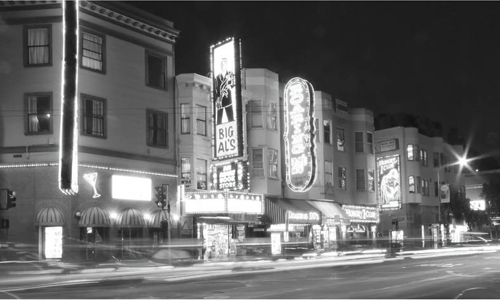 Tawdriness frozen in concrete (p20).
Alignment
Each human is a set of intersecting "spaces," each with its own attribute profile — a slate of characteristics, some fixed, some adopted, some waxing with season. Every substance, action, and space has such a profile; when two profiles complement each other they resonate and align. Simple spaces (regular dimensions, primary colors, plain textures) align readily; intricate or gaudy ones, like an over-styled garment, match almost nothing. Just as we dress to express who we are, we furnish space to externalize our tastes — but we cannot reflect "who we are" without addressing "where we are." When inner and outer attributes resonate, that resonance propagates: cheerful people make cheerier rooms, cooperative attitudes make space "cooperative." So sukha can be read as cooperative space, duḥkha as uncooperative space (Svoboda ch.1, p20–21).
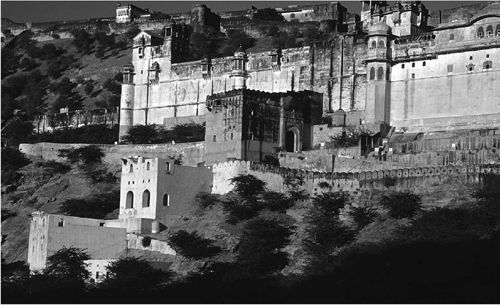 A well-perched palace (p21).
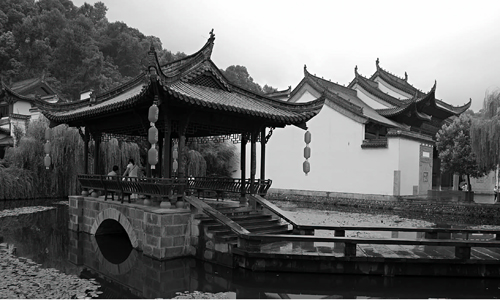 A pond-poised pagoda (p22).
Buildings are brought to life by their currents of prāṇa. Sometimes the effect is physical (the new Yankee Stadium's roof shifted the wind and increased home runs); usually it is subtler but still palpable — a well-designed building generates self-perpetuating healthy prāṇa that lifts whoever enters, while an oppressive one stifles. The unease may come from bad proportion, poorly placed doors, a strange ceiling, or physical factors (stuffy air, clashing colors); or from something subtler still — a previous inhabitant's residual vibration (a concert hall that still "sings," a house where violence lingers for years) (Svoboda ch.1, p21–23).
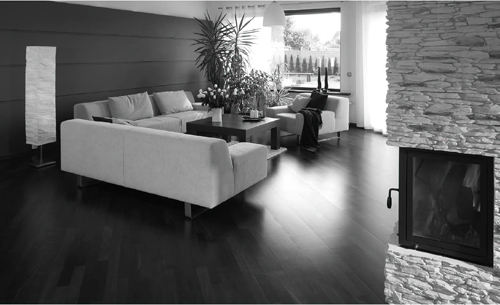 Relentless spikiness (p23).
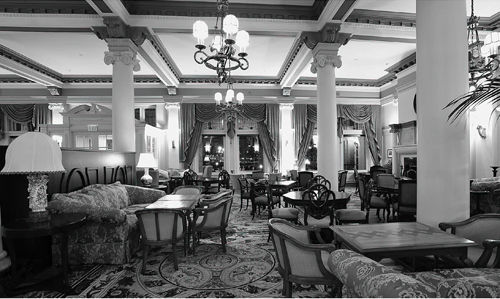 Eye-splitting cacophony (p24).
To address all this Vāstu offers tools: its Five Element and Ten Direction analyses (how external space pressures us to align, and how to respond) and Ayadi calculations (mathematical equations fixing apt proportions, aligning a structure with the directions and with our own bodies) (Svoboda ch.1, p24). [traditional]
Skins
Good space is "grown," and growth needs prāṇa, which is everywhere — even "empty" space is packed with it, accumulating wherever awareness concentrates. When walls enclose space, the energy "closes in on itself" and gains a rudimentary awareness of its own limits, which makes it behave in a life-like way. Breath is one of prāṇa's vehicles; you cultivate your own prāṇa by breathing well and a space's prāṇa by helping it "breathe" well. Like skin, Earth, and lungs, buildings respire — drawing in air, light, water, and prāṇa — and houses that breathe well encourage their residents to breathe vigorously, because a dwelling is part of our "supplementary skin" (Svoboda ch.1, p24–25).
Every living thing maintains a boundary — cell wall, membrane, shell, skin. Humans uniquely craft extra skins: clothes (once animal hides), then shelter (houses, offices, vehicles, furniture) that helps regulate temperature and calm the nervous system. These skins nest outward — lawn, fence, neighborhood, city, state, nation, planet — and inward too (between lymph and blood, flesh and fat, bone and marrow), with the central nervous system sheltering prāṇa and, at the core, pure awareness. We are layered like onions and need careful cultivation at every layer; the crucial discontinuity to watch is the seam between our birth-skin and the architectural skins we live in — which a well-built home can bridge gracefully (Svoboda ch.1, p25–26).
Mind, prāṇa, breath
We relate to the "earthy organism" called house on three levels: our body to its physical body and functions; our prāṇa to its prāṇa flows; and our mind (habits, idiosyncrasies) to its subtle sediments and vibrations. Good Vāstu makes you and your space resonate: as you breathe, so does your dwelling. Breath, prāṇa, and mind are the same manifested consciousness on three levels — control one leg of the tripod and you influence the others, which is why breath-control (prāṇāyāma) is a cornerstone of Haṭha Yoga (Svoboda ch.1, p26–27).
A classical principle shared by Āyurveda, Yoga, Tantra, and Vāstu: whenever two structures or functions interact, the subtler one exerts the greater influence. [classical] So prāṇa-flow influences breathing more than breathing influences prāṇa (breath-control works only through patient repetition); and attention, being subtler than prāṇa, directs it — wherever attention goes, prāṇa (and we) follow. We take in prāṇa through food, water, air, and some light and sound, then release it with our digestive fires; a subtle "cooked" prāṇa rises in the body like steam from a pot (the Chinese characters for qi depict vapor rising from cooking rice). Three sets of "vapors" must circulate freely in us, in three related spaces: nerve impulses in the nervous system, prāṇa in the nāḍīs (the ethereal channels, akin to acupuncture meridians), and thoughts and emotions in the mind (Svoboda ch.1, p27–28).
Exercise One — Breath Awareness. Sit with the back comfortably straight (floor or chair), palms up on the knees, eyes closed, and simply attend to the breath, letting it carry the mind in and out. Notice the breath naturally slowing and deepening; let the breathing-point sink into the abdomen until you take only a few breaths a minute, then "bookmark" that calm state. From then on, attend to the breath a few minutes daily, and watch how it shifts with mood, sleep, meals, exercise — and, crucially, with each change of room and building, correlating the shifts with changes in your awareness and prāṇa. It is often easier at first to sense bad Vāstu than good: sit in the cramped wedge under a sloping attic ceiling or beneath a staircase and a sense of oppression soon arises as the angle cramps your prāṇa (Svoboda ch.1, p28–30).
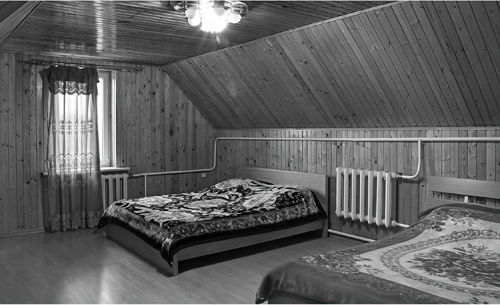 The perpetually falling wall (p31) — the kind of acute sloping ceiling the breath exercise warns about.
Observation itself creates a relationship: the equilibrium in a space is the sum of the observer's awareness of the object, the object's own (or projected) awareness, and the awareness accumulated in that space. Strong attention reinforces whatever it falls on — a revered sacred object grows more potent; a prominent angle in a room, repeatedly noticed, expands the eddies it stirs in the room's prāṇa. To learn what rightness feels like, visit a temple, church, or mosque that has been fortified by devotion over decades — it will align you almost at once. When Vāstu is right, "God's house becomes God's own skin"; indeed the earliest Vāstu texts were chiefly about building temples so the prāṇa of the Divine could invigorate them. Europe's great minsters (Durham, Chartres, Mont St. Michel) achieved the same by their own sacred-architecture traditions, "feeling out rightness" in body and mind (Svoboda ch.1, p30–32).
A space's prāṇa needs the right amount of empty room. Clutter obstructs prāṇa (acquisitiveness often reflects inner emptiness); but excess emptiness is also unhealthy (the cavernous haunted-castle dining hall where prāṇa "wanders aimlessly," breeding anxiety).
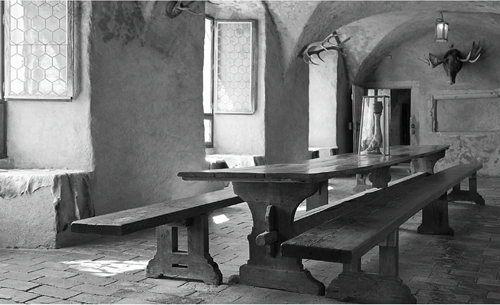 The relentless refectory (p33) — a cavernous hall whose emptiness lets prāṇa wander.
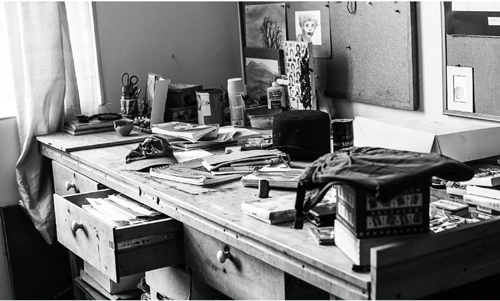 Chaos in clutter (p34) — clutter that obstructs the free movement of prāṇa.
Prosperity-prāṇa must be both free-flowing and stable, "well-rooted" — and a well-rooted space needs a stable, ordinarily unoccupied center: an open area at the center of room, home, or temple gives prāṇa the "breathing room" to take root and draws the occupants' attention. Obstruct the center, and you obstruct prāṇa (Svoboda ch.1, p34–35).
Exercise Two — The Gut Feeling. Baseline a room by sitting quietly (facing east) and noting its effect on your prāṇa. Then move anything sitting against the walls away from them and clear the middle; sit again — it should feel lighter, airier. Next fill the room "to bursting" and sit; then empty it completely and sit. Compare the over-full room (no room for prāṇa to circulate) with the bare one (nothing for prāṇa to hold onto) — neither feels right, even when the room itself isn't "wrong" (Svoboda ch.1, p35).
Concinnity and confluence
For all its calculations, Vāstu rests on perception — the felt sense of rightness or wrongness in space, read through the breath or through the gut, just below the navel (the Japanese hara, roughly the body's center of gravity, where prāṇa centers itself). Your home being an extension of your body, Vāstu speaks to us at the level of body, senses, and prāṇa; your first impression of a house is often your truest insight into it. But first impressions can't always be trusted, so the ancient experts distilled principles to guide perception — principles that must always defer to direct experience ("if you find good Vāstu where theory predicts misery, tear up the theory"). When a space is truly cooperative you sense it everywhere at once: it feels right to the gut, equalizes the breath, attracts the mind, warms the heart. Call that rightness concinnity ("fitness of parts to a whole; studied elegance of arrangement"); when a confluence of independent indications all point to concinnity, you can trust your perception is accurate (Svoboda ch.1, p35–37).
Tiger and cow, again
Returning to the opening image: tiger-mouthed tracts (wider in front) are said to benefit commerce, while cow-mouthed tracts (wider at the back) are good for dwellings but inauspicious for business (Svoboda ch.1, p37). [traditional] Svoboda offers commonsense reasons behind the rule: a tiger-mouth's wider front threshold invites people to cross it (a longer storefront draws customers), whereas a cow-mouth's narrow neck is more easily regulated and made secure — better for a private home. A subtler reason invokes "prosperity prāṇa," held in Indian tradition to be fickle and hard to "digest" (money from gambling especially so): a business wants wide inflow, but a household wants what flows in to stay, so narrowing the "neck" of your territorial moneybag keeps assets from slinking away. For a home business, prefer a regular square or rectangular plot — regularity keeps prāṇa from getting "kinked" (Svoboda ch.1, p37–38).