Home / Vāstu: Breathing Life into Space / Chapter 8
Organizing Spaces
This is the book's practical heart — putting the whole system to work. It diagnoses and remedies Marie's rooms, shows how to square or subdivide an irregular floor plan, gives the directional placement of every room in a house, and closes with two fine-tuning tools: offerings to the elements and color.
 The book's chapter-opener motif — a figure within a grid (p197).
Diagnosing a room: Marie's living room, directionally
A "Vāstu statement" is a plain diagnosis of a space. Marie's living room has a weak southeast corner — the two staircases jutting in disfigure the Vāstu Puruṣa's right hand (his auspicious hand) and weaken the SE's energies: Fire, rajas, and Venus. The staircases add transience (more rajas); compromised Venus inhibits creative expression; weakened Fire lets imbalance persist. The verdict: "those who frequent this room will tend to accumulate vāta-induced frustration and lack of focus." As with a person, the three doṣas govern the Vāstu Puruṣa's physical health and the three guṇas his mental health, and a room's occupants tend to resonate with how its Vāstu Puruṣa "feels." The way to gauge a space is to sit in it and monitor your breath (Exercises One and Two) (Svoboda ch.8, p197–199).
Remedying it: South Florida's warm-wet climate already strengthens Fire against vāta, helped by the adjacent kitchen. A sound system in the northwest can "aspect" (in Jyotiṣa, opposite directions strongly influence one another) and so strengthen the weak southeast — and calming sound steadies vāta — but only if it plays balancing, not stimulating, music. In practice Marie's stereo over-stimulated, so the chosen fix was a stable large chair aimed at the weak corner, plus light paint, Venusian wall hangings, more plants, and dedicating the room to entertainment (Svoboda ch.8, p199–200).
Organizing the home as a whole
Before balancing each room's own maṇḍala, place the rooms correctly within the whole house's Vāstu Puruṣa Maṇḍala. Marie's house spans three levels, with an L-shaped den jutting into the southwest — the one corner you least want strengthened (extensions are welcome in the north and east, tolerated in NW/SE, strongly frowned on in the southwest). Two fixes (Svoboda ch.8, p202–205):
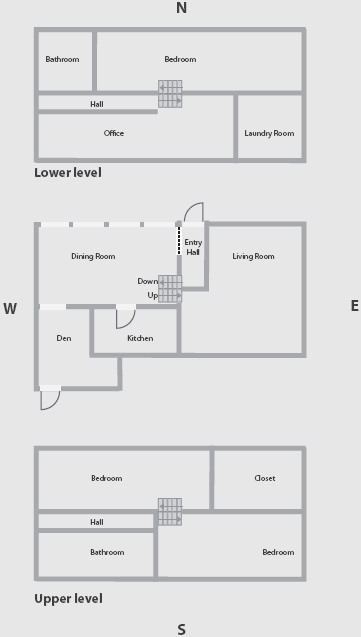 The floor plan for Marie's house (p202).
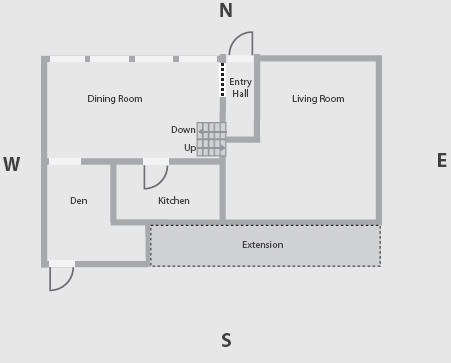 Completing the larger rectangle — adding a screened veranda or garden room to square the plan (p204). The drawback: it would shift the Brahma Sthāna near the kitchen sink, a poor center.
- Complete the larger square/rectangle — extend the house (a conservatory, screened veranda, slatted "garden room") to absorb the irregularity. (Downside: it can drag the Brahma Sthāna to a bad spot.)
- Subdivide into smaller squares/rectangles — wall off the irregular bit. Marie's den "doesn't belong"; she's happiest treating it as its own little world (its TV already sits NE, phone NW, the leafy view SE, the sofa SW). So the advice is to subdivide and let the den keep its own tamas, freeing the rest of the house to flow toward sattva.
For an irregular space that can't be extended, partition it into regular rectangles and keep the largest piece as large and well-proportioned as possible (length:width ideally ≤ 1.5:1, never past 3:1, avoiding the forbidden padona ~1.75:1), ideally with its Brahma Sthāna coinciding with the whole plan's center, and with appendages in the north and east (sattva) rather than south/west (tamas):
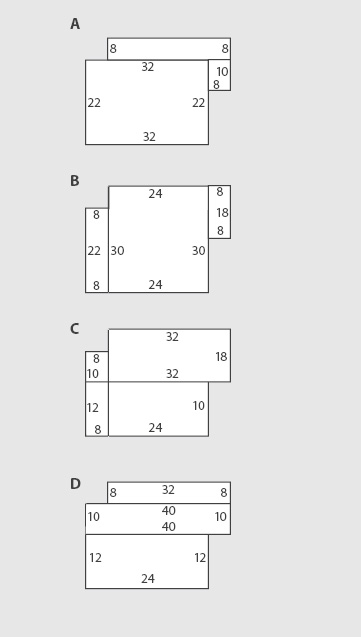 Four ways (A–D) to partition the same irregular 1040-sq-ft space into regular rectangles; plans A and B keep the largest, best-proportioned main room, with A preferred for its north/east appendages (p207).
Organizing a house full of rooms
Aiśānyāṁ deva-gṛhaṁ mahānasaṁ cāpi kāryam āgneyyām | Nairṛtyāṁ bhāṇḍopaskaro 'rtha dhānyāni mārutyām — "The worship room should be in the northeast, the kitchen in the southeast, the storeroom in the southwest, and the treasure room and granary in the northwest." — Bṛhat Saṁhitā 53:118 [classical]
Vāstu's ideal residence is a hollow square of rooms around a central courtyard that serves as the Brahma Sthāna — large enough for family worship, weddings, and music; "the owner's private piece of the sky" (Hassan Fathy). Like a South Indian astrological chart (the twelve signs arrayed around an empty center), the house assigns rooms by their location around the center (Svoboda ch.8, p208–210).
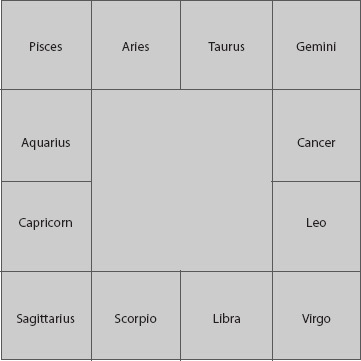 South Indian style astrological chart (p209) — signs around an empty center, the layout Vāstu echoes in assigning rooms around the Brahma Sthāna.
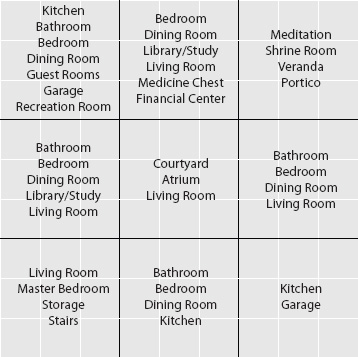 Most desirable room locations (p210) — north at top: e.g. NE meditation/shrine, SE kitchen, SW master bedroom/storage, NW library/granary, center courtyard/living room. Bedrooms fit almost anywhere except NE and SE.
The rule of thumb: a room reaches its potential more easily when it sits in its Vāstu-suggested quadrant. Only when a badly-placed room also has strong negative confluence is structural change or moving justified (e.g. a southwest kitchen with no "backing" behind it, a steep drop-off, big windows, an odd shape). In Marie's house the genuinely problematic rooms are the two NE bedrooms, the SE master bedroom (too much Fire + Air — pitta, irritability; remedied with Water/Earth décor, a heavy SW "ballast" piece, an east-wall shrine, and a focusing lamp in the SE corner), and the SE multipurpose "family room" (Svoboda ch.8, p210–212).
What to look for in each room
No room will fit the ideal, and none has to — just watch for a confluence of less-than-desirable traits (Svoboda ch.8, p213–221):
- Bathroom. Authorities differ — tub/shower in the SW (heavy) or NE (Water); but water should drain toward the northeast, the sink ideally west, the toilet south or west (never opposite the front door, or prāṇa "flows right out down the gurgler"). Keep its door only slightly ajar.
- Bedroom. The master bedroom belongs in the tamasic southwest (Earth's stability promotes sleep); NW suits guests, west suits children; SE over-heats (pitta), NE over-waters (kapha). Keep the bed off the walls and not in line with a door or window. Sleep with your head pointing east (best), or south (deep sleep); never north ("unless you're dead or ready to die"); west brings active, dreamful nights. Fall asleep on your right side (opens the calming left nostril). No "spears" overhead — hanging lights, sharp objects, or model planes pointed at the bed pierce your prāṇa. No mirror in line with the bed. Keep a small shrine in the NE corner; don't point your feet at sacred images. Sleep in darkness; don't read or worry in bed.
- Dining room. Any cardinal direction (west adds a Saturnian gravity to eating). Face east while eating, breathing through the right (Fiery) nostril to stoke digestion; eat seated, calm, attentive, only when hungry, with the senses fed and gratitude given.
- Kitchen. Belongs on the south side, preferably the southeast (Fire); never the NE. The stove on the east wall (cook faces the rising sun; facing S/SW/W/N is unlucky); the sink to the stove's north (cook's left); heavy appliances along south/west. Keep the NE corner empty — no utensils, racks, brooms, or bins there. Offering the food to the Ultimate undoes many misalignments.
- Library/study. West (Saturn, old wisdom) or north (Mercury, learning); face E/N/NE; bookshelves SW, computers SE; never sit with your back to the door.
- Living room. Ideally the home's center — keep its Brahma Sthāna open; ancestors SW, heavy furniture along S/W (so seats face E/N), phone NW, entertainment SE, a revered image NE.
- Shrine room. The northeast corner of the home; don't share a wall (or face a door) with a bathroom, and keep toilets/kitchens/storerooms from sitting above or below it; place your contemplated image in its NE corner; avoid praying toward S/SW/W until you can "digest" those energies.
Offerings to the elements
Honor each element in the quadrant it rules — and observe confluence: strengthen an element freely only if it is weak everywhere (room, home, and horoscope); otherwise make a small token offering. "Never use a floodlight when a candle will suffice" (Svoboda ch.8, p222–225):
- Earth (SW) — a crystal, rock, or terra-cotta object to "nail down" the corner; aromas (Earth rules smell): natural scents, essential oils, incense, fresh flowers.
- Water (NE) — a small fountain, fish tank, or even a carafe; a pond in a garden's NE; or simply leaving the NE corner empty. (Water rules taste — well-digested food is an offering too.)
- Fire (SE) — abundant sunlight (or full-spectrum bulbs); a candle, oil lamp, or copper fire-pot in the SE; uplifting art (Fire rules sight) — and avoid dark, menacing, or death-related images.
- Air (NW) — a house that breathes without being windy; wind chimes, prayer flags, incense in the NW; rich textures (Air rules touch); centering, uplifting music.
- Space (center) — leave the center empty (but for an occasional flower); answer well the questions of how full a space should be — clutter and over-emptiness both aggravate vāta.
Color
Color reinforces weak traits or tempers strong ones — warm tones heat a "cold" room, cool blues/greens calm a "hot" one. (Baker-Miller pink famously suppresses rage hormones — used in some holding cells — but too long unbalances.) Each hue carries its planet (Svoboda ch.8, p225–229):
| Color | Planet | Lifts | In excess |
|---|---|---|---|
| Earth tones | — | stability, sustenance | — |
| White | Moon / Venus | refinement, tranquility | kapha/vāta; sappiness (titanium-white = death in India) |
| Red | Sun / Mars-Ketu | energy, appetite, drive | pitta; egotism, irritability |
| Orange | Sun | awareness, vivacity | pitta; arrogance, vanity |
| Yellow | Jupiter | digestion, optimism, philosophy | pitta/kapha; overconfidence, lavishness |
| Green | Mercury | calm, healing, youthfulness | kapha/pitta; muddled discrimination |
| Blue | Saturn | practicality, constancy, calm | vāta; poor appetite, depletion |
| Indigo/violet/black | Saturn | contemplation, introspection | tamas, fear, melancholy, isolation |
You can paint rooms by their direction (red south, green north, radiant white SE, indigo west) or by purpose (red kitchen, green study, indigo bedroom), or even the whole house in one planet's shade — but only if you can "digest" that much of its energy. And you can extend color outdoors by planting flowers by direction/planet: Sun tall strong trees / red flowers; Moon sappy trees / white; Mars thorny / red; Mercury fruitless / green; Jupiter fruit trees / yellow; Venus blossoming / fragrant white; Saturn gnarled / blue-violet (Svoboda ch.8, p229) — the garden being the next chapter's subject.